


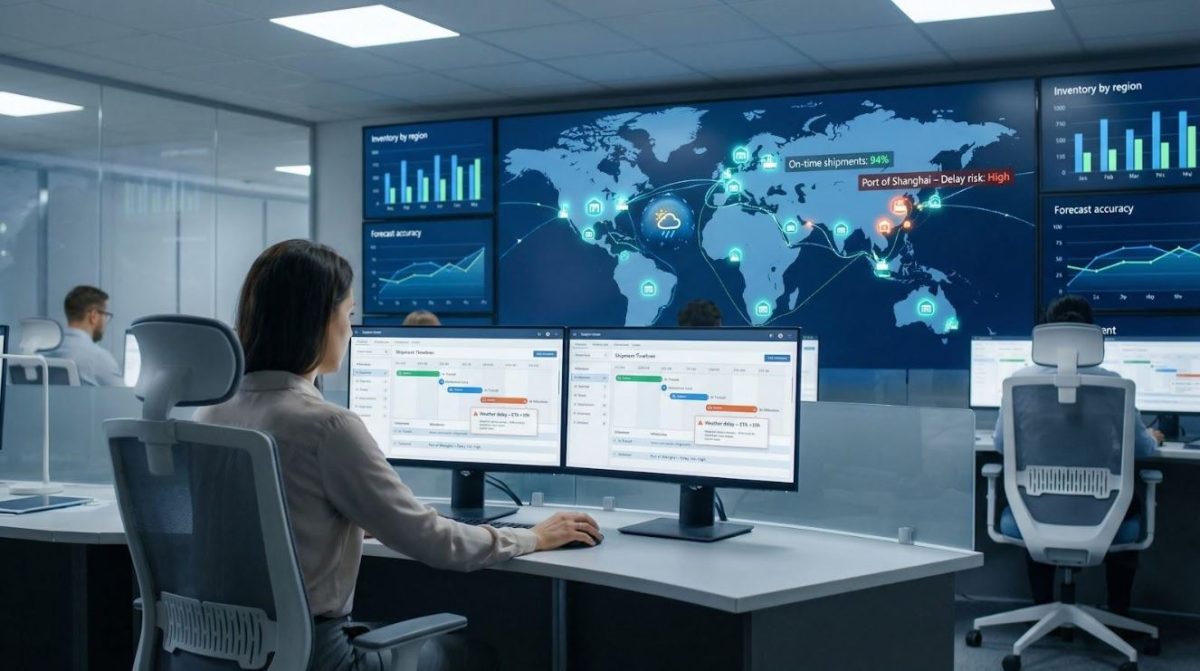
Unplanned port closures, talent gaps, and climate-driven delays have turned the 2026 supply chain into a daily stress test.
Yet one remedy keeps rising to the top: clear, real-time visibility. According to the February 27, 2024 “State of Visibility” survey from GlobeNewswire, 77 percent of supply-chain professionals now call real-time tracking indispensable.
We dug into the platforms that deliver on that promise.
Ahead, you’ll meet the eight platforms we trust most and see how they line up across three practical segments—so you can spot the right fit, faster.
How we picked these eight platforms
We didn’t grab names from a Magic Quadrant and call it a day. Instead, we ran every contender through a scorecard that stresses real-world impact.
First, we mapped features across the full plan-make-move cycle. A platform had to sense a demand spike, trigger a purchase order, and track the truck, all within one flow.
Next, we graded technology depth. We looked for practical AI, digital-twin modeling, and low-code extensibility that busy IT teams can maintain.
Market credibility mattered too. Leader badges from Gartner or IDC signaled who’s battle-tested, while user reviews on G2 and Peer Insights revealed day-to-day reality.
Finally, we weighed interoperability, total cost, and time-to-value. Any tool that locks you in, or takes years to deploy, slid down the list.
Industry commentators warn that 2026 will separate companies that invest in operational clarity from those that invest in optimism. That perspective shaped our weighting, prioritising platforms that convert curated data and pragmatic AI into measurable gains.
It also mirrors MCA Connect’s 2026 supply chain trends research, which highlights three priorities for the year ahead: consolidating data across ERP, CRM, and shop-floor systems, using AI as decision support tied to financial outcomes, and bringing customer signals directly into planning decisions. Using those themes as a sense check on our scoring helps ensure the shortlist that follows tackles the real obstacles on deck for next year, not just a generic feature checklist.
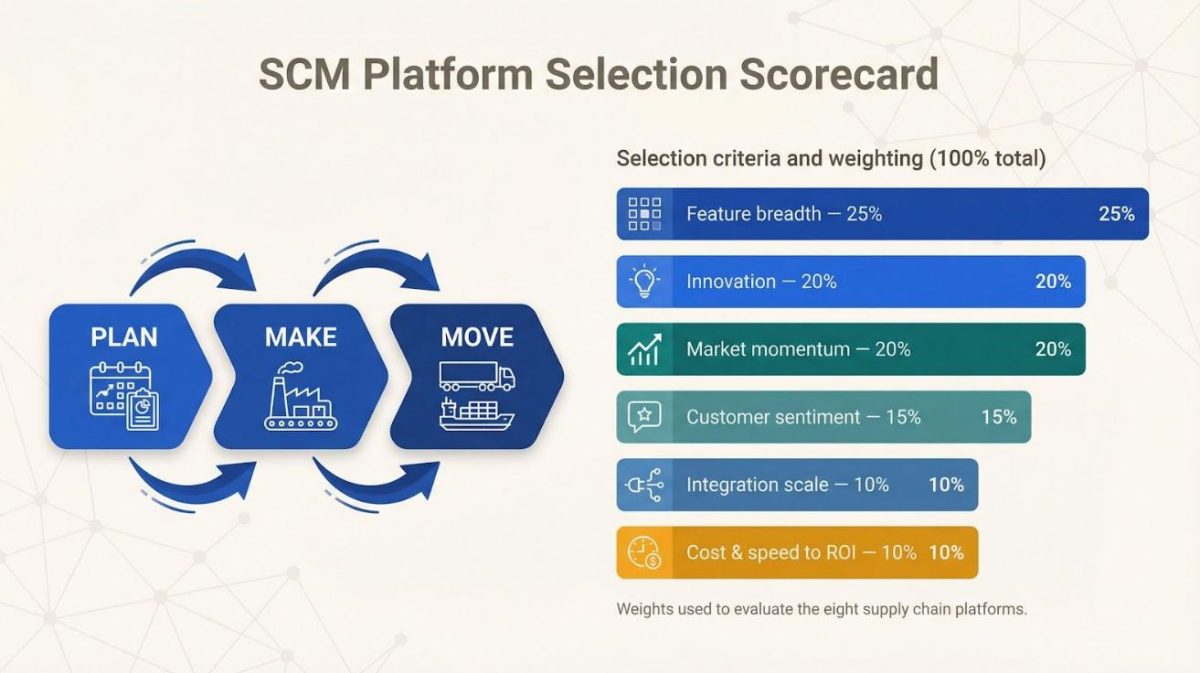
For transparency, here’s the quick math we used:
- Feature breadth 25 percent
- Innovation 20 percent
- Market momentum 20 percent
- Customer sentiment 15 percent
- Integration scale 10 percent
- Cost and speed to ROI 10 percent
That blend favors platforms that deliver visibility now and stay flexible as your network evolves.
Microsoft Dynamics 365 Supply Chain
Microsoft’s supply-chain play starts with a simple wager: if your teams already live in Outlook, Excel, and Teams, why not let them plan freight or chase a late supplier in the same universe?
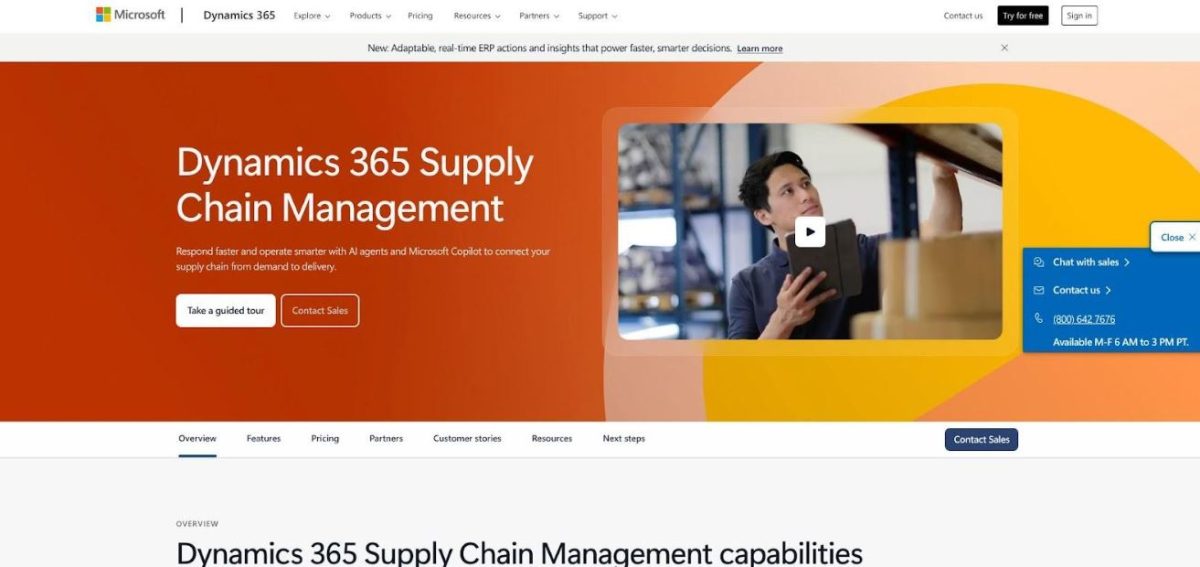
Microsoft Dynamics 365 Supply Chain Management Official Product UI Screenshot
Dynamics 365 Supply Chain stitches that idea together. Planners get an end-to-end workspace that talks natively to Azure IoT sensors on the shop floor, Power BI dashboards in the boardroom, and, thanks to the new Copilot agents, plain-language alerts in Teams when forecasts wobble.
We like how the platform handles the basics without feeling basic. A demand spike in the planning module can spin up a purchase order, trigger a vendor collaboration workflow, and push predicted delivery ETAs straight into order management, all before lunch. That closed loop is the core of visibility: no CSV exports, no swivel-chair data entry.
Dynamics also leans on composability. Need advanced warehouse automation later? Bolt on the WMS microservice without rewriting your ERP backbone. Prefer to keep your proven MES? Standard APIs and low-code connectors make co-existence feasible instead of painful.
Cost realism deserves a nod. undefined
Trade-offs? Ultra-complex manufacturers may still crave deeper finite-scheduling algorithms than Microsoft ships today, and license bundles can get tangled if finance, CRM, and field service all come into play. But for many companies already on a Microsoft tech stack, Dynamics 365 offers the fastest route to a single, real-time control tower.
SAP S/4HANA Digital Supply Chain
SAP sits at the very top of the enterprise hierarchy for a reason: it covers every process from new-product design to last-mile delivery without leaving the suite.
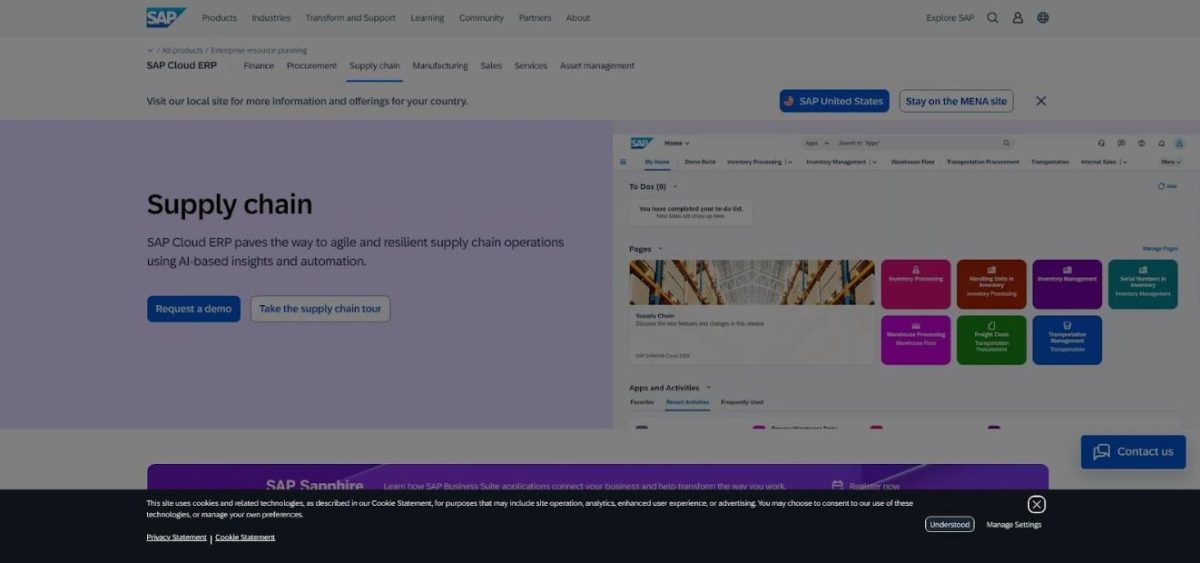
SAP S/4HANA Digital Supply Chain and IBP Interface Screenshot
The heart of that breadth is S/4HANA paired with Integrated Business Planning (IBP). Planning changes ripple straight into execution tables, so finance, factory, and freight stay in sync. Flip a demand signal in IBP and production orders, material reservations, and cash-flow forecasts refresh in seconds. That tight loop is why global brands rely on SAP when a one-percent service miss can cost millions.
SAP’s Business Network widens the view beyond your firewall. More than eight million trading partners exchange forecasts, ASNs, and shipment events on a common backbone, turning what was once EDI dark matter into live data your planners can act on. Add SAP’s new AI-driven risk alerts and you spot late parts or tariff shocks days, not hours, before they bite.
Depth carries weight. Full-suite projects routinely cross the four-year mark and the budget comma moves quickly. SAP answers with a more modular, cloud-first roadmap (think IBP or Transportation Management as SaaS plugins), yet you still need seasoned integrators and disciplined data governance to realise value.
When scale, audit-grade precision, and regulatory muscle outrank speed of deployment, SAP remains the practical choice. If your board wants a single vendor that can trace a lot number from farm to pharmacy shelf and satisfy every auditor on the journey, S/4HANA Digital Supply Chain is a safe, heavyweight bet.
Oracle Fusion Cloud SCM
Oracle takes a different route to the same destination: one common data model in the cloud. Everything—orders, forecasts, work-in-process—lives in the same database rows, so planners never chase stale replicas.
That single source pays off when disruptions hit. An unexpected component shortage in Supply Planning flows automatically to Order Management, which recalculates promise dates, and on to Transportation Management, which rebooks capacity. No batch jobs, no overnight lag.
Oracle layers AI into each step. Machine-learning demand sensing sifts point-of-sale data to sharpen forecasts, while adaptive intelligence flags likely late shipments before the carrier admits trouble. The new Redwood experience wraps it all in a cleaner interface that feels more consumer app than legacy ERP.
Industries with deep bills of material, such as high-tech, aerospace, and industrial machinery, value Oracle’s heritage in discrete manufacturing. Lot genealogy, serial tracking, and project-driven supply chains come ready to use, not bolted on.
The trade-off is complexity. Implementing the full suite can feel like assembling a 5,000-piece puzzle, and subscription costs rise when you license planning, manufacturing, logistics, and trade modules together. Teams running non-Oracle finance systems also face extra integration work, though well-documented REST APIs soften the blow.
Still, for enterprises that want a cloud-first backbone with heavyweight functionality and prefer quarterly updates that arrive automatically, Oracle Fusion Cloud SCM delivers a powerful, future-proof platform.
Kinaxis RapidResponse
When every hour of delay costs revenue, speed beats elegance. Kinaxis built RapidResponse to answer the one-line question every planner asks: “If this changes, what happens next?”
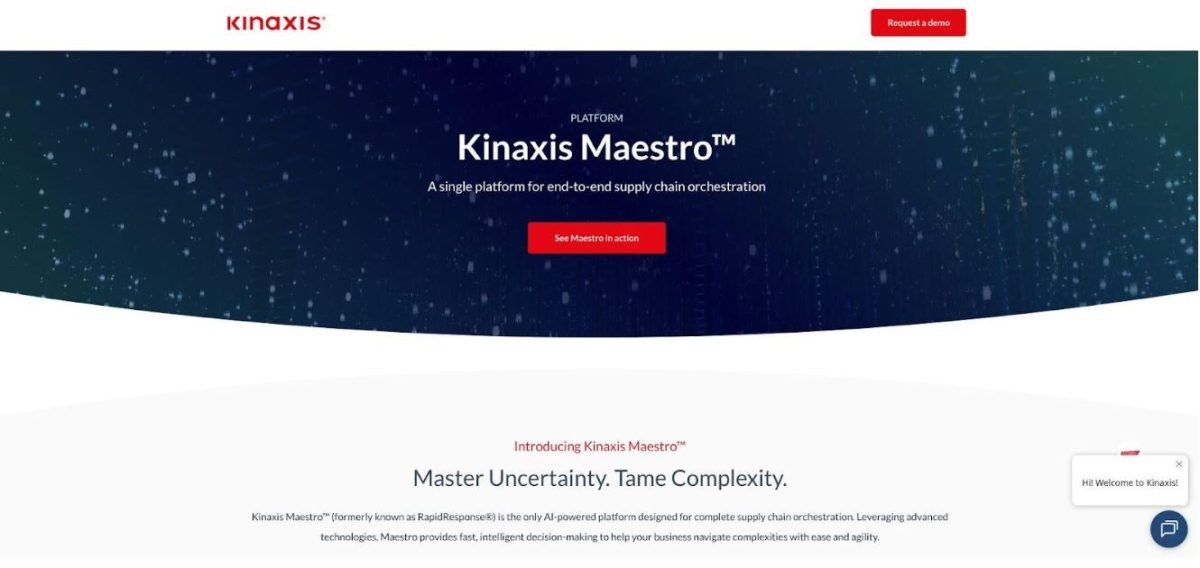
Kinaxis RapidResponse Concurrent Planning Dashboard Screenshot
The platform’s in-memory engine recalculates demand, supply, capacity, and margin scenarios in seconds, not overnight. You tweak a forecast for a key SKU and instantly watch inventory projections, supplier commits, and EBIT light up on the same screen. That concurrency replaces spreadsheet ping-pong with data everyone trusts.
Collaboration feels just as quick. Sales, finance, and operations can join a live what-if session, vote on alternatives, and publish the agreed plan before the meeting ends. No extra slide deck required.
Kinaxis has moved beyond pure math, adding Demand.AI and anomaly detection that flag forecast drivers your team might miss. The recent MPO integration links planning with execution data, so a shipment delay pings RapidResponse and triggers a fresh plan automatically.
Most rollouts land inside 12 months, a pace far quicker than typical ERP projects, and customers often report 10 to 15 percent inventory reductions in the first year. The catch? You still need clean, timely feeds from ERP, MES, and WMS systems. Kinaxis supplies adapters, but data discipline remains on you.
If volatility is your biggest enemy and meetings feel like rear-view reporting, RapidResponse turns planning into a forward-looking, shared cockpit. It will not run your warehouse, but it will tell you right now which lever to pull.
o9 Solutions Digital Brain
Think of o9 as a digital twin that never stops learning. The platform builds a knowledge graph of every product, node, and constraint in your network, then feeds it a diet of internal history plus external signals such as POS data, web searches, and weather.
The result is a living model that predicts demand swings earlier and shows exactly which factory, supplier, or lane will feel the impact. Planners can ask plain-language questions, run profit-weighted scenarios, and push the chosen plan straight into their ERP with a click.
o9 shines when you need value and volume on the same canvas. A promotion scenario, for instance, can display expected sales lift, margin change, and carbon footprint side by side, letting marketing, finance, and sustainability vote from the same source of truth.
Speed to value is solid. Many enterprises launch a focused demand-planning rollout in six to nine months, then layer supply, S&OP, or revenue management without starting over. Because the interface is highly configurable, business teams can tweak dashboards or add new attributes without IT tickets.
Caveats? o9 is still younger than the ERP giants, so the pool of certified consultants is growing but not yet everywhere. Its engine tackles strategic and tactical planning well, yet leaves detailed shop-floor scheduling to specialised APS or MES tools.
If your growth depends on spotting market shifts before competitors and turning that knowledge into an integrated volume and value plan, o9’s Digital Brain is a strong contender.
Blue Yonder Luminate Platform
Blue Yonder built its reputation on retail and CPG forecasting, then spent the last five years weaving machine learning through every module. The payoff is Luminate, a suite that pairs deep domain algorithms with a real-time control tower.
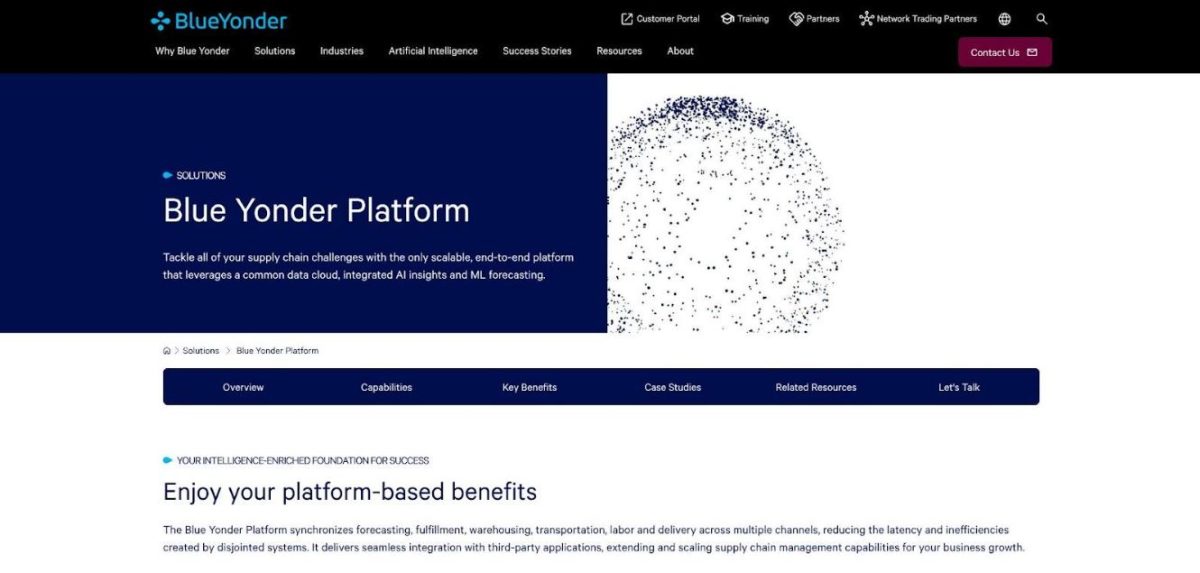
Blue Yonder Luminate Platform Retail Forecasting and Control Tower Screenshot
Start with demand. The platform ingests promo calendars, weather feeds, and social buzz to shape store-level forecasts that typically cut error by about 10 percent. Those numbers feed replenishment and allocation logic that decides, sometimes hourly, which DC or store receives scarce inventory.
Execution sits in the same house. Blue Yonder’s top-tier WMS and TMS run high-volume warehouses and plan multi-leg routes, so the system can not only see a disruption but act on it by rerouting loads or shifting pick waves without human re-keying.
The new autonomous capabilities extend that loop. If a shipment falls outside tolerances, Luminate can automatically generate a replan, alert the carrier, and update store ETAs before a planner even spots the spike on the dashboard.
Implementation is more data-heavy than code-heavy. You’ll spend time cleansing POS and inventory history to let the ML models learn, yet most customers still go live in under 15 months. License fees land mid-pack for enterprise platforms, but ROI often appears as a blended win: higher on-shelf availability plus a 5 to 10 percent drop in overall stock.
If your brand lives or dies by getting the right unit to the right shelf on Friday, not next week, Blue Yonder provides the predictive capability and execution tools to make that promise stick.
Coupa Supply Chain Design & Planning (powered by LLamasoft)
Most supply-chain tools tell you how to run today’s network. Coupa’s design suite asks the bigger question: should you even keep that network?
Using LLamasoft’s optimisation engines, you build a digital twin that mirrors every plant, lane, tariff, and service promise. Then you push scenarios through it, from nearshoring and new DC locations to SKU rationalisation, watching cost-to-serve, lead time, and carbon output shift in real time.
The solver can crunch thousands of permutations overnight, but executives love the clarity that follows. You walk into the boardroom with a map that says, “Close two legacy warehouses, open one cross-dock in Texas, save ten percent in transport, and cut four days from delivery.” Numbers that specific free up capital faster than any slide of industry averages.
Pairing the model with the broader Coupa spend platform adds extra negotiating power. When the model flags a high-risk supplier, you can kick off a sourcing event from the same cockpit, turning design insight into contracted savings without exporting a single CSV.
Expect a learning curve. Building the first digital twin demands clean master data and a team comfortable with network modelling. Yet many firms recover the licence fee with one optimisation project, often during a merger integration or a post-pandemic resilience redesign.
If your CFO keeps asking, “Are we structured for the next disruption?” Coupa’s design tools hand you a defensible, data-backed answer, and let you refine it whenever the market throws a new curveball.
E2open Multi-Enterprise Network
Visibility inside your four walls is table stakes; E2open addresses the harder part: seeing every tier beyond them. Its cloud network links more than 400,000 suppliers, manufacturers, carriers, and distributors, turning fragmented EDI feeds into a single live data stream.
That scale pays dividends the moment something drifts off plan. A late container pinging the INTTRA ocean hub flows straight into demand-planning alerts, inventory projections, and even automated carrier rebooking, all without waiting for a manual status call. Planners move from detective work to decision work.
Breadth is the other draw. E2open bundles demand sensing, supply planning, TMS, global-trade compliance, and channel inventory in one suite, so the same platform that forecasts a spike can clear customs paperwork and book the truck that covers it. Few rivals offer that end-to-end, multi-party loop.
Implementation does require change management. Partners not yet on the network must be onboarded, and internal teams need to trust shared data after years of siloed spreadsheets. Yet once connected, companies often report 10 to 15 percent cuts in manual track-and-trace labour and similar reductions in safety stock.
If your biggest blind spot is what happens after a purchase order leaves the ERP, E2open turns that black box into a glass box and gives you the tools to act on what you see.
At-a-glance comparison and key takeaways
Different platforms shine for different reasons, so let’s stack them side by side before we wrap.
| Platform | Planning speed | Multi-tier visibility | Built-in execution (WMS/TMS) | AI depth | Typical time-to-value |
| Microsoft Dynamics 365 | Good | Moderate | Good | Growing fast | 9–15 months |
| SAP S/4HANA + IBP | Strong | Strong | Best in class | Mature but complex | 24–48 months |
| Oracle Fusion Cloud SCM | Strong | Strong | Strong | Embedded across suite | 18–30 months |
| Kinaxis RapidResponse | Excellent | Depends on data feeds | None | Focused on planning | 6–12 months |
| o9 Solutions | Excellent | Depends on data feeds | None | Very high | 9–15 months |
| Blue Yonder Luminate | Strong | Strong | Best of breed | High (ML + autonomous) | 12–18 months |
| Coupa (LLamasoft) | Strategic design only | Scenario visibility | None | High for optimisation | Project-based (3–6 months per study) |
| E2open Network | Good | Outstanding | Good (TMS) | Network AI | 12–18 months |
A few patterns stand out.
First, speed versus scope is a real trade-off. Kinaxis and o9 deliver answers in weeks because they sit above your existing stack. SAP, Oracle, and Microsoft take longer, yet repay the wait with one throat to choke when auditors call.
Second, network matters. E2open’s pre-connected community gives you live supplier and carrier data on day one, something point solutions cannot match without months of partner onboarding.
Third, AI is no longer a bonus feature. Every vendor on this list markets predictive algorithms or generative copilots. What differs is maturity. Blue Yonder and o9 built their roadmaps around machine learning from day one, while ERP giants are racing to weave AI into large, established codebases.
Finally, the right answer is often a stack, not a single logo. Many enterprises pair SAP or Oracle for transactions with Kinaxis or o9 for agile planning, Coupa for annual network redesign, and E2open for real-time partner data. The trick is choosing the anchor system that best matches your most painful gap today, then adding complementary tools as budget, bandwidth, and timing allow.
Conclusion
Armed with that perspective, you can zero in on a shortlist that matches both your technical reality and your strategic ambition.
 NTG Execs Named Pros to Know for Expert Knowledge in Carrier Services/3PL
 FICT’s Tianjin Port Hits Operational High With Navis N4
 Cultura invests in merchandise & assortment planning precision with Aptos Technology
 British shoppers likely to spend £4.4bn less on non-essentials during Christmas period
 Clinicians spend a third of working hours on clinical documentation
 Tecsys Appoints Shannon Karl as Chief Marketing Officer