

Manufacturing has never been static, with waves of change defining industries. Mechanization fundamentally changed human labor. Electrification amplified scale. Automation fundamentally impacted precision and consistency.
Digitalization connects machines, data, and decision-making. Yet, are we not at the cusp of another defining wave, albeit one that’s less about augmenting intelligence within systems and more about permitting systems to be autonomous?
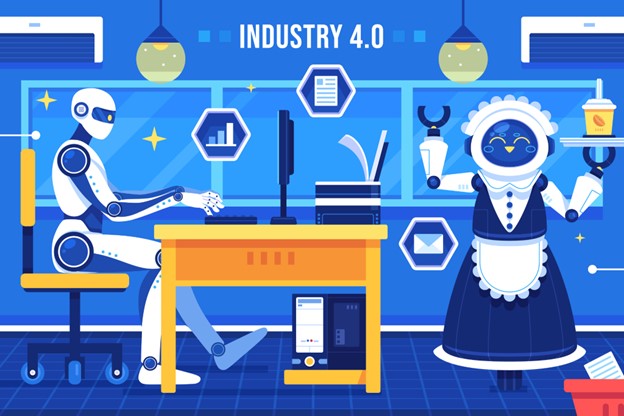
Industry 4.0 proposed the notion of smart factories, which featured connected devices, IoT, predictive maintenance, digital twin, and many other exciting technologies, greatly enhancing visibility and efficiency with these technologies.
The next phase will change that balance.
Agentic AI-driven manufacturing systems embody a structural shift from purely passive analytics toward goal-oriented decision-taking digital actors. No longer are AI systems merely meant to detect anomalies or produce predictions; they are starting to interpret what is going on, consider options, and take actions that fulfill operational needs. This is not a further level of digital control. It is a redefinition of decision-making within industrial settings.

From Smart Factories to Autonomous Decision Systems
One of the core issues was resolved by Industry 4.0 technology since the initial systems lacked any intelligence. Because they employed PLCs, MES, ERP, quality, and maintenance systems, the data was fragmented across the systems. There was commonality because there was connectivity.
However, understanding will not necessarily lead to action.
Factories these days seem to be battling what might be called “the last-mile choice gap.” A predictive system may raise a flag about an approaching machine failure. However, scheduling maintenance still involves human interaction. Similarly, quality analytics may display a problem, but root cause analysis and improvement action still require human intervention. However, optimized planning engines exist despite supervisors having to respond to disruptions.
Agentic AI bridges the gap by integrating decision logic into the operational process. This is where the paradigm truly changes: factories no longer rely solely on human interpretation layers, but increasingly on AI agents in manufacturing that can evaluate conditions, coordinate constraints, and initiate decisions in real time.
Agentic architectures, on the other hand, view the elements of artificial intelligence as actors inside the industrial ecosystem rather than as advising systems. As a result, they establish goals, work out limitations, and cooperate with other systems; as a result, this digital infrastructure is no longer only a layer to observe but to take action.
What Makes AI ‘Agentic’ in Manufacturing?
The word “agentic” is, as noted, commonly misunderstood. It does not suggest a form of uncontrolled autonomy, nor does it propose anything like science fiction-like independence. In industrial settings and contexts, “agentic” refers to:
1. Goal-Directed Behavior
Agents act on defined objectives to minimize downtime, maximize throughput, stabilize quality variance, optimize energy consumption, balance workloads, or meet delivery commitments.
2. Contextual Reasoning
They reason about dynamic factory states, rather than considering only static rules: a delay in material supply is assessed differently based on order priority, downstream dependencies, and resource availability.
3. Multi-Step Decision Making
Instead of providing single-point predictions, agents evaluate downstream effects. Changing machine variables might optimize one metric, like yield, while affecting another metric, such as cycle time or tool wear.
4. Initiate Action
Agents initiate systemwide changes, rescheduling, adjusting control parameters, invoking maintenance activities, rebalancing resources, or revising inspection workflows.
5. Continuous Learning
Operational patterns change. Agentic systems adapt strategies during the processing based on incoming data, historical performance, and environmental feedback. The shift is subtle but radical: intelligence moves from “analysis of events” to “participation in events.”
The Operational Domains Being Transformed
Agentic AI’s influence is not confined to a single function. Its impact spans multiple layers of manufacturing operations.
1. Production Planning and Scheduling
Traditional planning engines work in batch cycles. They calculate the very best schedules based on presumed constraints. Disruptions, machine failures, lack of labor, and late materials render assumptions invalid.
Agentic systems continually reconcile plans against reality. This rebalancing of priorities, resources, and workflows occurs without waiting for human escalation. Decisions become fluid rather than episodic.
2. Quality Management and Process Control
Traditionally, quality systems are misunderstood to detect anomalies after they occur. Even predictive analytics is focused on early detection.
Agentic AI rethinks the concept of quality as an optimizing process. In Agentic AI, quality is an optimizing process where parameters are evaluated, scenarios are tested virtually through digital twins, and corrective actions are taken in advance. The focus is no longer on detection and response; instead, it’s on stabilization.
3. Maintenance and Asset Reliability
Predictive maintenance identifies risk, while agentic maintenance strategies determine the timing of intervention, resource coordination, and operational trade-offs.
For example, delaying maintenance may preserve output in the short run but increase the probability of a disastrous failure. Agentic reasoning explicitly models these types of trade-offs, optimizing competing objectives over production and reliability.
4. Supply Chain and Inventory Dynamics
Manufacturing disruptions are frequently caused by problems that originate outside the facility and spread to other areas. To make dynamic decisions on safety stock, alternate sourcing, and sequencing, agentic AI enables the integration of external signals.
5. Energy Optimization and Sustainability
It is no longer an issue from outside the core business. New sustainability constraints affect production strategies.
Agentic systems can optimize load balancing, shift energy-intensive processes, and coordinate the usage of equipment to satisfy both cost and environmental goals, a feat seldom achieved by static automation systems.
Interoperability: The Hidden Challenge
The key to successful agentic AI-driven manufacturing systems is not model complexity, but how deeply it is integrated.
Factories are complex ecosystems made up of:
- Legacy machinery
- Proprietary Control Systems
- MES PLATFORMS
- ERP layers
- SCADA environments
- IoT Gateways
- Data Lakes
- Quality tools
- Maintenance systems
Agentic systems must intertwine smoothly with this diverse terrain. Erratic integration is detrimental to autonomy. Agents require warranted access to operational states and to instigate changes. It is where the discipline of architecture comes in. Event-based systems, the data model, API orchestration, and governance models define scalability.
The Rise of Multi-Agent Collaboration
Modern factories have multiple interconnected decision domains. Production optimization and maintenance scheduling may conflict. Energy conservation strategies may impact throughput. Inventory management may impact lead times.
No artificial intelligence system can approximate complex models.
In multi-agent architectures, intelligence is distributed across specialized entities.
- Quality agents
- Maintenance agents
- Logistics agents
- Energy agents
These agents will coordinate, negotiate constraints, and align actions, reminiscent of human organizational structures but operating at machine speed. This model of distributed intelligence is well adapted to the inherently decentralized complexity of manufacturing.
Data Is Necessary But Not Sufficient
The discourse within an industry tends to overemphasize the amount of data. While high-quality data is essential, highly autonomous systems require more than just telemetry data
Agentic AI relies upon:
- Structured operational semantics
- Clear Objective Hierarchy
- Decision boundaries
- Risk Tolerance Definitions
- Feedback Loops
Exception Handling Logic Without such components, it provides recommendations but cannot act responsibly. Decision intelligence is as much about organizational design as it is about technological capabilities.
Risk, Governance, and Trust
A manufacturing environment is a hostile world where errors can be extremely costly. Autonomous decision systems must be held tightly within boundaries.
Key governance considerations include:
- Action authorization boundaries
- Explainability of decisions
- Auditability of the system behavior
- Failure Containment Mechanisms
- Human override protocols
- Detection of model drift
- Compliance Alignment
Trust does not derive from an absence of uncertainty but rather from the ability to manage it transparently. Factories do not require infallible AI. They require predictable and controllable AI behavior.
Organizational Transformation: The Overlooked Factor
Adoption of technology by itself does not bring about change. Deeply established operational systems are put to the test by agentic AI.
Manufacturers need to think again:
- Models of decision ownership
- Hierarchies of escalation
- Metrics of performance
- Coordination across functional boundaries
- Methods of change management
- Development of workforce skills
Decentralized digital decision systems may be difficult for factories built around strict command chains to use. Just as important as technical preparedness is cultural readiness.
Expanding Role of Digital Infrastructure
“Agentic AI makes foundational concerns about digitization more consequential,” and “Fragmented, brittle systems won’t support autonomous decision loops.”
Modern IT solutions for manufacturing increasingly serve as the backbone of agentic environments, enabling:
- Real-time Data Synchronization
- Cross-system orchestration
- Scalable compute frameworks
- Secure communication layers
- Decision Traceability
- Workflow automation
Simulation environments. Without such infrastructure, autonomous systems remain purely theoretical.
A New Industrial Operating Model
The next stage of Industry 4.0 holds the promise of an even more significant change, one beyond the scope of connective and analytical technologies. In this next stage, factories will be designed and thought of as ecosystems in which digital entities will drive the direction of operations.
“Decision-making, which has traditionally been seen as a uniquely human skill, is seen as a collaborative task for both humans and machines. Intelligence shifts from being descriptive to being participatory. Systems change from being tools to being teammates.”
The factories that thrive in the future will not be the ones with the most data or the most automation, but the ones that can orchestrate adaptive decision intelligence.
Agentic AI-driven manufacturing systems do not signal the end of Industry 4.0 but symbolize its maturity, where the digital infrastructure does not merely observe but also acts with purpose within the industrial ecosystem.
And this will likely redefine competitiveness in manufacturing for decades to come.
 Best Smart Bikes for Home Workouts: Stay Fit the Smart Way
 Pop-Ups, Trackers, and Privacy Risks: A Guide for IT Managers
 Auto Transport Services vs. DIY Shipping: Pros and Cons
 Norn AI produces advisory report for Government of Aruba - unaided by humans
- IT Vs OT Readiness For Supply Chain Companies In 2026
 Future-Proofing Industrial Builds: Why Electrical Design Can’t Be an Afterthought