

Not all centrifugal pumps are built for the same job. A pump that thrives in a food processing plant — where hygiene and precise batch control are non-negotiable — isn’t the right fit for an HVAC system running 24/7 across a large manufacturing facility. Getting the match right matters: the wrong pump leads to wasted energy, higher maintenance costs, and in food production, potential compliance failures.
This guide focuses on two pump types that consistently deliver results in these environments: stainless steel centrifugal pumps for food and beverage applications, and vertical centrifugal pumps for HVAC and process cooling. Both work well with Variable Frequency Drives (VFDs) for energy savings — but their strengths, and their failure modes, lie in different places.
Why Variable Speed Control Changes the Economics
Centrifugal pumps follow the Affinity Laws, which means power consumption drops with the cube of speed reduction. In practice: a 20% reduction in pump speed saves nearly 50% of the energy. Pair the right pump with a VFD, and real-world energy savings of 30–50% are achievable — not in ideal lab conditions, but in operating plants. The catch is that those savings only materialize if the pump is correctly matched to the application from the start. An oversized or misspecified pump running on a VFD still underperforms.
Stainless Steel Centrifugal Pumps: Food & Beverage Applications
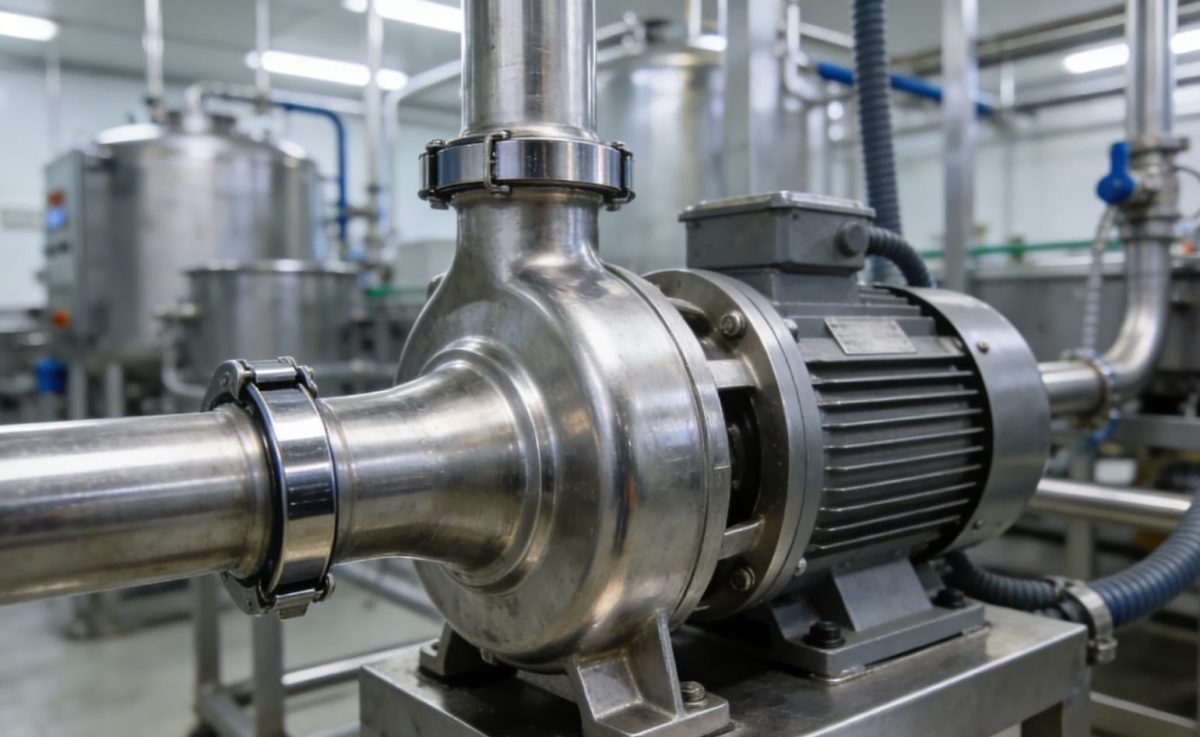
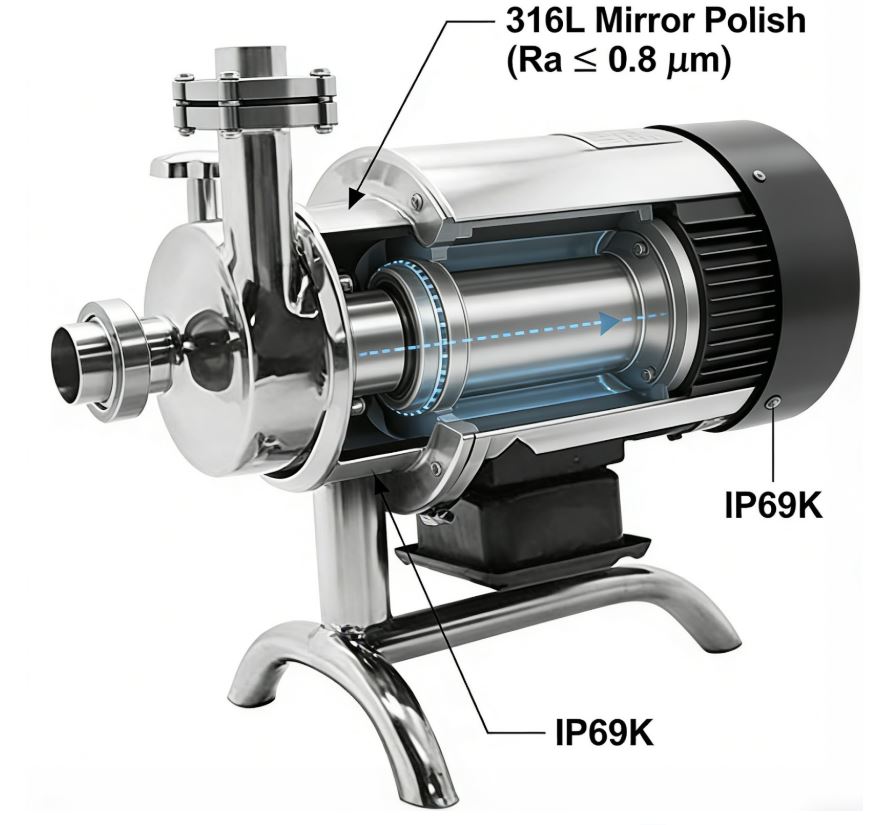
In food processing, dairy, and beverage production, the pump is often in direct contact with the product — or with the cleaning solutions that run through the same lines. That shifts the priorities from pure hydraulic performance to material compatibility, cleanability, and regulatory compliance. Stainless steel centrifugal pumps, typically constructed from 316L stainless, are designed specifically for this environment: corrosion-resistant against acidic juices and cleaning agents, with smooth internal surfaces that meet FDA and EHEDG hygiene standards.
When paired with a VFD, these pumps adapt well to the variable demand patterns of food production — slowing during recirculation phases, ramping up for transfer or filling, and adjusting automatically between CIP cycles and production runs. The energy savings are real, but the operational benefit of stable, controllable flow is often just as valuable on a fast-moving production line.
Common pitfall: seal selection
One of the most frequent and costly mistakes in food pump specification is choosing the wrong seal type. Standard mechanical seals — common in industrial pumps — create crevices and dead zones where fluid can become trapped. In a sanitary application, those zones cannot be reached by CIP cleaning cycles, meaning bacteria can accumulate between cleans without any visible sign of contamination.
The correct choice is a hygienic or sanitary-grade seal designed with flush faces and no dead spaces. It costs more upfront, but the alternative is recurring contamination risk and potential regulatory action — a far more expensive outcome.
Motor protection rating is equally easy to overlook at the specification stage. Food processing environments typically involve high-pressure washdowns — a standard IP55 motor will not survive routine CIP and sanitation cycles. For most food and beverage applications, IP69K is the correct minimum: it is rated for high-pressure, high-temperature water jets from any direction, which is exactly what sanitation crews use.
Vertical Centrifugal Pumps: HVAC and Process Cooling
Large manufacturing facilities and commercial buildings depend on consistent fluid circulation for climate control and process cooling. Vertical inline centrifugal pumps have become the standard choice for these systems because their design is well suited to the demands: compact footprint in tight mechanical rooms, capable of handling medium to high flow rates across building-wide loops, and available in multistage configurations when higher pressure heads are needed. Their vertical inline layout also simplifies piping — the suction and discharge ports are on the same centerline, which reduces installation complexity and cost.
HVAC demand is rarely constant. A factory running two shifts sees very different cooling loads at 2 PM versus 2 AM, and seasonal variation adds another layer. Without variable speed control, pumps run at full capacity regardless, burning energy against throttle valves and bypasses. With a VFD, the pump slows when demand drops — typical savings run 15–45%, with the biggest gains in facilities with highly variable occupancy or production schedules.
Common pitfall: NPSH and cavitation
One of the most misunderstood failure modes in HVAC pump installations is cavitation caused by insufficient Net Positive Suction Head (NPSH). When the pressure at the pump inlet drops below the vapor pressure of the fluid, small vapor bubbles form and then collapse violently as they pass through the impeller — a process that erodes the impeller surface, generates noise and vibration, and dramatically shortens pump life.
Many operators attribute this to a defective pump when the real cause is a system design issue: undersized suction piping, excessive suction lift, or a pump specified without adequate NPSH margin. The fix is straightforward at the design stage — verify that the available NPSH in the system exceeds the pump’s required NPSH by a safe margin — but it becomes expensive to correct after installation.
For HVAC applications, IP55 is generally the appropriate baseline — it provides sufficient protection against dust ingress and water jets from any direction without over-specifying for a dry mechanical room environment. If the pump is installed in an outdoor plant or exposed plant room, IP65 or higher should be considered.
Quick Selection Reference
Before reaching for a spec sheet, a few boundary conditions are worth settling first. If the fluid is food-grade or in direct contact with product, the material decision is straightforward — stainless steel sanitary pump, nothing else is appropriate. If floor space is the binding constraint, vertical inline is the natural fit regardless of other factors.
Two conditions should give you pause before going further with a centrifugal pump at all. If fluid viscosity exceeds 200–400cP — concentrated syrups, heavy oils, viscous slurries — centrifugal pumps begin to fall outside their effective operating range and will cavitate, underperform, and fail early. Positive displacement pumps are the right category at that point. And if the pump will run on a VFD continuously, confirm upfront that the motor is inverter-rated and the bearings are insulated against shaft current. It’s a small spec detail that’s easy to miss, and it’s one of the more common causes of premature bearing failure in variable-speed installations.
Use this table to match your application to the right pump type at a glance:
| Criteria | Stainless Steel Pump | Vertical Centrifugal Pump |
| Primary Use | Food, beverage & dairy transfer | HVAC chilled/hot water circulation |
| Material | 316L stainless steel (FDA-compliant) | Cast iron or stainless steel |
| Hygiene Requirement | High — CIP-compatible | Standard industrial |
| Installation | Horizontal, compact footprint | Vertical inline, space-saving |
| VFD Compatibility | Excellent — handles batch demand swings | Excellent — matches seasonal load changes |
| Typical Energy Savings | 30–50% vs. fixed-speed | 15–45% vs. fixed-speed |
| Common Pitfall | Wrong seal type creates CIP dead zones | Insufficient NPSH margin causes cavitation |
Before You Specify
Whichever pump type fits your application, a demand audit before sizing is worth the time. Map your actual flow requirements across a full operating cycle — including peak demand, average load, and minimum flow conditions. Oversized pumps waste more energy and wear faster, even with VFD control. At the same time, confirm your system curve accounts for pipe diameter, valve positions, and total pressure drop; pump efficiency depends on the whole system, not just the pump itself.
For HVAC installations, run the NPSH calculation before finalizing pump selection. For food applications, verify seal type and surface finish specifications match your cleaning protocol. These are small steps at the specification stage that prevent large problems in operation.
Bottom Line
Stainless steel centrifugal pumps keep food and beverage lines clean, compliant, and efficient — provided the seals are specified correctly. Vertical centrifugal pumps keep HVAC systems running without hemorrhaging energy — provided the system NPSH is properly calculated. Both deliver meaningful returns in energy savings and equipment longevity when paired with VFD control and sized to actual demand. The selection table above is a practical starting point; a system audit will show you exactly where the biggest gains are.
 Coastal Cargo Company Signs a Subscription Agreement with Octopi by Navis for its New Orleans, LA Facility
 August U.S. Containerized Imports Reach Third-Highest Level on Record Amid Persistent Trade Risk
 Opportunities Created by IT in the Gaming Industry
- Decentralized Autonomous Organizations (DAOs): Redefining Governance in the Digital Trust Era
 Nulogy introduces Rapid Contact Tracing to bolster supply chain resilience against COVID-19
 FourKites Named a Great Place to Work for Third Consecutive Year