

Modern supply chains are no longer just physical networks; they are massive data ecosystems. Automated warehouses, predictive maintenance systems, and real-time logistics tracking rely heavily on edge computing and artificial intelligence.
These high-density electronic systems are deployed directly on the warehouse floor, close to the data source. However, this architectural shift introduces a severe, yet often overlooked, vulnerability: thermal overload.
As compute density increases, the massive heat generated by these devices becomes a critical single point of failure. Without proper thermal management, the most advanced algorithmic supply chain can be brought to a halt by a simple overheated control board.
Precision Airflow: Engineering the Right Cooling Strategy
Addressing high-density heat generation requires moving beyond brute-force cooling. Engineers must focus on precision airflow, calculating exact Cubic Feet per Minute (CFM) and static pressure requirements for localized environments.
To maintain optimal temperatures without skyrocketing energy costs, modern supply chain infrastructure increasingly relies on electronically commutated (EC) technology. For instance, integrating intelligent ACDCFan capable of adapting to varying thermal loads via PWM controls can significantly reduce energy consumption while ensuring stable continuous operations in high-density automated warehouses.
Implementing these advanced cooling solutions requires attention to specific technical parameters:
- CFM (Cubic Feet per Minute): Ensuring sufficient volumetric flow to remove heat from densely packed server racks.
- Static Pressure Optimization: Overcoming airflow resistance caused by tight cable routing and dense component placement.
- PWM (Pulse Width Modulation): Allowing dynamic speed control based on real-time thermal sensor data.
- IP68 Ingress Protection: Shielding cooling components from industrial dust and moisture common in logistics centers.
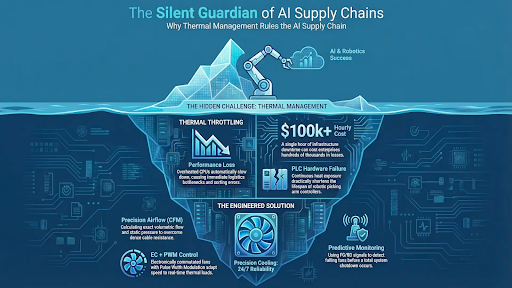
How Heat Degrades IT and Robotics Performance
Edge Computing and Control Cabinet Thermal Failure
Thermal stress is the silent killer of localized IT infrastructure. When temperatures inside an industrial control cabinet exceed operational thresholds, CPUs automatically throttle their performance to prevent permanent damage.
This thermal throttling leads to delayed data processing, directly causing unexpected logistics bottlenecks or sorting errors on high-speed conveyor belts. Furthermore, continuous exposure to high temperatures drastically shortens the lifespan of Programmable Logic Controllers (PLCs).
A failing PLC in a robotic picking arm doesn’t just slow down operations; it creates a hard stop. The resulting downtime ripples across the entire fulfillment network, proving that hardware resilience is just as vital as software efficiency in [Internal Link: Automation & Digital Transformation].
Energy Efficiency in Continuous Operations
Modern warehousing and logistics facilities operate on a relentless 24/7 schedule. In these continuous operations, relying on outdated, inefficient cooling methods leads to exorbitant energy consumption.
Traditional cooling systems often run at full speed regardless of the actual thermal load, wasting massive amounts of electricity. Upgrading the physical infrastructure to highly efficient, load-adaptive systems is no longer optional.
Energy-efficient thermal management not only lowers overhead costs but also aligns with corporate sustainability goals. It ensures that the physical infrastructure can support the growing demands of AI without inflating the facility’s carbon footprint.
The Role of Predictive Maintenance in Thermal Management
The modern approach to thermal management is proactive, not reactive. By utilizing [Internal Link: IoT Devices] and advanced sensors, facility managers can monitor temperature fluctuations and fan speeds in real time.
Using tachometer (FG) and alarm (RD) output signals, these smart systems can detect a failing fan or a blocked vent long before thermal shutdown occurs. This allows maintenance teams to replace components during scheduled downtime rather than during a critical operational peak.
The cost of ignoring physical infrastructure health is staggering. According to a recent industry analysis on the financial impact of data center outages, a single hour of IT infrastructure downtime—often triggered by thermal overload in critical localized environments—can cost enterprises hundreds of thousands of dollars, making predictive thermal monitoring a non-negotiable asset for logistics companies.
Key Takeaways
| Area | Key Takeaway | Impact/Data |
| Hardware | Heat throttles CPUs & destroys PLCs | Causes hard stops in automated robotics |
| Cooling | Deploy EC fans with PWM control | Slashes 24/7 operational energy waste |
| Maintenance | Implement IoT predictive thermal monitoring | Prevents $100,000+/hour downtime losses |
| Standards | Mandate IP68, CFM & static pressure specs | Shields systems from industrial dust/moisture |
Conclusion: Future-Proofing Supply Chain Infrastructure
A robust digital supply chain requires more than just cutting-edge algorithms and cloud software. It demands a highly reliable physical hardware foundation capable of withstanding extreme industrial conditions.
As we deploy more AI and robotics into fulfillment centers, the heat generated by these systems will only increase. By investing in intelligent, precision thermal management today, supply chain leaders can eliminate hidden bottlenecks and ensure seamless, automated operations for the future.
 Cyber Security Careers: Solving the Talent Gap Crisis
 Infor Introduces Control Center to Make Data-Driven Supply Chain a Reality
 Beating background noise in remote working
 Click Click Clear with CABIE
 2021 Predictions – Thoughts from Experts at Quest Software
 Circle Logistics Appoints Philip Barnes as New VP of Marketing