

Six years ago, maybe more, A crack showed up on the road two streets from my house. Still there. Nobody’s touched it. Cracks everywhere, water pooling after every rain. So when I mentioned solar roadways to him, roads built from panels that generate electricity he laughed. Not rudely. Just the laugh of someone who’s seen too many infrastructure promises go nowhere.I get it. I laughed too, at first.
What actually surprised me, the more I read, was how un-hype-y the people building this stuff are. They’ll tell you straight up what’s broken and why.That honesty is actually why the research keeps moving forward.
What a Solar Roadway Actually Is
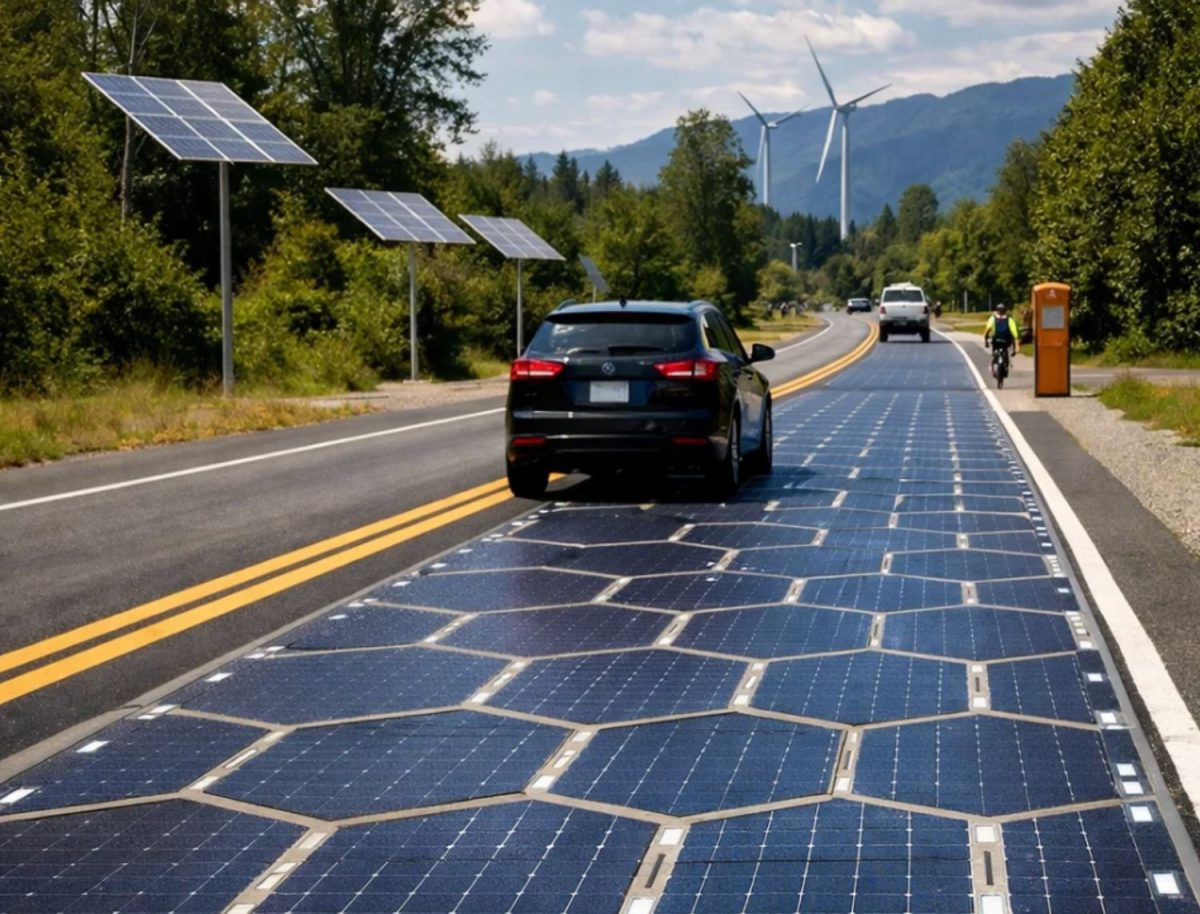
Strip away the futurism and the pitch deck language, and a solar roadway is a paved surface where the top layer does double duty carrying traffic above while converting sunlight into electricity below. The panels replace asphalt. Everything else about how a road functions stays roughly the same.
The solar side of that equation is the part people understand. Photovoltaic cells, sunlight, electricity are familiar enough. What trips up nearly every early project is the road side. Weight distribution, surface friction, water runoff, thermal expansion, joint sealing. These aren’t glamorous engineering problems. They’re also the ones that caused the first generation of solar road installations to crack, flood, and wear down faster than anyone publicly admitted at the time.
I came across a project update last year where a road developer mentioned almost in passing — that they’d finally brought in people who actually build highways for a living. Not solar people. Road people. The difference in how the newer panels performed was apparently significant enough that they wondered why it hadn’t happened in the first phase. That’s the thing about transportation engineering firms their value in this space isn’t obvious until something cracks that they shouldn’t have. After that, nobody questions why they’re in the room.
How the Technology Functions
A solar road panel has three layers, and each one has a job.
The top layer takes the abuse. Vehicles, weather, debris, years of friction all of it lands here first. Hard enough to not crack under a truck. Rough enough that wet tires actually grip it. Clear enough that sunlight still gets through to the cells underneath. Pick any two, getting all three right in one material is something researchers are still genuinely wrestling with.
Current solutions involve trade-offs.
The middle layer is where power gets generated. Solar cells sit here, protected by the surface above. Light reaches them, electrons move, current flows. The same basic process as any solar installation, just happening under conditions of constant vibration, variable load, humidity that a rooftop panel never has to deal with.
The bottom layer handles everything else: wiring, LED systems, sometimes heating elements. The LEDs matter more than they might seem. They can project lane markings, speed limit indicators, hazard warnings all programmable, all changeable without a paint crew. A few cities have started looking at this feature independently, separate from the electricity generation question, because the maintenance savings on road markings alone are worth something.
The Projects That Ran, and What Happened
France’s Wattway installation in Normandy is the most documented case. About a kilometer of panels on a public road, opened in 2016. The surface degraded faster than projected. Power output came in well below the estimates. By 2019 it was mostly functioning as a data collection exercise rather than an energy source. The researchers involved published detailed post-mortems. Those documents are now required reading for anyone designing the next attempt.
China’s Jinan highway project made bigger headlines. Wireless EV charging built into the road, impressive footage, global coverage. It also suffered from something no engineering simulation had accounted for: theft. Sections of the panel were physically removed by people who figured out the material had resale value. The project continued in a reduced form, but the theft problem forced a redesign of how panels are secured to the base.
The American crowdfunded version Solar Roadways Inc. out of Idaho generated enormous public interest and modest electricity. The gap between the promotional video and the actual output numbers was significant. Independent engineers had flagged the efficiency projections as unrealistic before the panels were even installed. They were right.
What all three share: they produced failure data, which is genuinely useful. The next generation of prototypes is being built around what went wrong, not just what the simulations said should work.

The Real Numbers
The road surface globally covers tens of millions of square kilometers. Even a small percentage of that, converted to low-efficiency solar panels, represents a large absolute energy number. This is why the concept keeps attracting attention despite repeated setbacks the surface area argument is hard to dismiss.
The cost argument is harder. Solar road panels currently cost several times more per square meter than asphalt. The electricity they generate doesn’t offset that gap within any reasonable payback window. For the economics to work, either panel costs have to drop significantly or governments need additional reasons to justify the premium.
The heated road surface is one such reason. In climates where ice and snow cause serious road damage, the cost of winter maintenance salt, plowing and repairs to frost-damaged asphalt runs into billions annually. A road surface that heats itself and reduces that damage has a different cost-benefit calculation than one being evaluated purely on electricity output. That’s where some of the more credible current research is focused.
What Comes Next
Nobody with actual skin in the game thinks we’ll see major highways resurfaced with solar panels anytime soon. The realistic version of this technology’s near future looks a lot smaller: a bike lane here, a parking lot there, maybe an airport taxiway where the load is manageable and someone’s willing to run the experiment. Lower loads, more controlled environments, easier maintenance access.
From those installations, better data. From better data, improved designs. From improved designs, eventually, surfaces that hold up long enough and generate enough power to justify moving toward higher-traffic applications.
I checked Pape-Dawson’s project portfolio once out of curiosity firms like that are out there doing the unglamorous groundwork while the concept is still being debated online. That crack on the road two streets down? Still there. I checked last week.
 The Revolutionary Impact of the Internet of Things on Supply Chain Management
 Enhancing Resilience in Pharmaceutical Supply Chains Strategies
 Confluent Appoints Richard Jones as Vice President of Enterprise Sales, Northern EMEA
 Axele Webinar Helps TL Carriers Meet Drug & Alcohol Clearinghouse Requirements
 Why it’s time to adapt to the virtual world: how to master online negotiations
 Will the Olympic Games disrupt transport operations in France?