

When management asks for a trailer procurement recommendation, the challenge is rarely a lack of site experience – it’s a lack of technical vocabulary. You know your haul roads, your load profiles, your operational constraints. What’s missing is the framework to name a specific trailer type, justify the choice, and hold that position when the procurement team pushes back.
This article covers the primary trailer types used in mining logistics, what each is built for, and how to match them to site conditions. The wrong trailer choice has real consequences: lost payload capacity, faster road deterioration, compliance risk, and budget overruns.
Match the Trailer to the Job Before You Match It to the Budget
Every trailer procurement decision comes down to four variables: load type, terrain, haul distance, and regulatory limits. Together, these determine the ideal trailer for purpose, and that’s the standard engineers and procurement teams apply when they’re evaluating equipment, even if they don’t always say it out loud.
Specifying outside this framework creates predictable problems. A flatbed ordered for bulk ore, a float trailer substituted for a lowboy, a fuel tanker procured without ADG compliance sign-off. Each of those is a recoverable mistake, but each one costs time, money, or both, and more often than not the cost lands on the operation rather than the procurement decision that caused it.
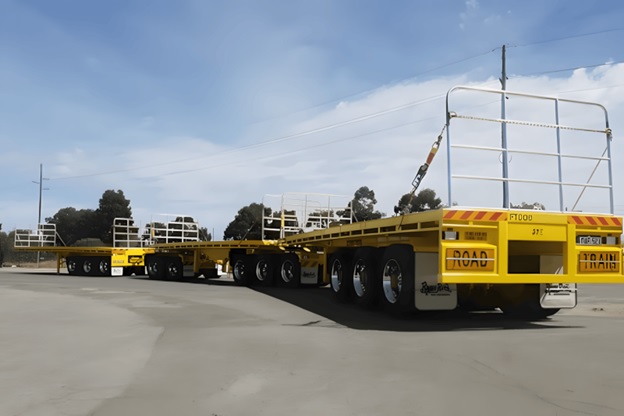
Flat Top Trailers in Mining Logistics
A flat top trailer, also called a flatbed, is an open-deck platform with no sides or roof, built for general freight and oversized rigid loads. It’s the standard choice when the load has a fixed shape and can be restrained with chains, straps, or twist locks, and in mining that covers a lot of ground.
Common applications include machinery mobilisation, structural steel, conveyor sections, and modular site infrastructure. The key procurement figures are deck strength rating and tie-down anchor point capacity, because those are the numbers that will come up when the conversation turns to specs and you want to have them ready.
Loads exceeding 2.5 metres in width, or projecting beyond the deck, will likely require a permit under NHVR mass and dimension limits, and because requirements vary by state, route approvals need to be confirmed well before dispatch, not on the morning of. Where flat tops fall short is with loose bulk material, and that’s where tippers come in.
Tipper Trailers in Mining Logistics
For loose bulk material, whether that’s ore, overburden, waste rock, aggregate, or gravel, tippers are the standard option because there’s really no practical substitute when you’re moving volume.
Two configurations are in common use: end-tip and side-tip. End-tip suits most bulk dump scenarios, but side-tip is where it gets more site-specific. Side-tip trailers discharge laterally, which matters on sites where the dump zone doesn’t allow a full rear-tip arc, such as a tight ROM pad, a narrow bench, or a dump area constrained by bunding. In those conditions, an end-tip configuration creates both a productivity problem and a safety exposure, and in practice this is the configuration call that gets underestimated most often at the procurement stage.
Key specs are tipping angle, payload rating, and body material. For sites handling abrasive ore, hardox steel is the correct body specification because it outlasts mild steel significantly, and that difference shows up directly in wear costs per tonne. It’s worth raising explicitly in any procurement discussion, since it’s the kind of detail that signals you’ve actually thought through the site conditions.
Lowboy Trailers in Mining Logistics
When a tracked or wheeled heavy plant needs to move without travelling under its own power, a lowboy is the right call, and that’s exactly what it’s built for.
The defining feature is a low deck height, typically 500 to 600mm from ground level, which in practice means a lower centre of gravity and enough clearance to move under bridges and overhead structures on access roads. Lowboys handle excavators, bulldozers, large generators, compressors, and crushers, so basically anything that can’t or shouldn’t self-propel between pit areas or to an off-site workshop.
Key procurement specs are GVM rating, deck length, and ramp type. Hydraulic ramps are worth specifying on sites that move tracked machines regularly, because the loading efficiency difference adds up over time even if it’s not obvious upfront. On public roads, NHVR oversize and overweight permits are required for most lowboy movements, and permit fees, pilot vehicle costs, and route pre-approvals are all billable. On a multi-pit operation where plant moves frequently, those costs accumulate quickly, so they belong in the procurement budget from the start rather than being treated as contingencies.
Tanker Trailers in Mining Logistics
On remote mine sites, tanker trailers serve two functions: water haulage and fuel delivery. Straightforward in principle, but they’re often underspecified in practice, and that tends to show up at the worst possible time.
Water tankers handle dust suppression on haul roads, fire response, and water supply for drill operations, and all of that becomes operationally critical when a site is hours from reticulated water supply, which describes a lot of Australian mining operations. Fuel tankers service equipment in pit areas where fixed bowsers aren’t viable, keeping machines running without the cost and delay of sending them back to a central fuel point.
Procurement specs to confirm are tank capacity, body material (poly for water, steel for fuel), and pump discharge rate, which sets refuelling cycle time. Fuel tankers are classified as dangerous goods transport under Australian law and must meet ADG requirements, so this needs to be confirmed at the specification stage, well before the order goes in.
Other Trailer Types in Mining Logistics
Three more trailer types come up regularly enough in mining logistics to be worth knowing, even if they don’t feature in every procurement conversation.
Curtainsider trailers have retractable curtain sides in place of fixed walls, which makes them practical for consumables, chemicals, PPE, and sensitive equipment on supply runs where weather protection or cargo security is a real consideration, particularly on remote sites where exposed freight is a genuine risk.
Dog trailers are a coupled second unit pulled behind the lead trailer and prime mover, distributing load across more axles to increase legal payload per trip. Use is subject to NHVR access conditions and state road rules, but on approved internal haul roads the configuration offers a measurable cost-per-tonne advantage on high-volume cycles, so it’s worth understanding when haulage efficiency is part of the conversation.
Float trailers look similar to lowboys, but that’s where the similarity ends. They’re built for civil and agricultural loads, and their GVM ratings and ramp specs are generally below what mining plant requires. They appear occasionally on procurement shortlists as a lower-cost alternative to a purpose-built lowboy, but in most cases that’s a false economy, and it’s worth confirming the specs before any float trailer makes it to a final recommendation.
You Now Have the Language
The five trailer types covered here, flat top, tipper, lowboy, tanker, and curtainsider, each map to the four procurement variables introduced at the start: load type, terrain, haul distance, and regulatory limits. A supervisor who can articulate that mapping has what’s needed to put a defensible equipment recommendation on the table.
Procurement decisions don’t go to the person with the most information. They go to the person who can translate site conditions into equipment specifications, clearly and without hesitation.
For operations that need trailers built specifically for mining conditions, Bruce Rock Engineering engineers heavy haulage equipment to site-specific requirements.
 Business dashboard: definition and usefulness for small businesses
 Driving Digital Transformation in Retail with AI-Powered Experiences
 Over half of fashion retailers weren’t agile enough to capitalise on eCommerce boom
 Dairy Products Supply Chain Planning at leading purchasing group Euromadi
 Movu Robotics showcases compact scalability & accessible warehouse automation at IntraLogisteX 2025
 Twin Disc selects Syncron to power its service parts pricing optimisation