
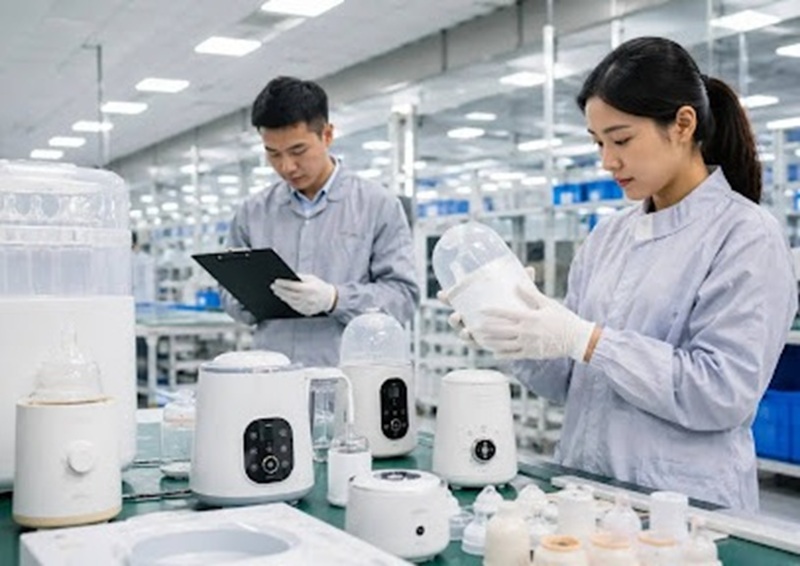
Baby appliances occupy a sensitive position in the global consumer product supply chain. Unlike many general household appliances, products used around infants must meet higher expectations for material safety, hygiene, usability, durability, and product consistency. For distributors, retailers, private-label brands, and sourcing teams, choosing the right manufacturing partner is therefore not only a pricing decision. It is a supply chain risk-management decision.
From bottle sterilizers and bottle warmers to formula makers and baby food preparation appliances, buyers need to evaluate whether a manufacturer can consistently deliver safe, compliant, and commercially reliable products across different markets. A low unit price may look attractive at the quotation stage, but weak quality control can later lead to product returns, customer complaints, compliance delays, brand damage, or even market withdrawal.
For this reason, global buyers should assess several core quality-control factors before confirming a baby appliance supplier.
1. Material Safety Should Be Verified Early
Material selection is one of the first quality checkpoints in baby appliance manufacturing. Since many baby appliances come into contact with bottles, water, steam, formula, or feeding accessories, buyers should ask suppliers about food-contact materials, BPA-free plastics, heat resistance, and material documentation.
For example, sterilizers and warmers often use plastic parts exposed to repeated heat and steam. If the material is not properly selected, the product may deform, discolor, release odor, or fail after repeated use. Buyers should request clear information about plastic grades, food-contact compliance, heat resistance, and material test records.
This step should happen before sample approval, not after mass production begins.
2. Functional Testing Must Match Real-World Use
A baby appliance may look good visually but still fail in daily use. This is why functional testing is essential. Buyers should check whether the manufacturer tests each product type according to its actual function.
For bottle sterilizers, important checks may include steam generation, drying performance, temperature stability, UV or ozone function if applicable, cycle timing, lid safety, and internal capacity. For bottle warmers, buyers should review heating speed, temperature control accuracy, overheating protection, compatibility with different bottle sizes, and keep-warm performance.
A reliable manufacturer should be able to explain how these functions are tested during development, sample approval, and mass production.
3. Electrical Safety and Component Reliability Matter
Baby appliances are often used daily by parents, sometimes at night, in kitchens, bedrooms, or nursery spaces. Electrical safety is therefore a core sourcing issue.
Buyers should ask suppliers how they control heating components, PCBA quality, power cords, plugs, internal wiring, sensors, switches, and safety shutoff systems. For international sales, voltage requirements also need to match the target market, such as 110–120V or 220–240V configurations.
Component consistency is especially important for OEM and private-label orders. If a supplier changes components without proper approval, product performance can become unstable between batches. Buyers should make sure that component lists, approved samples, and production specifications are clearly controlled.
4. Production Consistency Is More Important Than One Good Sample
Many suppliers can prepare a good-looking sample. The real test is whether they can produce the same quality repeatedly in bulk.
Global buyers should evaluate the manufacturer’s process controls before placing larger orders. Key points include incoming material inspection, assembly-line quality checks, functional testing, packaging inspection, and final random inspection before shipment.
For OEM buyers, the approved sample should become the production reference. Any changes in structure, material, color, logo, packaging, accessories, or electrical specification should require confirmation before mass production.
This is particularly important for brands selling across multiple regions, where product consistency affects both consumer trust and regulatory confidence.
5. Packaging and Logistics Testing Should Not Be Ignored
In baby appliance sourcing, packaging is not only a marketing tool. It is part of the product protection system.
Sterilizers, warmers, and formula makers may include internal trays, lids, water tanks, heating plates, plastic housings, electronic controls, or accessories. If packaging is not properly designed, products may be damaged during ocean shipment, warehouse handling, or last-mile delivery.
Buyers should ask whether the manufacturer performs carton strength checks, drop tests, vibration tests, and loading analysis. For distributors and retailers, packaging quality can directly affect return rates and customer satisfaction.
Good packaging also supports private-label presentation, shelf display, barcode management, user manual clarity, and after-sales communication.
6. Compliance Support Should Be Discussed Before Order Confirmation
Different markets may require different compliance documents. Baby appliance buyers may need CE, EMC, RoHS, REACH, ERP, CB, FCC, UKCA, food-contact material documentation, or other market-specific requirements depending on product type and destination.
A supplier does not always need to hold every certificate before the first discussion, especially for customized OEM projects. However, the supplier should be able to explain what documents are available, what needs to be tested, what costs may apply, and how long certification may take.
For B2B buyers, early compliance planning helps avoid shipment delays and prevents misunderstandings after orders are placed.
7. OEM Capability Should Include Engineering Communication
For private-label baby appliance projects, buyers should look beyond standard product catalogs. A capable OEM partner should support product adaptation, packaging customization, logo application, instruction manual preparation, market-specific voltage options, and sometimes structural or functional adjustments.
This is where working with an experienced baby appliance OEM manufacturer can reduce development risk. A manufacturer with engineering support can help buyers evaluate whether a requested customization is practical, safe, cost-effective, and suitable for mass production.
For example, a distributor may want to modify a sterilizer’s control panel, add drying functions, adjust packaging language, or prepare a product set for a specific regional market. These details require technical review, not only sales communication.
8. Buyers Should Review Product Range and Manufacturing Fit
Before choosing a supplier, buyers should also check whether the manufacturer’s product range matches their commercial plan. A company sourcing only one model may focus on price, but a brand building a long-term baby care appliance line needs a broader product roadmap.
A supplier with a complete baby feeding appliance portfolio can support future expansion from bottle sterilizers and warmers to formula makers, food makers, and related infant care appliances. This makes it easier for buyers to build product bundles, seasonal promotions, and regional catalog strategies over time.
Product range also matters for supply chain efficiency. Working with one qualified manufacturing partner across several related categories can simplify communication, packaging alignment, inspection standards, and shipment planning.
Final Thoughts
Quality control in baby appliance manufacturing is not a single inspection step. It is a full process that starts from material selection and product design, continues through engineering review and sample testing, and extends into mass production, packaging, compliance, and shipment.
For global buyers, the best sourcing decision is not always the lowest-cost supplier. It is the supplier that can provide stable quality, clear communication, reliable production control, and the ability to support long-term product development.
In the baby appliance industry, where safety, hygiene, and trust are closely connected to brand reputation, careful supplier evaluation is essential. Buyers who review material safety, functional performance, electrical reliability, production consistency, packaging durability, and OEM support before placing orders are better positioned to build a stable and competitive product line.
 7 Ways AI SEO Can Help Your Logistics Business Grow
 Why crunching data is not the same as making decisions
 Schneider Electric launches new EcoStruxure Service Plans
 How Digital Accounting Is Transforming Field Service Businesses
 Understanding Supply Chain Issues in the Face of Climate Change
 Expert comment on the latest Dominican Republic quantum ransomware attack