

For IT companies, email outreach is still one of the most efficient ways to start sales conversations.
SaaS teams use it to reach product-qualified prospects. Agencies use it to open doors with niche verticals.
Founders use it to test markets before investing in large paid campaigns. But the rules have changed. Scaling outreach is no longer about sending more emails to more people.
It is about sending more relevant, personalized, timely, and technically sound emails without damaging trust or sender reputation.
Email outreach is getting harder
The first challenge is volume. Decision-makers receive more automated emails than ever, and many of them look almost identical: a generic compliment, a vague pain point, a meeting request, and a follow-up two days later. In IT and SaaS, where buyers are technical and skeptical, this kind of outreach is easy to ignore.
The second challenge is the buying process itself. Gartner notes that B2B buying is nonlinear, involves multiple buying tasks, and increasingly combines digital research with human interaction. Its research also found that 75% of B2B buyers prefer a rep-free sales experience, which means sales emails must be useful enough to support an informed buyer, not just interrupt them.
The third challenge is technical. Gmail, Yahoo, Microsoft, and other mailbox providers now pay closer attention to authentication, complaint rates, unsubscribe behavior, and sender reputation. Google’s sender guidelines require all senders to use SPF or DKIM, while bulk senders must use SPF, DKIM, and DMARC; Google also tells senders to keep spam rates below 0.3%.

Where email warm-up fits
Email warm-up can help new or underused mailboxes build a more natural sending history before larger campaigns begin. It is not a shortcut around poor outreach practices, and it cannot compensate for irrelevant messaging or bad data.
Tools such as Snov.io Email Warm-up can support the process of preparing mailboxes and protecting sender reputation, but warm-up should be used together with clean data, proper authentication, relevant messaging, and responsible sending volumes. Snov.io describes its warm-up feature as a way to prepare sender accounts and monitor deliverability before campaigns, which makes it one useful part of a broader deliverability workflow rather than a complete solution.
Basic automation is no longer enough
Basic automation helped sales teams move beyond manual follow-ups, but it also created new problems. A generic five-step sequence can damage performance when it targets the wrong accounts, uses outdated contacts, or sends the same message to a CTO, product manager, and operations lead.
Poor segmentation is especially costly in IT outreach. A cybersecurity platform selling to fintech companies should not use the same message for a 50-person SaaS startup and a regulated enterprise bank. The problem, risk level, buying committee, and urgency are different. When automation ignores those differences, personalization becomes cosmetic.
Bad data compounds the issue. Invalid addresses increase bounce rates. Old job titles lead to irrelevant messaging. Duplicate records cause embarrassing repeat emails. Weak personalization, such as adding only a first name or company name, no longer feels thoughtful when the rest of the message is clearly templated. HubSpot reports that segmented emails drive 30% more opens and 50% more clickthroughs than unsegmented ones, which reinforces a simple point: relevance usually beats volume.
What smarter email automation looks like
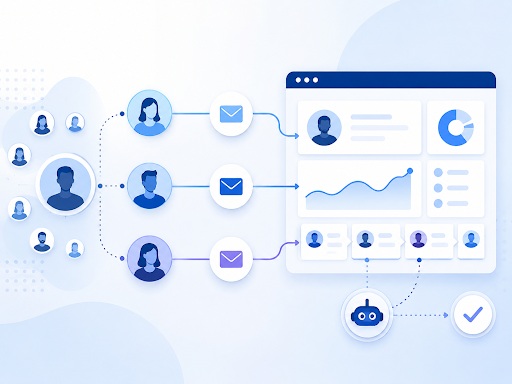
Smarter email automation starts before the first email is written. It begins with a clear ideal customer profile: industry, company size, tech stack, growth signals, pain points, buying triggers, and decision-makers. The goal is not to build the largest possible list, but the most plausible one.
From there, teams need verified contact data, account-level segmentation, and messaging that reflects the prospect’s context. For example, an IT services company could segment prospects into “recently funded SaaS companies,” “companies hiring DevOps engineers,” and “legacy software vendors moving to cloud infrastructure.” Each segment deserves a different problem statement and proof point.
Smarter automation also includes behavior-based triggers. If a prospect opens a technical guide, visits a pricing page, or replies with “not now,” the next step should reflect that behavior. CRM integration matters because sales reps need full visibility into previous touches, objections, and engagement. A/B testing matters because assumptions about subject lines, value propositions, and calls to action are often wrong.
Human oversight remains essential. Automation should handle timing, routing, data syncing, and reminders. Humans should still own strategy, message quality, account fit, and judgment.
Deliverability is now a growth issue
Deliverability is often treated as a technical detail, but for IT companies it is a revenue issue. If your emails do not reach the inbox, your best positioning, offer, and sales team do not matter.
A responsible outreach program should monitor SPF, DKIM, DMARC, bounce rates, spam complaints, domain reputation, sending limits, and unsubscribe behavior. Google states that messages without proper authentication may be marked as spam or rejected, and it recommends monitoring domain spam rate, authentication, and domain or IP reputation in Postmaster Tools.
A practical mini-case: when Gmail and Yahoo tightened sender requirements in 2024, many companies had to move deliverability from “someone in marketing will handle it” to a shared responsibility across marketing, sales ops, and IT. Teams that had authentication, list hygiene, and unsubscribe processes in place adapted quickly. Teams relying on scraped lists and high-volume sending saw more bounces, filtering, and inconsistent inbox placement.
Validity’s 2025 Email Deliverability Benchmark Report highlights why this matters: only one quarter of surveyed respondents said their spam complaint rates were in the below-0.1% band associated with best-practice programs, and the report describes spam complaints as the biggest factor that harms sender reputation.
A practical framework for smarter outreach
A simple operating model helps teams scale without losing control:
1. Define the ideal customer profile clearly. Know which companies are worth contacting and why now is a relevant moment.
2. Verify and clean contact data. Remove invalid addresses, duplicates, role mismatches, and stale records before launching.
3. Set up authentication. Configure SPF, DKIM, and DMARC correctly for every sending domain.
4. Warm up mailboxes responsibly. Increase volume gradually and avoid sudden spikes from new domains or accounts.
5. Segment prospects. Group accounts by industry, role, company stage, technology use, or buying trigger.
6. Personalize messages meaningfully. Reference business context, not just name and company.
7. Automate follow-ups carefully. Use fewer, better follow-ups and stop when there is no engagement or when the prospect opts out.
8. Track replies, bounces, complaints, and conversions. Open rates alone are not enough; Google itself says it does not track open rates and cannot verify third-party open-rate accuracy.
9. Improve campaigns based on evidence. Test subject lines, offers, segments, timing, and calls to action.
The risks of over-automation
Smarter automation also means knowing what not to automate. Generic AI-generated emails can create scale without substance. Poor data can lead to privacy mistakes, irrelevant targeting, or outreach to people who should not be contacted. Excessive follow-ups can turn a legitimate sales motion into a reputation problem.
Adobe’s 2025 research emphasizes that fragmented data blocks real-time, one-to-one personalization. For outreach teams, that means automation is only as good as the data, systems, and governance behind it.
Conclusion
IT companies need smarter email automation because the old playbook is breaking. More volume does not guarantee more pipeline; in many cases, it creates more risk. The companies that win with outreach will be the ones that combine accurate data, thoughtful segmentation, useful personalization, careful follow-up, strong authentication, deliverability monitoring, and human judgment. Done well, smarter automation helps teams scale outreach without sacrificing trust, relevance, or inbox access.
 How To Succeed In Bitcoin Trading: Essential Skills To Develop
 Ericsson enhances enterprise 5G portfolio with generative AI virtual expert to simplify network operations
 Video Surveillance in Smart Cities: Safety for All
 Meeting OFAC’s Call To Action: Combating Illicit Cargo
 Leverage Cyber Security Content Marketing with Video Marketing in 2023
 Creating an authentic & credible sustainability policy