

The convergence of Artificial Intelligence and the Internet of Things (IoT) has long promised to turn raw telemetry into actionable insight. Until recently, that insight was primarily textual or analytical—dashboards filled with graphs, predictive maintenance alerts in spreadsheets, or anomaly reports in text logs.
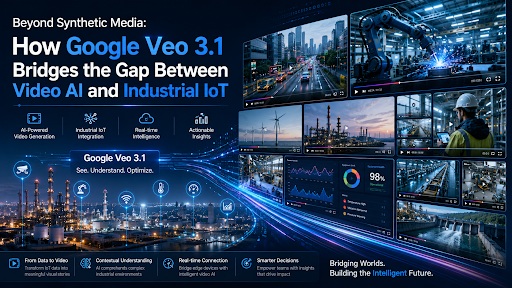
However, the launch of Google Veo 3.1 marks a significant shift in how enterprises can utilize generative video and audio models. While mainstream discussions around Veo 3.1 focus on creative filmmaking and marketing assets, its core architecture—capable of photorealistic physics comprehension, multi-angle temporal consistency, and native, synchronized audio generation—presents highly practical applications for modern supply chains, warehousing, and industrial IoT ecosystems.
Here is how this advanced AI video generate model is moving out of the creative studio and onto the smart factory floor.
Transforming IoT Telemetry into High-Fidelity Digital Twins
Digital twins have become a staple of smart logistics, but keeping them visually accurate in real-time remains a computational bottleneck. Traditional 3D rendering engines require massive processing power to simulate complex warehouse environments or shipping yard workflows based on IoT sensor data.
Google Veo 3.1 changes this dynamic through its deep understanding of real-world physics. By feeding live IoT telemetry—such as forklift tracking data, conveyor belt speeds, or automated guided vehicle (AGV) coordinates—into the model, operators can generate high-fidelity, photorealistic visual representations of their facilities instantly.
- Real-time Visual Context: Instead of looking at a 2D map with blinking dots, managers can view a synthesized, dynamically accurate 3D video feed of a remote facility.
- Predictive Incident Visualization: When an IoT sensor flags an anomaly (e.g., a bearing overheating on a high-speed sorter), Veo 3.1 can ingest that data and render a predictive video simulation of the impending failure. This gives maintenance teams a clear visual understanding of the mechanical risk before they even dispatch a technician.
Immersive Training and SOP Generation for Warehousing
Standard Operating Procedures (SOPs) in supply chain management are notoriously difficult to update. When a warehouse introduces a new IoT-enabled scanning system, a robotic palletizer, or an updated sorting protocol, updating the training documentation usually involves a slow process of manual filming and editing.
Veo 3.1 streamlines this by allowing supply chain managers to generate hyper-realistic training videos directly from text prompts and schematic diagrams.
Because the model maintains exceptional temporal consistency, it can produce multi-step instructional videos that demonstrate exact hand movements, equipment interactions, and safety protocols without visual distortion. If a process changes, updating the video is as simple as tweaking the text prompt or updating the underlying IoT workflow log. The result is a highly agile training ecosystem where educational content updates at the same speed as technological deployment.
Enhancing Edge-AI Video Analytics and Quality Control
Many modern distribution centers rely on computer vision at the edge to inspect packages, verify barcodes, and detect damaged freight. However, training these edge-AI models requires tens of thousands of high-quality images and videos representing every conceivable type of defect—crushed boxes, torn labels, fluid leaks, or structural wear.
Gathering this data physically is time-consuming and often impractical. This is where Google Veo 3.1 serves as a powerful synthetic data engine.
[IoT Sensor Flag] ➔ [Text/Data Input to Veo 3.1] ➔ [Synthetic Video Generation of Defect] ➔ [Training Edge-AI Vision Models]
By generating hyper-realistic video sequences of specific operational failures, damaged goods, or safety violations, logistics companies can use Veo 3.1 to train and refine their on-site security and quality control cameras. The model’s ability to render complex lighting, shadows, and material textures ensures that the synthetic data matches the real-world environment perfectly, dramatically reducing the false-positive rates of edge analytics systems.
Next-Generation Remote Assistance via AR/VR and Native Audio
One of the standout features of Google Veo 3.1 is its native audio generation capabilities. It doesn’t just patch audio onto a video after the fact; it computes video and audio simultaneously, ensuring perfect acoustic synchronization with physical actions.
In a supply chain context, this introduces major advancements for remote assistance and augmented reality (AR) maintenance:
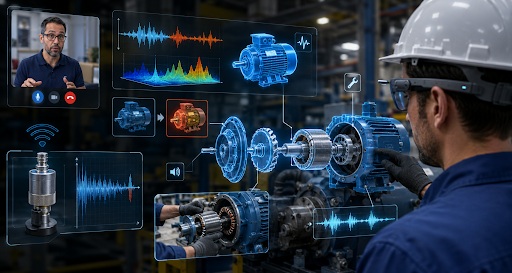
- Acoustic Digital Twins: Industrial mechanics rely heavily on sound to diagnose machinery issues (e.g., the specific hum of a healthy motor versus the grinding click of a failing belt). Veo 3.1 can simulate the exact acoustic profile of machinery based on IoT vibration sensor inputs.
- Immersive AR Overlays: Field technicians using AR glasses can receive generated video overlays showing the exact breakdown of a machine component, complete with accurate audio cues that mimic what the machine should sound like during proper assembly or disassembly.
The Path to Implementation: Data Infrastructure First
Integrating a model as sophisticated as Google Veo 3.1 into industrial operations requires a robust data pipeline. Enterprises cannot simply plug a raw video generator into a warehouse management system. It requires a middleware layer capable of translating structured IoT data (MQTT or AMQP protocols) into semantic prompts that the video model can interpret.
Organizations looking to leverage this technology must focus on structuring their environmental data, ensuring low-latency edge computing, and maintaining strict data governance over their internal operational videos.
As the lines between digital simulation and physical reality continue to blur, tools like Google Veo 3.1 prove that generative AI is no longer just for content creators. For the IT supply chain, it represents the next evolution of operational visibility—turning invisible data points into clear, actionable, and visual reality.
 30+ Healthcare Accounts Look to Tecsys to Address Post-Pandemic Supply Chain Challenges
 Why Insurance Companies Are Investing More in Compliance Automation
 Brexit leads to increase in break bulk for cross-border parcel traffic
 Putting traceability top of the agenda – is your company hoping for the best or planning for the worst?
 NetApp and Google Cloud Advance Strategic Partnership to Drive Innovation in the Cloud
 Rethinking How the World Builds, One Layer at a Time