

The SEO software market has never been more crowded.
Every platform promises deeper insights, faster growth, better rankings, and
smarter automation. Yet many marketing teams find themselves facing the same frustrating reality after investing in multiple subscriptions. They have more dashboards, more reports, and more data than ever before, but they are not necessarily making better decisions.
This was exactly the situation a mid-sized e-commerce company found itself in last year.
The business had grown steadily through paid advertising and repeat customers, but organic traffic had plateaued. Competitors were appearing more frequently in search results, while AI-powered search experiences were beginning to influence how customers discovered products and researched purchases.
The marketing team responded the same way many companies do. They added more tools.
One platform was used for keyword research. Another tracked backlinks. A third monitored rankings. Several free tools filled in additional gaps. Over time, the team’s workflow became increasingly fragmented.
Ironically, the problem was no longer a lack of information. The problem was figuring out what to do with it.
Too Much Data, Not Enough Direction
When the company conducted an internal review, they realized their biggest challenge wasn’t visibility. It was prioritization.
Every week produced a new list of opportunities. New keywords to target. New competitors to analyze. New technical issues to investigate.
Without a clear framework, the team spent more time gathering information than acting on it.
One marketing manager described the situation perfectly.
“We kept thinking the next tool would give us the answer. Instead, it gave us another report.”
That realization led them to rethink their approach entirely.
Rather than searching for another specialized platform, they decided to simplify their workflow and focus on tools that could help them move from research to action more efficiently.
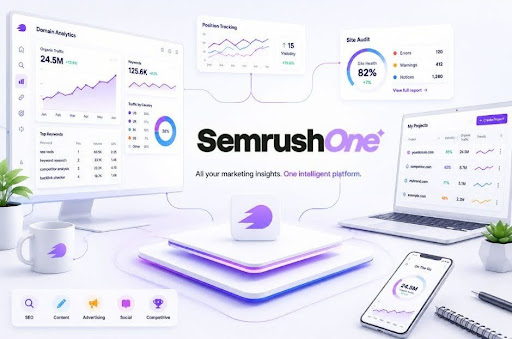
This led them to adopt Semrush One Solution as a central part of their search and visibility process.
Importantly, they did not abandon every other tool they used.
The goal was never to rely on a single solution for everything. The goal was to create a workflow that reduced friction and helped the team spend more time executing and less time switching between platforms.
Building a More Practical Search Workflow
The first step was identifying where time was being lost.
Previously, keyword research, competitor analysis, site audits, and performance monitoring all happened in separate environments. Information had to be exported, compared manually, and shared across departments.
The team consolidated much of that process into a single workflow.
They started by reviewing competitor visibility and identifying categories where rival brands consistently outperformed them. Rather than immediately creating new content, they looked for patterns.
Were competitors publishing more comprehensive buying guides?
Were they targeting questions further up the customer journey?
Were there technical issues preventing existing content from performing as well as it could?
Those questions produced more valuable insights than simply chasing high-volume keywords.
Next came content planning.
Instead of producing large amounts of content based on assumptions, the team focused on topics supported by actual search demand and competitive gaps. This resulted in fewer pieces being published, but each article served a clearer purpose.
At the same time, technical audits revealed several issues that had quietly accumulated over the years. None were catastrophic on their own, but together they were limiting performance.
Fixing those issues required significantly less effort than creating dozens of new articles, yet the impact was noticeable within a few months.
The Results That Actually Mattered
One of the most interesting outcomes was not a specific ranking increase or traffic percentage.
It was speed. The marketing team estimated that they reduced the time spent gathering and organizing data by several hours each week.
That time was redirected toward strategy, content improvement, and collaboration with other departments.
Organic traffic began improving gradually rather than dramatically. More importantly, the traffic aligned better with commercial goals.
Visitors arriving through search were engaging with more pages, spending longer on the site, and converting at higher rates than before.
The company also gained greater visibility into emerging AI-driven search experiences.
As search behavior continues to evolve, understanding how a brand appears across both traditional search engines and AI-generated responses is becoming increasingly important. Having access to that information helped the team make decisions with a broader view of online visibility rather than focusing exclusively on rankings.
The Bigger Lesson
The most valuable lesson from this case study has little to do with software.
Many organizations approach SEO as a tool-selection problem.
In reality, it is often a workflow problem.
The companies seeing the strongest results are not necessarily using the most tools. They are using the right combination of tools for their goals and eliminating unnecessary complexity wherever possible.
That is why the idea of finding a single perfect platform is often misguided.

Most SEO tools are overrated when they are treated as miracle solutions. Features alone do not create growth. Execution does.
The businesses that consistently improve their search performance tend to choose platforms that help them save time, uncover meaningful opportunities, and make better decisions.
For this e-commerce company, Semrush One Solution became an important part of that process because it helped connect several pieces of the puzzle in one place. It was not the only tool they used, nor was it responsible for every result they achieved.
What made the difference was having a workflow that turned information into action.
In an industry where marketers are constantly tempted by new features and new platforms, that may be the most important competitive advantage of all.
 Consumers Already Holiday Shopping to Avoid the Supply Chain Grinch
 Why your business broadband keeps dropping out & how to fix it
 6 Details That Shape A More Peaceful And Enjoyable Poolside Environment
 Tackling the skills gap in the tech & cybersecurity sector
 Stockton’s Map Group charts route to warehouse efficiency with Indigo Software
 Technology Channel puts productivity & customer-centricity first