


Not all drone motors are built for the same job. In field deployments across the US Midwest, one of the most common causes of first-season platform failure isn’t battery management or firmware — it’s motor selection. A motor that performs well on a compact photography drone will fall apart under the demands of a 30-kilogram agricultural sprayer or a long-range logistics platform. For engineers and procurement teams working with industrial-grade UAVs, getting the drone motor selection right is not a technical footnote — it is the foundation of whether the system performs reliably in the field or gets grounded after the first season.
This guide focuses specifically on heavy lift multirotor applications: the segment where payload capacity, torque output, and power system compatibility matter most, and where the cost of a wrong decision shows up not in specs but in operational failure.
Why Heavy Lift Is a Different Category Entirely
Heavy lift multirotors are technically still multi-axis aircraft — six-axis and eight-axis configurations are common — but they operate in a completely different performance envelope than consumer or prosumer drones. Where a standard multirotor might spin a 10-inch propeller at high RPM to achieve nimble flight, a heavy lift platform needs to push air through a 28- to 40-inch propeller at controlled, sustained torque to carry meaningful weight across meaningful distances.
This is why KV rating — the UAV motor’s RPM per volt — is the first thing to understand. The industrial heavy lift segment broadly spans two tiers. Ultra-heavy platforms — those carrying 10 kilograms or more, such as large agricultural sprayers or cargo UAVs — typically use motors in the 29 to 150 KV range, paired with propellers from 28 to 40 inches or larger. Mid-range heavy lift applications, including professional aerial imaging, LiDAR mapping, and 5 to 10 kilogram industrial platforms, sit in the 150 to 400 KV range and run 15- to 26-inch propellers. Lower KV motors produce more torque per amp at a given voltage, which is what large-diameter propellers require to generate sufficient thrust without overspeeding the blade tips.
Both tiers prioritize torque over speed — which is the opposite of how consumer and racing drone motors are designed. Conflating the two tiers, or sourcing a mid-range industrial BLDC motor for an ultra-heavy platform, is one of the most common and costly mistakes in industrial UAV procurement.
Matching Motors to Industrial Use Cases
Industrial UAV applications vary widely, but brushless drone motor selection logic tends to cluster around three real-world use cases.
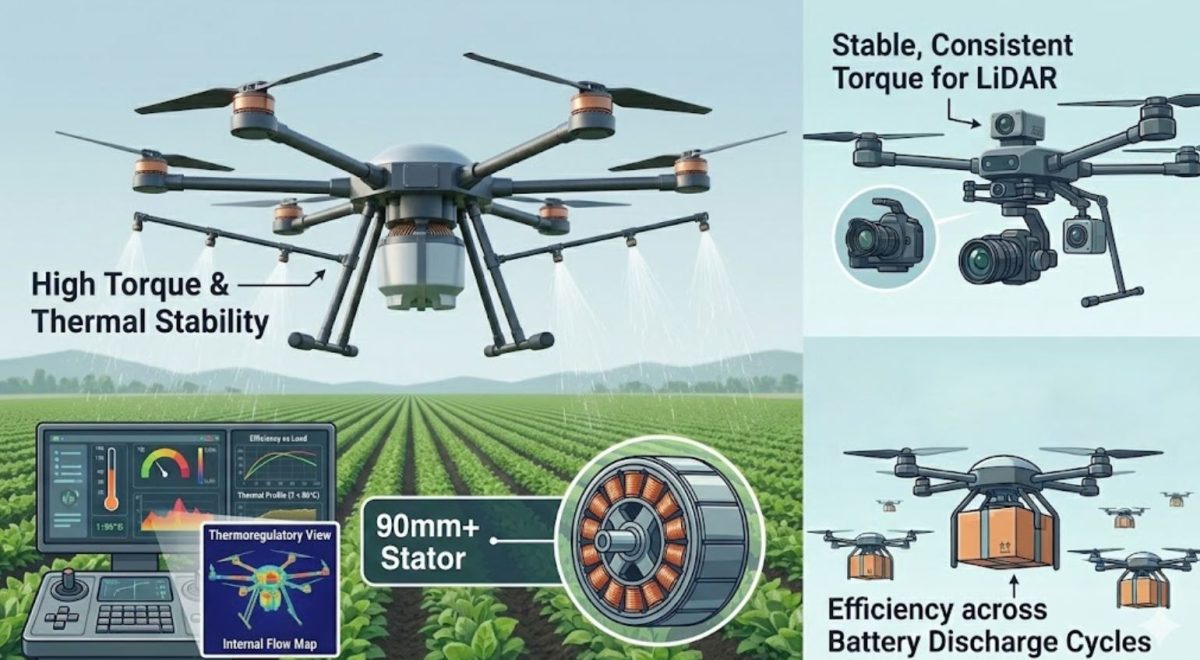
Agricultural spraying platforms are among the most demanding. These systems carry liquid tanks that shift in weight as they discharge, which means the motor needs to handle variable loads without performance degradation. High torque output and thermal stability are non-negotiable here.
Operators in the US market are increasingly deploying these platforms at commercial scale, and downtime due to motor failure translates directly into missed application windows and crop loss. For this profile, prioritize motors with copper windings rated for continuous operation above 80°C and a stator diameter of 90mm or larger.
Professional aerial imaging and LiDAR mapping represent a second major category. Cinema-grade cameras and LiDAR sensors used in infrastructure inspection or land survey can weigh several kilograms on their own. The motor in this context needs to provide stable, vibration-controlled thrust — not raw power. Smoothness and consistent torque delivery matter as much as lifting capacity, because any motor instability translates into image quality problems or sensor data corruption.
Last-mile logistics and cargo UAVs are the fastest-growing industrial segment in North America. These platforms are built around sustained, repeatable flight cycles with predictable payloads.
For procurement teams sourcing motors for this application, efficiency across the full discharge cycle of the battery is the critical variable — a motor that performs well at full charge but loses efficiency as voltage drops will shorten effective range and increase operational cost over time. Look for efficiency curves that remain above 85% across 80% of the battery discharge range, not just at peak load.

Industrial UAV Propulsion Selection Matrix
The following matrix maps each industrial use case to its recommended motor specifications:
| Application | KV Range | Prop Size | Battery | Key Priority | ESC Protocol |
| Agricultural Sprayer (10–30 kg) | 29–80 KV | 32–40 in | 12S (~44V) | Thermal stability ≥80°C, stator ≥90mm | CAN bus / Active braking |
| Cargo / Logistics (10–25 kg) | 80–150 KV | 28–36 in | 10S–12S | Efficiency >85% across full discharge | CAN / DSHOT600 |
| LiDAR / Survey (5–10 kg) | 150–250 KV | 18–26 in | 6S–10S | Torque smoothness, minimize vibration | DSHOT300–600 / Soft braking |
| Cinema / Imaging (3–8 kg) | 200–400 KV | 15–22 in | 6S–8S | Throttle linearity, smooth response | DSHOT300 / PWM |
| Infrastructure Inspection (2–6 kg) | 300–500 KV | 12–18 in | 4S–6S | Response speed, agility | DSHOT150 / PWM |
Beyond KV: How to Select a BLDC Motor for Industrial UAV
KV rating is the entry point, but it does not tell the whole story. Industrial BLDC motor selection requires looking at the full system, not just the motor in isolation.
Voltage system compatibility is one of the most overlooked factors at the procurement stage. Heavy lift motors are typically designed for 6S to 12S battery systems (roughly 22V to 50V). Sourcing a motor without confirming voltage compatibility with the existing power system architecture can mean replacing components well beyond the motor itself. This is particularly relevant when scaling a fleet or transitioning from a prototype to a production platform.
Thermal management is another area where industrial applications diverge from consumer use. A drone flying 10-minute recreational sessions will never stress a motor the way a 45-minute agricultural run will. Motors intended for sustained industrial operation need to be evaluated for their heat dissipation design — not just peak performance ratings, which are measured under controlled, short-duration test conditions.
ESC compatibility is the third critical element. The motor and the electronic speed controller must be matched not only in voltage and current rating but in communication protocol and braking behavior. Mismatches here can create instability in flight — a problem that is difficult to diagnose after integration and nearly impossible to catch at the component sourcing stage without deliberate verification.
The Cost Argument for Getting This Right the First Time
Industrial BLDC motors for heavy lift applications carry a meaningfully different price tag than consumer components. Mainstream industrial motors from established brands — units in the U8 to U13 class — typically sell in the $300 to $450 range per unit. At the ultra-heavy end, motors designed for the highest payload tiers can reach $600 to over $1,900. For teams that approach this as a commodity purchase and default to the lowest unit price without evaluating performance specifications, the downstream costs tend to be higher: replacement cycles, integration rework, and in some cases, full platform redesigns when a motor proves unsuitable at scale.
That said, the market has matured enough that engineering teams no longer have to choose between performance and cost. Comparable specifications at more accessible price points are increasingly available — which makes a thorough evaluation of the full spec sheet, rather than brand recognition alone, the more reliable procurement approach.
The more productive framing for procurement is total system cost over a defined operational period — factoring in replacement frequency, integration labor, and platform downtime — rather than unit price alone.
Closing Thoughts
Heavy lift multirotor propulsion is a specialized discipline, and the drone motor is where the performance of the entire system is either enabled or constrained. For engineering teams designing platforms and procurement managers responsible for sourcing decisions, the key is treating motor selection as a systems-level decision — one that accounts for the full operational profile of the UAV, not just the mechanical specs on a datasheet.
When KV rating, voltage compatibility, thermal performance, and ESC integration are evaluated together against a defined use case, the selection process becomes significantly more reliable — and the platforms built around those decisions perform accordingly.
 Barron McCann to use Rizikon Assurance from Crossword Cybersecurity plc to Expedite Supplier Onboarding
 Aligning the rising warehouse demand with sustainable innovation
 How Warehousing & Fulfillment Services for Amazon Impact Your Shipping Times & Customer Satisfaction?
 What is the role of a third-party logistics company?
 Image Analyzer comments on Internet Matters child livestreaming report
 Citrix Announces DataSolutions as Distributor of the Year for Northern Europe