


Why the right fixed HCl detector isn’t just a compliance purchase — it’s the difference between a near-miss and a tragedy. The answer starts with understanding what HCl gas actually does to the human body — and why warehouses are uniquely dangerous.
The Risk You Can’t See — or Feel Right Away
Picture this: a worker in a chemical warehouse notices a faint, sharp smell near a storage rack. It stings a little, but nothing serious. He finishes his shift and heads home. Six hours later, he’s in the emergency room struggling to breathe.
This is the most misunderstood danger of hydrogen chloride (HCl) gas: the warning signs are there, but they’re easy to dismiss. HCl is highly water-soluble, which means it reacts almost immediately on contact with the moisture in your nose, throat, and airways — producing burning, coughing, and tearing within minutes. The problem isn’t that symptoms are delayed. It’s that at lower concentrations, they feel manageable. A worker might notice mild irritation, assume it will pass, and keep working. Meanwhile, sustained exposure is doing cumulative damage — and at higher concentrations, pulmonary edema can develop within hours, progressing rapidly to serious respiratory failure.
At concentrations above 50 ppm, symptoms become severe enough to force most people out of a space — but not before real damage has been done. At several hundred ppm and above, rapid pulmonary edema and the risk of fatal respiratory failure become very real.
In chemical warehouses and storage facilities, this is not a hypothetical. HCl is present in countless industrial processes — from acid storage and chemical manufacturing to metal treatment and cleaning operations. Cylinders develop pinhole leaks. Pipe fittings corrode. Valves fail. And in an enclosed or semi-enclosed space, concentrations can spike from safe to dangerous in minutes.
The instinct is often to act after the fact — to treat HCl detection as a box to check for regulatory compliance. But compliance doesn’t keep workers alive. Early warning does.
What Makes Warehouses Especially Dangerous
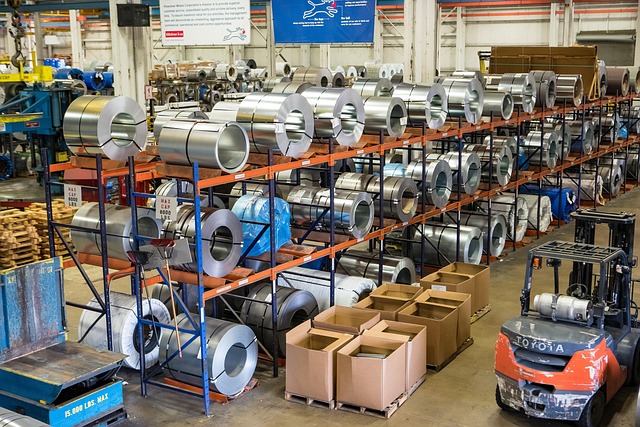
Open-air environments are forgiving. When something leaks outside, the gas disperses quickly. Warehouses don’t offer that luxury.
HCl is heavier than air, so it doesn’t float away — it sinks and accumulates along the floor, around storage pallets, and in corners where ventilation is weakest. In a room with limited airflow, a moderate leak can build dangerous concentrations before anyone notices the smell intensifying. And because HCl numbs olfactory receptors with sustained exposure, the body’s natural warning system — your nose — stops working exactly when you need it most.
Then there’s the time factor. Warehouses often run overnight with skeleton crews or no staff at all. A slow leak that starts at 11 PM may not be noticed until 6 AM, by which point the environment has become genuinely hazardous for anyone who walks in.
This is what makes a fixed HCl gas detection system not a nice-to-have, but a fundamental piece of infrastructure — equivalent in importance to fire suppression or emergency lighting.
Choosing the Right HCl Detection Technology
Not all fixed HCl gas detectors are built the same, and the differences matter more than most buyers realize. Whether you’re selecting a single wall-mounted hydrogen chloride detector for a small storage room or deploying a network of fixed HCl monitors across a large facility, the sensing technology inside the housing determines how much real protection you actually get.
Electrochemical sensors are the established standard for fixed HCl leak detection — sensitive, fast-responding, and cost-effective. Their selectivity for hydrogen chloride is well-proven, and they remain the most widely deployed technology in chemical warehouses today. The main tradeoff is lifespan: sensing elements typically need replacement every one to three years, and frequent calibration may be needed in facilities with significant temperature or humidity swings.
Infrared (NDIR) sensors offer a longer service life and better resistance to environmental variation, but carry a significantly higher upfront cost. They’re more commonly found in emissions monitoring than warehouse fixed-point detection, so if you go this route, verify the product has been specifically validated for HCl applications before committing. For most facilities, a quality electrochemical hydrochloric acid gas detector remains the reliable starting point.
One technology to avoid for standalone HCl monitoring is the photoionization detector (PID) — it lacks the selectivity to reliably distinguish HCl from other gases.
Key Specifications for Industrial Fixed HCl Gas Detectors
When evaluating detectors, a few parameters cut through the noise.
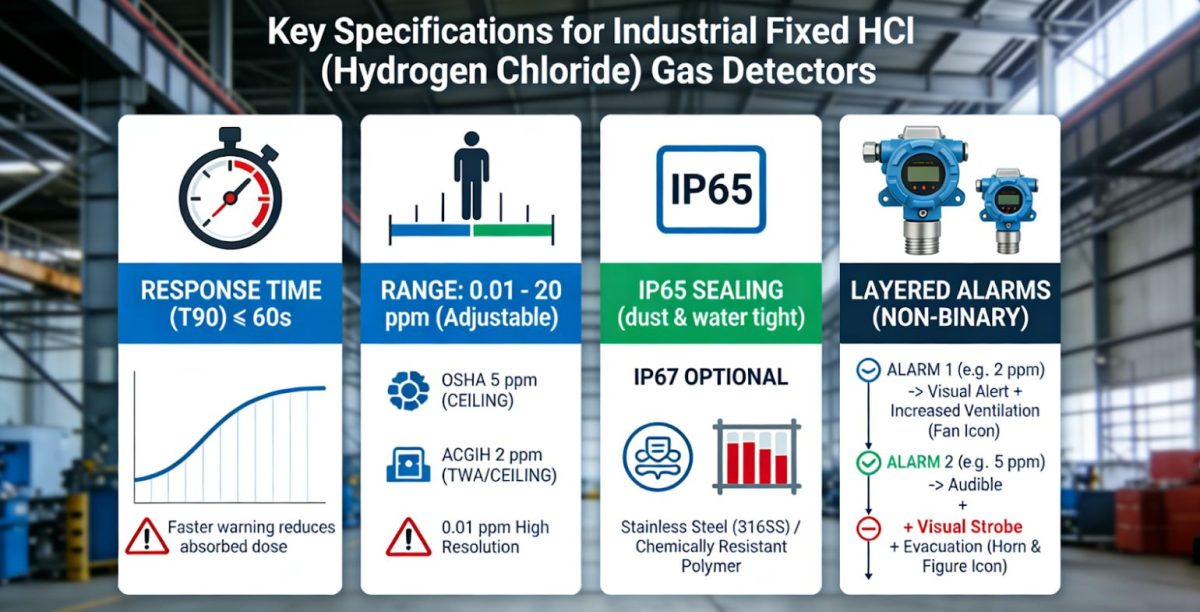
Response time is arguably the most critical. Look for a T90 value — the time it takes to reach 90% of the true reading — of 60 seconds or less; ideal models achieve ≤30 seconds for the fastest early warning. This matters because HCl-induced lung damage is dose-dependent: every additional second of exposure at elevated concentrations increases the absorbed dose. A detector that takes two minutes to fully register a leak is not protecting your workers — it’s documenting their exposure after the fact.
Detection range and sensitivity determine whether the device can catch a problem early enough to matter. The occupational exposure limits set by OSHA (5 ppm ceiling) and ACGIH (2 ppm ceiling) give you a benchmark. Your detector needs to reliably read at concentrations well below those thresholds — ideally starting from 0.5 to 1 ppm — so you’re alerted to a developing problem, not a full-blown emergency.
Enclosure rating and material are easy to overlook but impossible to ignore in a chemical warehouse. HCl doesn’t just harm people — it attacks metal, circuit boards, and sensor housings. A detector with a flimsy plastic shell or inadequate sealing will corrode from the inside out, creating a situation where the instrument silently fails right when you need it most. Look for IP65-rated housings at minimum, and in high-acid environments, prioritize units built with stainless steel or chemically resistant polymers.
Alarm configuration should give you layers, not just a single alert. A well-configured system raises a first warning at low concentrations — enough to trigger increased ventilation and a visual check — and escalates to an evacuation-level alarm if the situation worsens. Binary on/off alarms don’t give you the time or information to respond proportionally.
Finally, regardless of which technology you choose, a quarterly bump test — exposing the sensor to a known gas concentration to confirm it responds correctly — is the minimum maintenance standard for any safety-critical HCl detection system. A detector that hasn’t been verified is little better than no detector at all.
Placement: Where You Put It Is Half the Battle
Sensor placement can render an otherwise excellent fixed hydrogen chloride gas detector nearly useless.
Because HCl sinks, mounting height is critical. Primary sensors should be positioned 30 to 60 centimeters above floor level, near the most likely leak sources — valve connections, cylinder storage racks, pipe joints, and fill stations. A secondary sensor at breathing height (around 1.5 meters) adds coverage for the zone where workers actually inhale.
High-traffic entry points and ventilation system inlets also deserve attention. A sensor near an air intake can catch contamination before it spreads through the facility. Exit pathways need coverage so evacuating workers aren’t walking through the worst of a plume.
One practical guideline: as a starting point, plan one detection point per 200 to 300 square meters of enclosed floor space, with additional sensors clustered around high-risk storage zones. Denser coverage near hazard sources is almost always worth it.
The Broader Picture
Choosing a fixed HCl gas detector shouldn’t feel like flipping through a product catalogue looking for the cheapest option that meets minimum specs. It’s a decision that lives downstream of a very real question: what happens to your people if there’s a leak tonight and nothing catches it?
The technology exists to detect HCl at concentrations low enough to prevent any serious harm — before the delayed pulmonary edema window even opens. That’s an extraordinary capability when you think about it. The detectors aren’t just measuring a gas; they’re compressing the warning timeline in a way that human senses simply cannot match.
When it comes to actual selection, it helps to benchmark against products that meet the criteria outlined above. As one example, wall-mounted and pump-suction models such as Gas Dog‘s GD300-HCL and GD700-HCL offer electrochemical sensing with 0.01 ppm resolution, corrosion-resistant die-cast aluminum housings, adjustable sound-and-light alarm setpoints, and ATEX certification — features that support 24-hour continuous monitoring in chemical warehouse environments. That said, the right choice ultimately depends on your specific conditions: corrosion level, spatial layout, budget, and how different units perform in side-by-side evaluation with other suppliers.
For chemical warehouses and storage facilities, that’s not a feature. It’s the entire point.
FAQ: HCl Gas Detector Selection
What is the best HCl sensor for warehouse use?
For most chemical warehouses, an electrochemical fixed HCl monitor is the most practical choice. It offers proven selectivity for hydrogen chloride, fast response times, and a lower total cost of ownership. NDIR sensors are worth considering for facilities with extreme corrosion or very high uptime requirements, but verify that the product is specifically validated for HCl fixed-point detection — not just emissions monitoring.
Where should I install a hydrochloric acid gas detector in a storage facility?
Because HCl is heavier than air, primary sensors should be mounted 30 to 60 cm above floor level near likely leak sources such as cylinder racks, valve connections, and pipe joints. A secondary sensor at breathing height (around 1.5 m) provides additional coverage for occupied zones.
How often should I test my fixed HCl monitor for corrosive environments?
A quarterly bump test — exposing the sensor to a known concentration of HCl to verify it responds correctly — is the recommended minimum for safety-critical applications. Sensors should also be recalibrated according to the manufacturer’s schedule, typically every three to six months depending on the environment.
 How IoT is Changing the Waste Water Industry
 Steps to Take Before Negotiating with an Insurance Adjuster
 NEW EUROPEAN DATACENTRE SURVEY HIGHLIGHTS KEY INDUSTRY ISSUES
 Season of love: Igniting the spark in retail for Valentine’s Day
 Want To Start Selling Online? Follow These Tips For Higher Profits
 The Evolution of the Raid: Reading World of Warcraft’s Greatest Challenges