


Today’s global trade operates less on the movement of containers and more on the constant, high-speed exchange of sensitive information. While logistics executives have traditionally focused their risk management on tangible disruptions, such as labor strikes, fluctuating energy costs, or port bottlenecks, the most persistent threat now resides within the communication infrastructure itself.
Specifically, email spoofing and Business Email Compromise (BEC) have evolved into the primary disruptors of supply chain reliability, bypassing physical security to strike at the heart of corporate trust.
As procurement processes shift toward full automation and digital-first workflows, the reliance on unverified email remains a critical strategic blind spot. Without a rigorous authentication framework and a correctly configured DMARC Record, organizations are effectively leaving their financial transactions and vendor relationships exposed to sophisticated impersonation tactics.
In an industry where timing and precision are everything, failing to secure the identity of the sender is an operational risk that can halt production lines and compromise the entire partnership ecosystem before a single physical asset is even moved.
How Spoofing Decimates Trust
At its core, email spoofing is a form of digital identity theft. An attacker masquerades as a trusted vendor, a shipping partner, or a high-level executive by manipulating email headers to make a message appear legitimate. In the context of a supply chain, where thousands of invoices and wire transfer requests are processed daily, the results are catastrophic.
The Federal Bureau of Investigation (FBI), in its Internet Crime Report, has consistently identified Business Email Compromise as one of the costliest cybercrimes globally. For the supply chain sector, the threat is amplified.
An attacker doesn’t need to breach a high-security server; they simply need to send a spoofed email from a “partner” domain, asking to update bank account details for an upcoming shipment. Because the communication looks familiar, the psychological barrier of skepticism is lowered, and the fraudulent payment is authorized.
The Role of DMARC
To combat this, the industry is turning to a standardized authentication framework. While most logistics firms are familiar with SPF (Sender Policy Framework) and DKIM (DomainKeys Identified Mail), these tools are often insufficient on their own. The missing piece of the puzzle is having a DMARC Record.
DMARC is a policy layer that allows a domain owner to specify what to do if an email fails authentication. In a supply chain, DMARC acts as a digital seal of authenticity. If a vendor has a “p=reject” policy in place, any spoofed email claiming to be from that vendor is automatically blocked by the recipient’s server before it ever reaches the procurement officer’s inbox.
Why Is the Supply Chain a Target?
Cybercriminals target supply chains specifically because of their inherent complexity. A single manufacturer may deal with hundreds of third-party logistics providers, raw material suppliers, and distributors. Each of these links represents a potential point of failure.
A report by Verizon in its Data Breach Investigations Report (DBIR) highlights that social engineering, of which spoofing is a primary tactic, accounts for a vast majority of breaches in the industrial and transportation sectors.
The “Just-in-Time” (JIT) delivery model further exacerbates this risk. When managers are under extreme pressure to clear shipments and avoid production line stoppages, they are more likely to bypass traditional verification steps, making them easy prey for a well-timed spoofed email.
The Reputation Trap
While the immediate financial impact of a diverted payment is significant, the long-term damage to supply chain integrity is even more severe. Trust is the currency of logistics. If a Tier 1 supplier is found to have a “leaky” domain that allows attackers to spoof their identity, their partners may view them as a high-risk liability.
Implementing a “Zero Trust” Email Strategy
The solution requires a shift toward a “Zero Trust” architecture in communications. Supply chain leaders must move beyond the assumption that an email is safe just because the “From” field looks familiar.
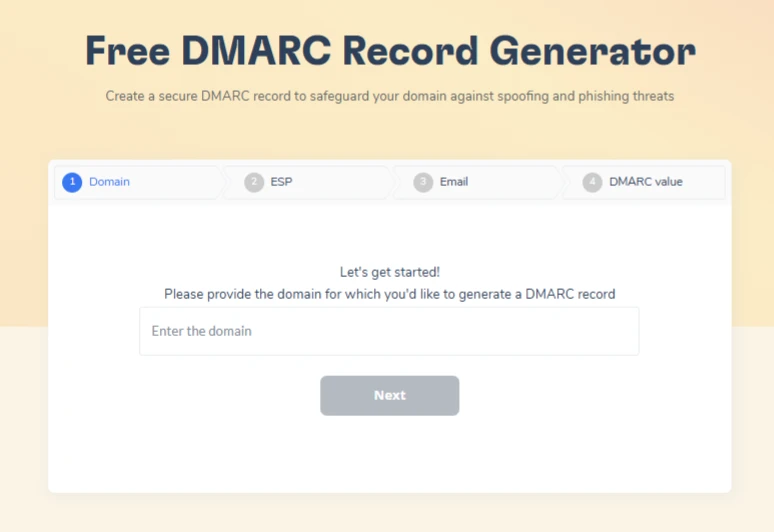
- Mandatory Authentication: Companies must require all vendors to implement SPF, DKIM, and DMARC. To simplify compliance, partners can use a free DMARC generator tool like the one from Warmy.io to secure their domains without added costs.
- Continuous Monitoring: DMARC provides reporting features that allow organizations to see who is attempting to send mail on their behalf, offering a “radar” for potential spoofing campaigns.
- Strict Enforcement: Moving toward a “Reject” policy ensures that unauthorized mail is never delivered, removing the possibility of human error.
Conclusion:
Even as the supply chain modernizes with AI-driven logistics and blockchain-based tracking, the fundamental vulnerability remains: the humble email. Global trade depends on the certainty that digital instructions, whether a change in shipping route or a million-dollar invoice, are authentic.
Email spoofing is the top threat because it exploits the most basic human instinct: trust. By prioritizing having a DMARC Record and robust authentication, supply chain leaders can fortify their digital borders and ensure that the weakest link in their network is not an open door to cybercrime.
 Why it is important to embrace a diverse cloud strategy
 Enhancing network infrastructure for better iGaming experiences
 Artificial Intelligence in retail – how will you apply it for the best outcome?
 Building Strong Teams in the Supply Chain: The Role of Collaboration and Engagement
 Holmen selects TimberTec, an Iptor company, as its SaaS-based timber ERP partner
 February U.S. Container Imports Post Seasonal Decline as Geopolitical Risks Intensify