


**This post is sponsored by Semrush. When you purchase through links in this article, we may earn an affiliate commission from Semrush.**
If you already rely on AI tools like ChatGPT, Claude, or coding assistants for research and analysis, there is now a way to make those conversations much more practical. Instead of relying on general explanations or estimates, you can connect your AI tools directly to real marketing data and turn them into research assistants that work with live insights. That is the idea behind the new Semrush MCP feature. If you want to see how AI conversations can move from brainstorming to real analysis, exploring Semrush One is a good place to begin.
AI has quickly become part of how people explore ideas and solve problems. In marketing, it is often the first place someone goes when trying to understand a new topic, plan content, or analyze competitors. Developers and analysts use it in a similar way. The conversational format makes it easy to ask questions, test assumptions, and work through ideas quickly.
But anyone who has used AI tools regularly knows there is still a limitation. AI can explain strategies well, yet it often lacks direct access to current data. When the conversation turns to keyword performance, competitor traffic, or backlink analysis, the answers tend to rely on patterns rather than real numbers.
Because of that, many teams still move back and forth between different tools. They might start by asking an AI assistant about keyword opportunities, then open an SEO platform to verify the data, and then return to the conversation to continue planning. The process works, but it breaks concentration and slows down the workflow.
Semrush MCP was designed to remove that friction.
MCP stands for Model Context Protocol. In simple terms, it allows AI tools to connect securely to external data sources so they can retrieve real information while responding to questions. Instead of relying only on their training data, AI systems can request live insights from connected platforms.
With the Semrush MCP server, those insights come directly from Semrush through its public APIs. This means AI tools can access reliable data about keywords, websites, backlinks, and competitors while the conversation is happening.
The practical result is that AI chats become far more useful. Instead of asking an assistant to estimate keyword opportunities or guess how a competitor is performing, users can see responses supported by actual metrics from the Semrush database.
This changes the nature of the conversation. Instead of using AI only for brainstorming, people can use it as part of their research process. A marketer can ask about keyword trends, explore competitive landscapes, or evaluate content ideas while seeing real data that supports those discussions.
Another reason the feature works well is that it fits into tools people already use. Semrush MCP can integrate with several AI environments, including Claude in both browser and desktop versions, Claude Code, Cursor, VS Code, and ChatGPT. Many professionals already rely on these tools throughout the day, so connecting them to Semrush data simply strengthens the workflow they already have.
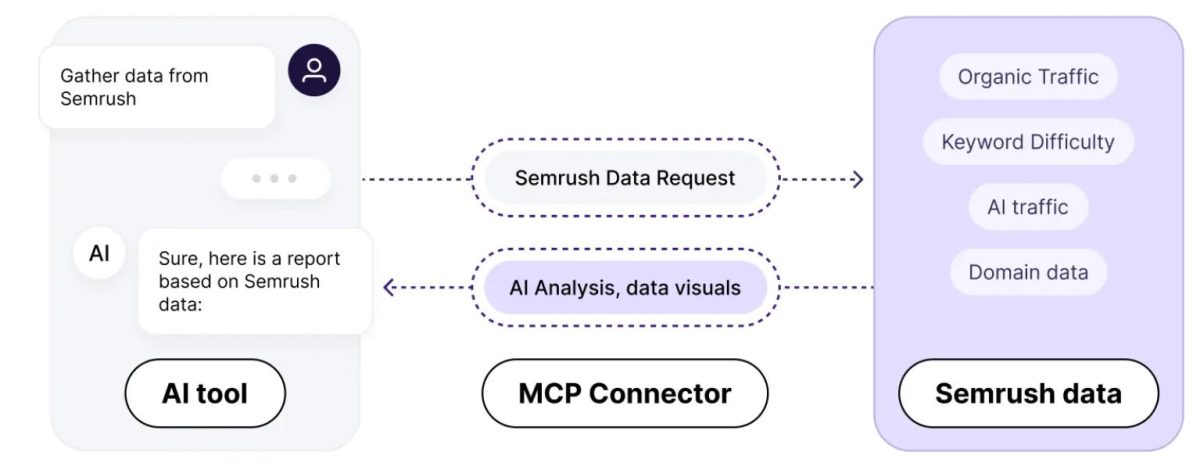
Once the connection is in place, the process of research becomes smoother. A user can ask an AI assistant to analyze a website’s performance, review keyword changes, or identify possible growth opportunities. Because the assistant can retrieve Semrush data through APIs, the answers are grounded in real insights rather than general suggestions.
This is especially useful for monitoring tasks that normally require checking several dashboards. For example, an AI agent can scan keyword rankings and backlink data on a regular basis and highlight meaningful changes. If a ranking drops unexpectedly or a new keyword opportunity appears, the system can point it out quickly.
Competitor monitoring also becomes easier. AI tools connected to Semrush can follow traffic patterns and notify users when competitor performance shifts. Those signals can help teams respond faster and adjust their strategies before trends become obvious.
Reporting is another area where the integration can save time. Many marketing teams spend hours building monthly performance reports by collecting data from different platforms. With Semrush MCP, an AI assistant can retrieve traffic insights, keyword updates, and performance summaries directly from Semrush and organize them into clear reports.
Those summaries can then be shared in collaboration tools like Google Docs or Notion, allowing teams to review and discuss results more easily. Instead of manually copying metrics from different dashboards, the data is already organized and ready to analyze.
Developers and analysts can also use the connection to bring Semrush insights into internal dashboards, reporting tools, or analytics environments. Because the integration works through APIs, the data can flow into existing systems without requiring complicated custom builds.
One of the reasons this feature is appealing is that it does not introduce another platform to manage. Access to the Semrush MCP server is already included in all subscription options of Semrush One and SEO Toolkit. Users can begin integrating their AI tools without purchasing additional add ons or setting up complex infrastructure.
That makes it easier to view the feature as a workflow improvement rather than a technical upgrade. The tools people already rely on simply become more capable because they can now work with real marketing data.
If you are curious about how the setup works, there is a short walkthrough that demonstrates the process. See how it works with OpenAI in this quick setup video: Video Link. The below screenshots will guide you through the steps required to connect AI tools to Semrush data so you can see how the integration works in practice.

AI tools are quickly becoming a central part of how teams explore ideas, plan strategies, and analyze information. When those conversations are supported by reliable data sources, they become far more valuable for real decision making.
If you want to turn AI chats into practical research tools and reduce the need to switch between multiple platforms, exploring Semrush One is a practical next step. It brings together trusted Semrush insights and modern AI workflows so research, analysis, and strategy can happen naturally in one place.
 Infor Hospitality Expands Partnership with Oliver Hospitality
 Neptune Energy Partners with TCS to Become an Insights-Driven, Cloud-First Organization
 How to Pay Taxes as an American Expat
 Umbraco users rank open-source CMS provider among G2’s top 20 Best Software Companies in EMEA 2024
 Cloud Security Under Fire: Why CNAPP Becomes Essential
 Dataiku’s No-Code Cloud Stack Accelerator Is Now Available on AWS