


Reliable power ends where the grid does. For field teams operating on construction sites, remote inspection routes, and disaster response zones, the gap between utility infrastructure and the actual worksite is a persistent operational constraint. The portable power station has become one of the most practical answers to this problem.
This article examines why last-mile power matters in professional field operations, how battery-based units compare to conventional generators, and what operations teams should assess when selecting mobile power infrastructure for sustained deployment.
The Last-Mile Power Gap
In field operations, “last-mile power” refers to the challenge of supplying electricity where grid infrastructure simply doesn’t reach. The scope is broad: telecommunications maintenance, pipeline inspection, environmental surveying, precision agriculture, and emergency response all place teams well beyond any fixed power source.
As projects push further into remote terrain, this gap has shifted from a manageable inconvenience into a genuine operational bottleneck—one that affects project timelines, equipment uptime, and the safety margins that field teams depend on.
Why Conventional Generators Fall Short
Diesel and gas generators have served field teams for decades, and in high-continuous-load scenarios—large lighting arrays, industrial compressors, welding operations—they remain a practical option. But the trade-offs have grown harder to justify as field deployments become faster-moving and more regulation-sensitive.
Fuel Supply and Maintenance Overhead
Every generator deployment involves a fuel supply chain: transport planning, on-site storage, and scheduled refueling. On extended remote assignments, fuel logistics can demand as much coordination as the job itself. Engine maintenance intervals—oil changes, filter replacements—add recurring overhead that compresses field scheduling flexibility.
Noise Restrictions and Indoor Limitations
Battery-based portable power stations produce zero exhaust and operate at low noise levels, which matters as site restrictions tighten. Many indoor jobs, hospital campuses, and residential-adjacent worksites carry emissions or noise policies that limit combustion-engine use on site. Protected natural areas often enforce time-based or zone-specific generator restrictions under local management plans.
What Modern Portable Power Stations Deliver
Battery technology, inverter design, and charge management have advanced considerably in recent years. Today’s commercial-grade portable power stations address a growing share of field scenarios that once required a generator—without fuel dependency, exhaust output, or routine mechanical servicing.
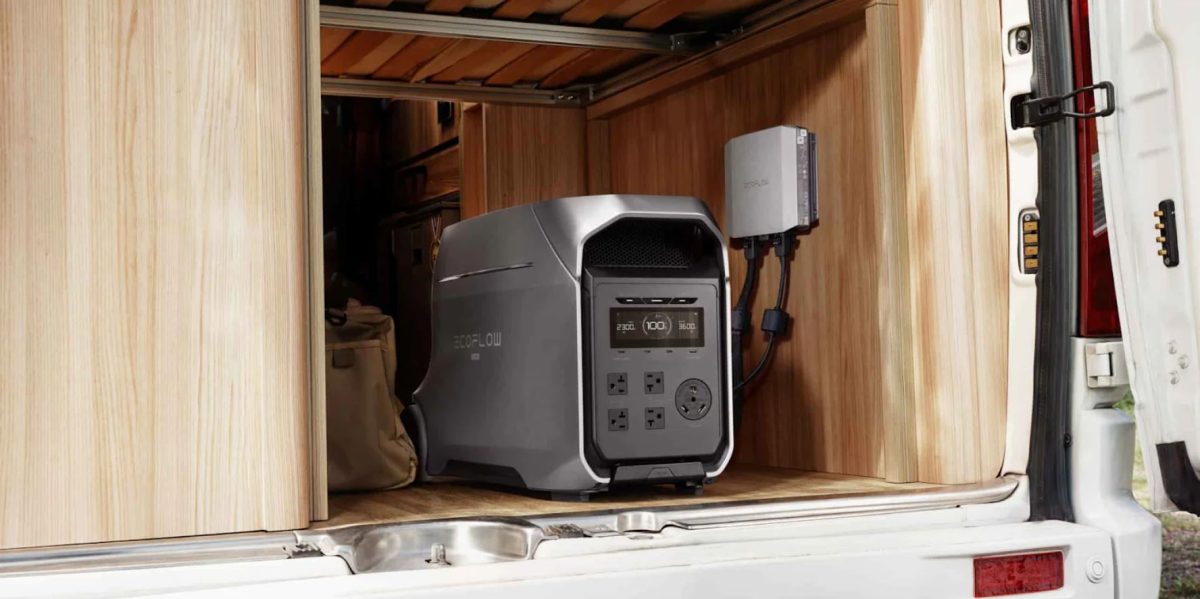
Output and Capacity
Commercial units now span a wide range—from sub-500Wh options suited to light equipment to systems exceeding 6,000Wh capable of running power tools, HVAC, and communication gear concurrently. The EcoFlow DELTA 3 Max Plus, for instance, offers 2,048Wh of capacity with a rated 3,000W AC output and a 6,000W surge rating.
Recharge Speed and Input Flexibility
Charge speed has improved substantially across the category. Several current models support AC fast charging capable of reaching 80% from near-empty in under 90 minutes. Most field-grade units also accept solar, vehicle, and generator input as alternative recharge sources—whether multiple input types can operate simultaneously depends on the specific model and configuration.
App-Based Load Control
Newer platforms include companion apps that let operations managers monitor battery state, configure output priority settings, and track consumption remotely. For teams deploying multiple portable power stations across different sites, this visibility supports better shift planning and reduces the risk of unplanned equipment downtime during critical work windows.
Where Field Teams Are Using Them
Battery-based field power has moved past proof-of-concept into standard practice across several industries. The two sectors below represent areas where the shift away from generator dependency has had the clearest operational impact for deployed teams.
Construction and Infrastructure Projects
Field crews operating laser levels, rotary hammers, concrete compactors, and portable lighting have historically depended on gas-powered sources. Portable power stations with high surge ratings now support these tools while eliminating exhaust in enclosed or partially enclosed environments—a meaningful advantage on mixed-use and urban worksites.
Three tool categories have seen the widest adoption of battery field power on active construction sites:
- Rotary and demolition tools (circular saws, SDS drills, angle grinders)
- Survey and measurement instruments (total stations, GPS base units, data loggers)
- Communication and safety devices (two-way radios, portable lighting systems, emergency equipment)
Emergency Response and Utility Inspection
Emergency management teams need reliable power for communication arrays, medical devices, and lighting—often in situations where establishing fuel logistics is not feasible. A portable power station’s silent, emission-free operation also eliminates interference risks for acoustic sensors and sound-sensitive diagnostic instruments used by utility inspection crews in the field.
How the Main Brands Compare
The portable power station market has become significantly more competitive. The table below reflects current publicly available specifications for standalone portable models; expandable home storage and ESS systems are excluded from the ranges listed.
| Brand | Portable Lineup Range | Key Strength |
| EcoFlow | ~256Wh–6,144Wh | High AC output, fast charge speed |
| Jackery | ~99Wh–5,040Wh | Intuitive operation, wide retail presence |
| Bluetti | ~128Wh–3,840Wh | Long LFP cycle ratings, broad accessory ecosystem |
| Goal Zero | ~187Wh–3,994Wh | Rugged build, established solar ecosystem |
| Anker SOLIX | ~192Wh–3,840Wh | Compact high-output designs, strong cost-per-watt |
Selecting the Right Unit for Field Use
Not every portable power station is built for professional deployment. Consumer-grade and field-grade units can look similar on specification sheets but differ substantially in build tolerance, cycle life, and the ecosystem support that matters most during sustained field use.
Battery Chemistry and Cycle Life
The two dominant chemistries in field-grade units are lithium iron phosphate (LFP) and lithium nickel manganese cobalt oxide (NMC). NMC typically offers higher energy density, while LFP generally provides better thermal stability, longer rated cycle life, and often advantages at the cell-material cost level—making it the lower-risk choice for equipment rotating frequently through field deployment.
Expandability and Platform Support
Some platforms support expansion modules that extend runtime without requiring entirely new hardware purchases—a practical advantage as project scope grows. App stability, firmware update cadence, and accessory availability all factor into long-term ownership costs but are harder to evaluate at purchase time than raw capacity figures.
Before committing a portable power station to a field program, operations teams should verify four deployment essentials:
- Peak wattage draw of the highest-load device in the deployment kit
- Daily runtime requirements and available recharge options on site (AC, solar, vehicle)
- Unit weight relative to transport and handling constraints in the field
- Warranty terms, particularly for cycle degradation coverage and replacement response
The Bottom Line
Battery-based field power technology has matured to a point where it can replace generators across a meaningful portion of professional deployment scenarios. Fuel-free operation, fast recharge, modular expansion, and remote monitoring give operations teams a practical basis for rethinking how field power infrastructure is planned and scaled.
For teams weighting recharge speed and high AC output as primary deployment requirements, EcoFlow is among the stronger options currently available—though the right choice ultimately depends on load profile, weight tolerance, and budget.
 The technologies powering high-performing logistics
 Sage announces new product integrations with Microsoft to make life easier for SMBs
 Qlik Expands Insight Advisor To Deliver Industry’s Most Robust AI-Driven Cloud Analytics Experience
 Tech Solutions Shaping Stronger Emotional and Cognitive Health
 Protecting sensitive data from cyber criminals requires AI-driven tools
 What Is Freight Factoring? The Ultimate Guide