


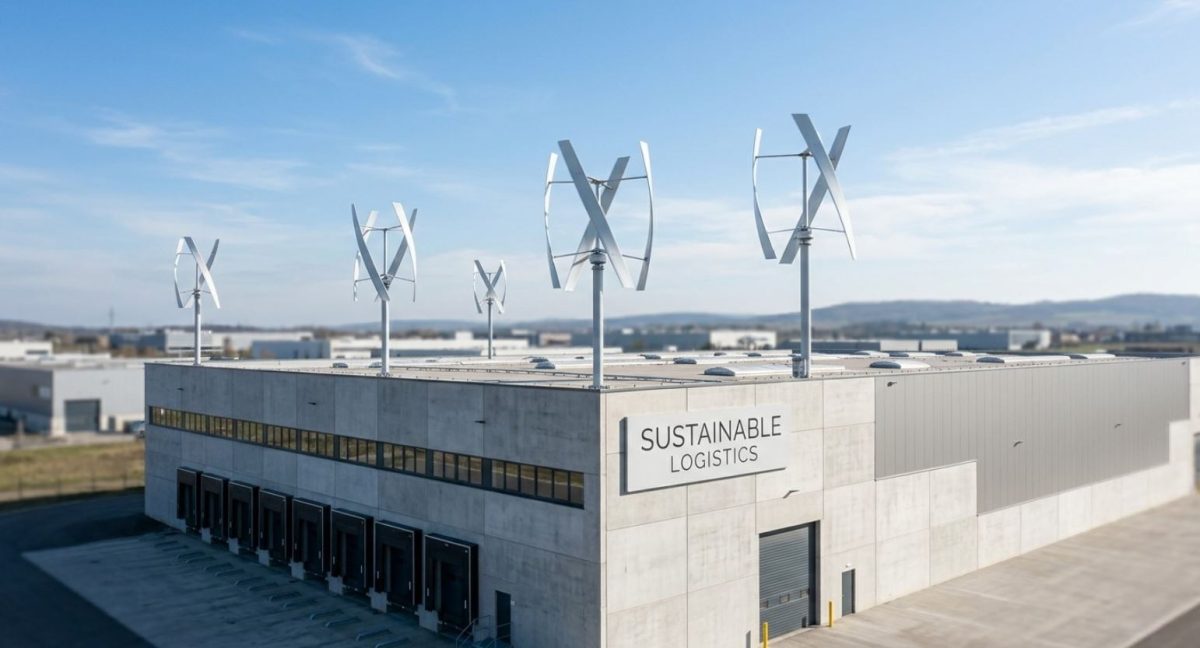
For logistics and warehousing operators across North America and Europe, on-site renewable generation has shifted from a “nice to have” to a boardroom priority — and vertical axis wind turbines (VAWTs) are increasingly part of that conversation.
But not every turbine suits every site. Before your facility commits capital to a rooftop or perimeter installation, here’s what you actually need to know in 2026.
What Makes VAWTs Different — and Why Logistics Sites Care
A conventional horizontal axis wind turbine (HAWT) needs to face directly into the wind to work efficiently. That’s fine on a hilltop, but it’s a liability in a logistics park where buildings, trailers, and loading canopies constantly redirect airflow.
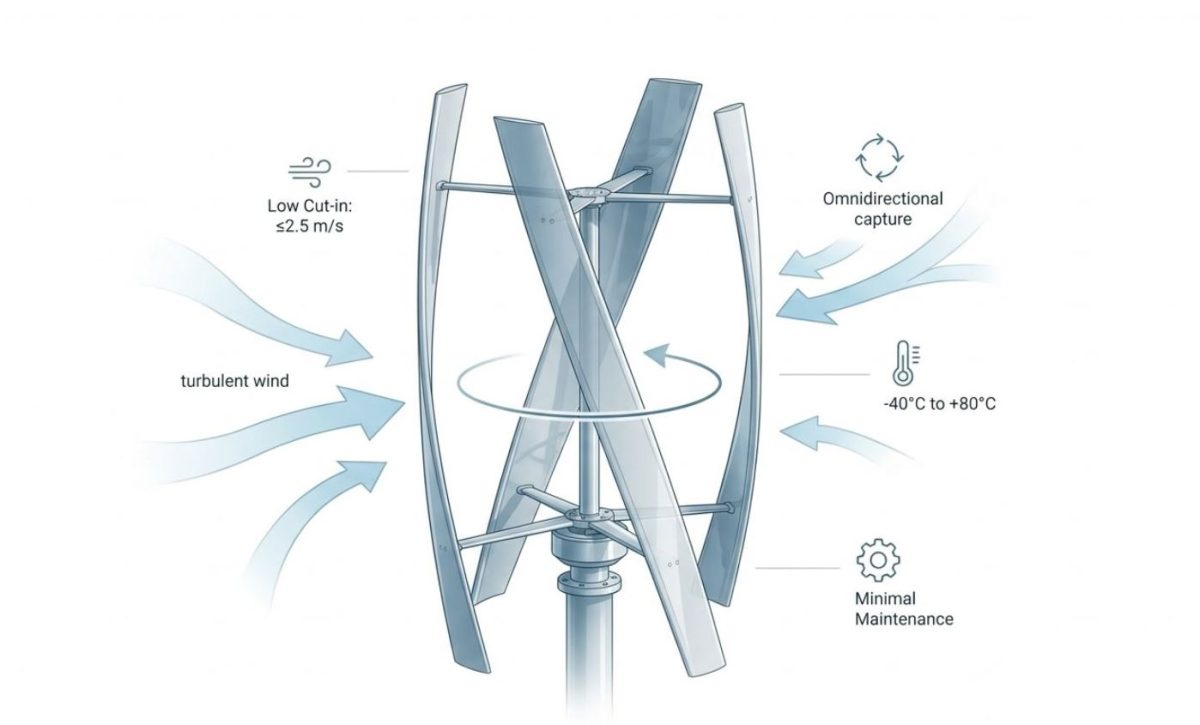
VAWTs — whether the egg-beater-shaped Darrieus type or the paddle-driven Savonius design — capture wind from any direction. That omnidirectionality matters enormously in built environments, where turbulent, multi-directional gusts are the norm rather than the exception.
The honest trade-off: vertical axis wind turbines typically deliver a power coefficient (Cp) of 0.20–0.30, compared to 0.40–0.50 for well-sited HAWTs. They generate less energy per unit of swept area. What they offer instead is reliable, lower-maintenance performance in exactly the kind of irregular airflow that warehousing environments produce.
For a 500,000 sq ft distribution center in an industrial park, deploying an array of vertical axis wind turbines is often the better engineering bargain.
VAWT vs. Solar: Which Makes More Sense?
For most logistics sites, the honest answer is both — they serve different roles. Solar PV delivers more energy per dollar in high-irradiance conditions, but output drops to zero at night and underperforms in winter. Wind fills those gaps, making a hybrid solar-wind system with battery storage more consistent and resilient than either technology alone.
Where VAWT has a clear edge: northern climates, coastal sites, facilities where roof space is already committed to solar or HVAC, and off-grid backup applications that can’t depend on daylight.
4 Site Selection Factors That Determine Success
1. Roof Structural Integrity
VAWTs distribute load differently than solar panels. A rooftop array must account for dynamic loading — vibration under high wind, torque on mounting points, and the cumulative stress of a 20-year operational lifespan. Before any installation, commission a structural assessment. Compact vertical axis wind turbines in the 500W–5kW range are significantly lighter than industrial-scale turbines — many aluminum-frame units weigh under 80 kg — but dynamic loading from vibration and torque still requires professional structural sign-off. Confirm your roof deck and parapet walls can handle both dead load and live wind load simultaneously.
2. The “Canyon Effect” — a Hidden Advantage
Groups of large warehouses create corridor-like gaps between buildings that accelerate wind flow. Studies of industrial park microclimates suggest this effect can boost VAWT output by 10–30% compared to open-field estimates. However, the same effect increases mechanical fatigue on blades and bearings. Request site-specific wind resource assessments — not generic regional data — and ensure the turbine’s structural rating accounts for gusts, not just mean wind speeds.
3. Grid Integration and Microgrid Readiness
A turbine that simply feeds surplus power back to the grid is a 2018 solution. In 2026, the more valuable configuration is grid-tied with battery storage and microgrid capability — allowing the facility to island during outages, time-shift generation to peak tariff periods, and participate in demand response programs. Confirm that the inverter and control system are compatible with IEEE 1547-2018 standards and your utility’s interconnection requirements before purchase.
4. Cut-In Wind Speed
Some advanced magnetic levitation designs genuinely achieve 1.5–2.0 m/s startup — a meaningful advantage for low-wind industrial sites. However, “cut-in” only means the rotor begins turning; useful power generation starts somewhat higher. For sites averaging below 4 m/s, ask for a full power curve across the 1–12 m/s range — it matters far more than the headline rated output.
Technical Specifications: 2026 Benchmark Standards
When comparing products, use this as your baseline checklist:
| Specification | 2026 Benchmark | What to Look For |
| Cut-in wind speed | ≤ 2.5 m/s | Maglev designs can reach 1.5–2.0 m/s |
| Rated wind speed | 10–13 m/s | Matched to your site’s mean wind speed |
| Survival wind speed | ≥ 45 m/s | Critical for rooftop exposure |
| Operating temperature | -40°C to +80°C | Essential for northern climates and desert logistics parks |
| Voltage options | 12V / 24V / 48V / 96V / 120V / 220V | Multi-voltage flexibility reduces inverter complexity |
| Blade material | Aluminum alloy or fiberglass composite | Corrosion-resistant; UV-stabilized |
| Brake system | Electromagnetic + automatic windward regulation | Protects generator in storm conditions |
| Noise output at 10m | ≤ 55 dB(A) at rated speed | Verify — not just claimed |
A note on voltage selection: For warehousing applications, 48V or 96V systems offer the best balance between cable run efficiency and compatibility with commercial battery storage. 12V/24V units suit smaller off-grid loads like yard lighting or forklift charging stations. The 120V/220V AC-output class (typically 5kW) integrates most directly with standard facility electrical infrastructure and is the natural choice for grid-tied installations.
For port and coastal logistics facilities, prioritize corrosion-resistant aluminum housings and plastic-spray-coated blades — ask suppliers for explicit environmental ratings, not just generic “weatherproof” claims.
Three Configurations That Work in Warehousing
Option A — Rooftop Array (Large Distribution Centers) Multiple 1kW–5kW units arranged across a flat or low-pitch roof, feeding a shared inverter system. A 5kW unit at 120V/220V output connects directly to facility electrical infrastructure with minimal additional hardware. A cluster of four 1kW units achieves similar capacity with more installation flexibility and lower per-unit structural loading. Best for facilities with consistent wind exposure and solid roof structure.
Option B — Perimeter Integration (Yard Infrastructure) Compact 300W–600W vertical axis wind turbines mounted on light poles or perimeter structures, powering LED yard lighting and EV/forklift charging stations at 24V or 48V. Lower structural risk than rooftop installation and simpler permitting. Increasingly practical as logistics operators electrify ground fleets and need distributed charging that doesn’t draw entirely from the main grid connection.
Option C — Off-Grid Emergency Backup (Cold Chain and Pharmaceutical) A standalone 2kW–5kW vertical axis wind turbine paired with battery storage and a backup generator provides temperature control redundancy for cold storage facilities — critical where a grid outage means spoiled product. The wide operating temperature range of quality units (-40°C to 80°C) makes them suitable for both arctic warehouse clusters and desert logistics hubs.
Power Home‘s VAWT range spans 300W to 5kW, covering all three configurations above. Units feature three-phase permanent magnet generators with magnetic levitation, electromagnetic braking, and an operating range of -40°C to 80°C. The 5kW model supports 120V/220V output for direct grid-tied integration; compact 300W–600W units operate at 24V/48V for perimeter and off-grid applications.
Calculating ROI: A Realistic Framework
The payback period on a vertical axis wind turbine installation depends on four variables: local wind resource, grid electricity price, available incentives, and whether carbon credits apply to your ESG program.
Simplified formula:
Payback (years) = Total Installed Cost ÷ (Annual kWh Generated × Grid Tariff + Annual Carbon Credit Value)
A 5kW unit (turbine ~$13,000–$14,000, fully installed ~$18,000–$22,000) generating 12,000–15,000 kWh/year at $0.12/kWh yields a payback of 8–13 years before incentives, or 6–9 years after applying the IRA Investment Tax Credit. Smaller perimeter configurations (four 600W units at ~$2,300 each) carry lower upfront cost and faster payback on targeted yard loads.
Sensitivity note: A ±20% variance in actual vs. projected wind speed can shift payback by 2–3 years in either direction. Treat the wind resource assessment as the single most important input in your business case.
Maintenance and Monitoring in 2026
VAWTs have fewer moving parts than HAWTs and no yaw mechanism to maintain. Three-phase permanent magnet generators with magnetic levitation reduce friction losses and extend bearing intervals — a genuine advantage in facilities without on-site technical staff. Modern units support IoT condition monitoring, with predictive alerts flagging bearing wear or blade imbalance typically 3–6 months before failure.
Common maintenance requirements:
- Bearing inspection and lubrication: Annual (more frequent in dusty or coastal environments; maglev designs extend intervals)
- Blade inspection: Bi-annual visual inspection of aluminum or composite blades; clean salt/dust accumulation as needed
- Electromagnetic brake system: Annual function test; verify automatic shutdown activates correctly at rated overspeed
- Electrical connections: Annual check; torque fasteners to specification; inspect plastic-spray coating on coastal installations
- Cold climate units: Confirm the unit’s rated operating range covers your winter low; most quality units operate to -40°C without additional heating
Bottom Line
VAWTs are a practical, increasingly cost-effective on-site generation option for logistics and warehousing operators — particularly where turbulent airflow, structural constraints, or noise requirements make horizontal axis turbines impractical.
They won’t replace your grid connection. But paired with battery storage and a credible energy management strategy, they can meaningfully reduce peak demand charges, improve ESG metrics, and add resilience to critical cold-chain or high-availability operations.
Do the wind resource assessment first. Build a conservative business case. Then buy the turbine that fits your site — not the one with the most impressive brochure.
 How Niche Consumer Products Are Reshaping Modern Supply Chains
 Intermodal Europe 2018
 The affordability gap in Britain’s broadband market
 Tomorrow’s ONS Retail stats: Businesses mustn’t try to coast through
 Aera Decision Cloud™ Empowers Front-Line Teams, Delivers AI ROI for Supply Chains
 Online shopping has changed logistics forever