


The global supply chain landscape was reshaped on February 20, 2026, following a landmark 6–3 U.S. Supreme Court ruling.
The Court determined that the International Emergency Economic Powers Act (IEEPA) does not authorize the Executive Branch to impose independent tariffs—invalidating billions of dollars in duties collected since February 2025.
For the IT, electronics, and semiconductor sectors—industries heavily reliant on complex international sourcing—the financial implications are massive.
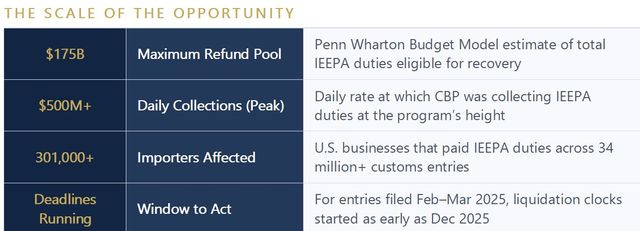
While Customs and Border Protection (CBP) estimates the refund pool at $130 billion, Penn Wharton’s Budget Model suggests the total exposure for U.S. importers could reach **$175 billion**.
The Recovery Gap: Why Automation Isn’t Automatic
Despite the legal victory, there is no automatic “check in the mail” for the 301,000+ U.S. importers affected. For IT supply chain managers who navigated 2025’s volatile tariff environment, the path to recouping these costs is procedural, time-sensitive, and data-heavy.
“The Supreme Court clarified that these tariffs were unlawfully collected, but the government will not cut a single check automatically,” warns David King, Deputy CEO of Occams Advisory, a leading firm helping businesses navigate the recovery. “For electronics importers who moved millions of units across 34 million entries, the clock is running on filing deadlines that could lead to a total forfeit of funds.”
A Four-Pillar Recovery Framework for Tech Importers
To manage the complexity of this “refund recession,” a new four-pillar recovery platform has emerged, blending AI technology with trade litigation and tax advisory:
1. AI-Powered Data Quantification
The primary hurdle for high-volume electronics importers is granular data. Identifying IEEPA exposure requires mapping entry summaries, HTS codes, and liquidation statuses.
- The Solution: Occams’ AI-powered IEEPA Tariff Refund Calculator allows supply chain teams to upload ES-003 Entry Summary CSVs from the CBP’s ACE portal. The tool identifies which components are eligible for Post Summary Corrections and which require more formal litigation.
2. Shifting to the Court of International Trade (CIT)
While many firms initially look to CBP protests, experts suggest the U.S. Court of International Trade (CIT) is the necessary forum for IEEPA-specific challenges.
- The Strategy: Importers must assemble comprehensive documentation—including CBP Form 7501s, commercial invoices, and certificates of origin—to join active dockets.
3. Supply Chain Liquidity & Claim Monetization
In an era of tight margins and high R&D costs, many IT firms cannot wait 12 to 36 months for a CIT judgment.
- Litigation Financing: A new market has emerged where institutional investors purchase the economic benefit of IEEPA claims. Typically trading at 40 to 45 cents on the dollar, this allows tech companies to convert a contested government claim into immediate working capital to reinvest in inventory or infrastructure.
4. Tax, Accounting & Transfer Pricing
A tariff refund is not “found money”—it is taxable income. For tech companies with complex intercompany transfer pricing models, these refunds require:
- Review of supplier contracts for “tariff pass-through” clauses.
- Updated cash flow projections to account for the reversal of previously deducted duty expenses.
- Strategic planning to avoid “tax blindsiding” upon receipt of the refund.
The Cost of Delay
The current administration has already signaled it will contest refund obligations, replacing the struck-down duties with a 15% Section 122 global surcharge. President Trump has publicly stated that years of litigation may follow.
For IT and electronics manufacturers who imported from China, the EU, Vietnam, or Mexico during 2025, speed is essential. Liquidation for February 2025 entries began as early as December 2025, meaning the 180-day protest window is closing rapidly.
The Bottom Line
“We built our program to democratize Fortune 500-quality advisory for mid-sized importers,” says Anupam Satyasheel, Founder & CEO of Occams Advisory. “A mid-size tech distributor facing a complex CIT filing deserves the same level of counsel as a multinational.”
For supply chain leaders, the question is no longer if the tariffs were unlawful, but how quickly they can execute a recovery plan before statutory deadlines expire.
To assess your firm’s eligibility and exposure, access the Occams AI IEEPA Refund Calculator or schedule a consultation via Calendly.
 Why Data Transparency Improves Outcomes In Forbrukslån Lending
 Kyndryl AI Innovation Lab Liverpool Opens In Iconic Royal Liver Building
 Elemica Enhances Visibility, Safety, and Sustainability to Digital Supply Network Solutions
 Senior Traffic Commissioner to Address Operators at Microlise Transport Conference
 Sainsbury’s sales up 9.8% – helped by Nectar Prices
 Merger of Sciforma & KeyedIn Enhances Their PPM Leadership Position