


The architecture of modern global logistics is incredibly complex and undeniably fragile. While physical security and route optimization dominate board-level discussions, invisible environmental factors often pose the greatest threat to high-value cargo.
Uncontrollable humidity fluctuations, temperature spikes, and atmospheric contamination can irreparably damage sensitive inventory during transit. For pharmaceutical, electronics, and specialty chemical sectors, these environmental vulnerabilities are unacceptable.
Securing these supply chains requires moving beyond traditional packaging. It demands the integration of advanced material science directly into the logistics framework to create an impenetrable, micro-environmental shield.
The Cost of Environmental Compromise in Global Logistics
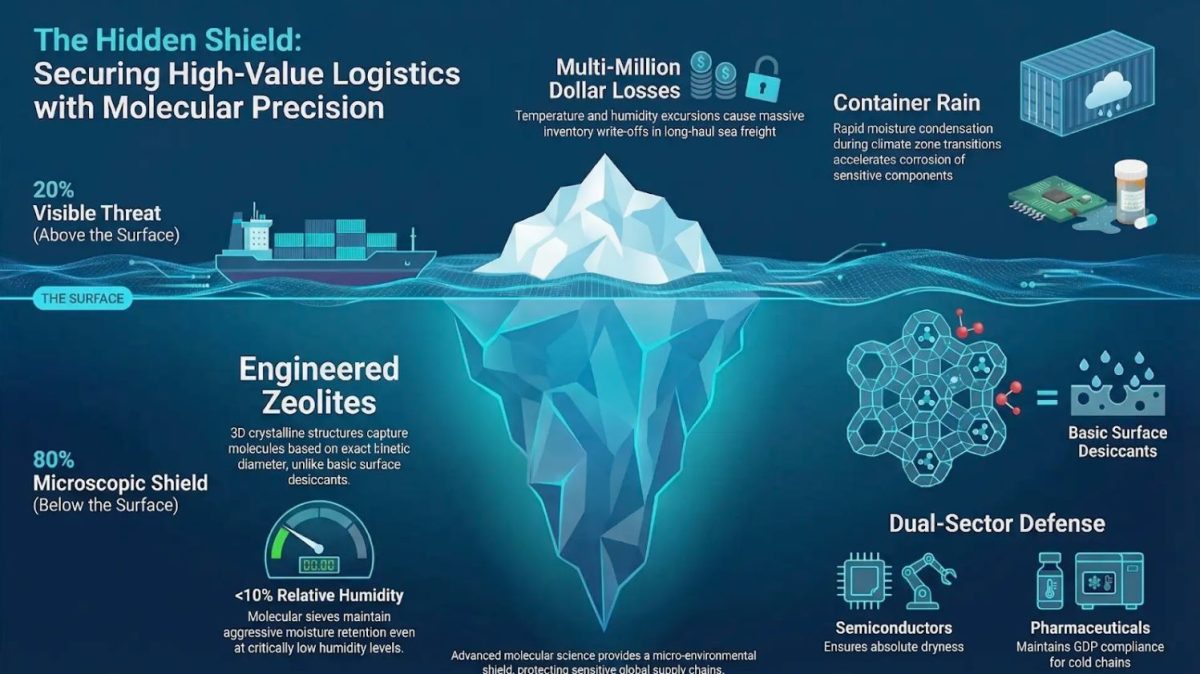
In the realm of international sea freight and long-haul cold chains, temperature and humidity excursions are leading causes of multi-million-dollar inventory write-offs. When ocean containers cross multiple climate zones, the phenomenon known as “container rain” rapidly accelerates the corrosion of sensitive components.
The economic fallout from these logistical failures extends far beyond the immediate loss of goods. It encompasses delayed production timelines, severe regulatory penalties, and permanent damage to brand reputation.
Consequently, proactive moisture mitigation and precise gas filtration have evolved from minor packaging concerns to core pillars of strategic risk management. Logistics directors must deploy highly engineered solutions to guarantee product efficacy upon arrival.
Beyond Basic Desiccants: The Role of Molecular Sieves
When mitigating supply chain risks for moisture-sensitive components, standard silica gel often falls short under extreme temperature fluctuations. For highly sensitive applications, such as semiconductor transport or PSA medical oxygen generation, logistics operators rely on engineered zeolite structures.
Sourcing these materials from a specialized
Jalon is critical, as the pore size must be precisely calibrated to adsorb specific molecules like water or nitrogen without degrading under mechanical stress during transit.
The Science of Zeolite and Adsorption
Unlike commodity desiccants that rely on surface condensation, synthetic zeolites feature a highly uniform, three-dimensional crystalline pore structure. This unique geometry allows them to selectively capture molecules based entirely on their exact kinetic diameter.
At critically low humidity levels (below 10% Relative Humidity), ordinary silica gel rapidly loses its moisture-retention capability. In stark contrast, high-performance molecular sieves maintain an aggressive desiccant action, pulling trace moisture from the localized atmosphere.
Furthermore, these advanced adsorbents exhibit selective gas separation properties. They can actively strip nitrogen from the air or sequester harmful volatile organic compounds (VOCs) that would otherwise degrade delicate shipments.
Key Industries Relying on Advanced Adsorption Technology
Electronics and Semiconductor Manufacturing
The global electronics supply chain demands an environment of absolute dryness. Microchips, printed circuit boards (PCBs), and optical sensors are highly susceptible to micro-corrosion and the “popcorning” effect during reflow soldering.
To combat this, logistics providers utilize customized adsorbent packs tailored for cleanroom standards. These packs ensure the shipping micro-environment remains consistently devoid of trace moisture and atmospheric contaminants.
Pharmaceutical Cold Chain and Medical Oxygen
In the life sciences sector, material science directly impacts patient safety. The pharmaceutical supply chain utilizes advanced adsorbents for two critical functions:
- Active Moisture Defense: Protecting hygroscopic APIs (Active Pharmaceutical Ingredients) and freeze-dried vaccines from premature degradation during transit.
- Medical Gas Logistics: Enabling portable Pressure Swing Adsorption (PSA) oxygen generators. Zeolite beds dynamically separate nitrogen from ambient air, guaranteeing continuous, logistics-free medical oxygen for critical care.
- Regulatory Compliance: Ensuring that transit environments strictly adhere to Good Distribution Practice (GDP) mandates for sensitive biologics.
Incorporating these materials ensures absolute Cold Chain Logistics integrity from the manufacturing floor to the final point of care.
Integrating Advanced Materials into Supply Chain Risk Management
The paradigm of global logistics has shifted from basic cost-efficiency to absolute resilience. In fact, mitigating unforeseen environmental and logistical vulnerabilities has become a board-level priority.
As highlighted by recent World Economic Forum analyses on global supply chain disruptions, organizations that proactively integrate specialized protective materials into their transit protocols significantly reduce their exposure to catastrophic inventory loss and regulatory non-compliance.
Procurement officers must establish deep Supply Chain Visibility by partnering with specialized material engineers. Upgrading to industrial-grade adsorbents is a measurable investment in operational continuity.
Key Takeaways
| Area | Key Takeaway | Impact/Data |
| Transit Risks | Replace silica desiccants with zeolites | Stops multi-million-dollar container rain losses |
| Material Science | Deploy engineered synthetic zeolites | Maintains desiccant action below 10% humidity |
| Electronics | Utilize cleanroom-tailored adsorbent packs | Prevents micro-corrosion and PCB popcorning |
| Pharma Logistics | Integrate specialized protective materials | Secures APIs and mandates GDP compliance |
Conclusion
The structural integrity of tomorrow’s supply chain is highly dependent on the microscopic precision of today’s material science. Traditional desiccants are simply inadequate for the rigorous demands of modern, high-value manufacturing and distribution.
By standardizing the use of advanced molecular sieves and synthetic zeolites, enterprise logistics leaders can effectively neutralize environmental threats. This scientifically grounded approach transforms vulnerable transit routes into highly secure, resilient supply networks.
 Why Real-Time Monitoring Matters for High-Risk Construction Environments
 The need to operationalise cybersecurity
 Combatting Growing Pains within Small Retailers
 The New Packaging Balancing Act: Meeting Wellness Demands in an Inflationary Era
 Visitor Registration made easy with RFID Technology from iDTRONIC
 Gartner Predicts Rise in AI-Based Supply Chain Forecasting by 2030