


In an era defined by volatile geopolitical trade routes, shifting consumer expectations, and rapid market fluctuations, the global supply chain operates in a constant state of complexity. Historically, enterprises relied on traditional demand forecasting—a process akin to driving while looking in the rearview mirror. By extrapolating historical sales data to predict future needs, organizations frequently fell victim to inaccurate projections.
The business consequences of these legacy approaches are severe: static operating models and poor planning lead to an estimated $5 to $15 million in lost earnings for every $1 billion in sales, alongside excess inventory and reduced productivity.
To survive and thrive, businesses must move beyond reactive supply chain management. The future lies in predictive analytics, real-time data integration, and intelligent automation.
By aligning commercial, financial, and operational planning, modern demand forecasting software transforms the supply chain from a vulnerable cost center into an engine for strategic resilience and sustainable growth.
Overcoming Legacy Bottlenecks for Strategic Resilience
For enterprise decision-makers and supply chain executives, the mandate is clear: mitigate supply chain risk while optimizing the Total Cost of Ownership (TCO). Traditional forecasting models operate in silos, meaning that by the time a demand plan is agreed upon across commercial and finance departments, it is already out of date. This latency leaves organizations highly vulnerable to the “bullwhip effect,” where minor shifts in consumer demand cause massive, costly disruptions upstream in manufacturing and procurement.
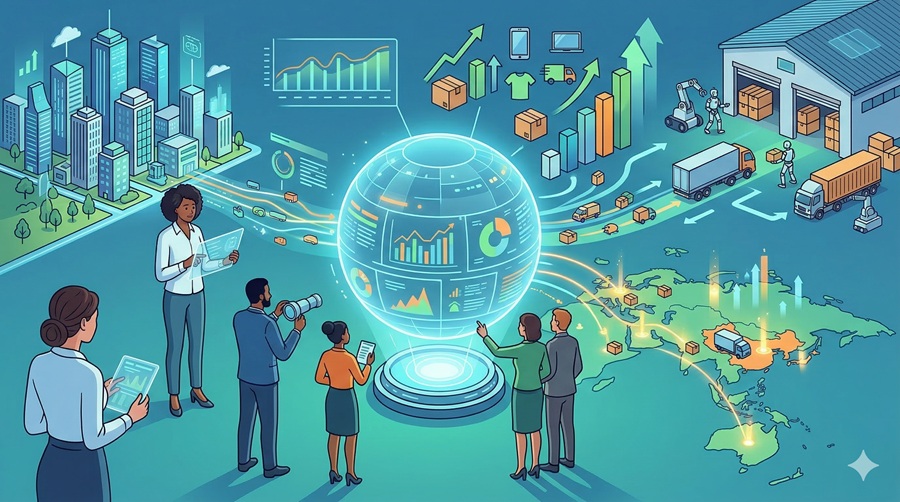
Advanced demand forecasting addresses these legacy bottlenecks by transitioning organizations to a demand-driven supply chain. Instead of relying solely on past shipments, modern predictive models ingest real-time market signals—such as point-of-sale (POS) data, weather patterns, and macroeconomic indicators.
This shift provides end-to-end global supply chain visibility, unlocking distinct advantages across the organization:
- For Procurement Teams: Optimize vendor management, conduct precise spend analysis, and execute strategic sourcing without the constant threat of raw material shortages.
- For SaaS Buyers and SMBs: Cloud-based forecasting solutions act as a critical equalizer. By anticipating demand spikes before they happen, SMBs can drastically reduce operational costs, avoid tying up vital working capital in excess safety stock, and navigate sudden capacity constraints to compete with global enterprises.
- For ESG Initiatives: Accurate demand forecasting aligns production exactly with actual market demand. This eliminates the waste associated with overproduction and drastically reduces the carbon emissions generated by expedited, emergency freight shipping.
The Architecture of Intelligence: Integrating the Tech Stack
Transitioning to an intelligent forecasting model requires a cohesive, secure, and highly integrated technological infrastructure. For technical admins and IT managers, the focus must remain on business-level architecture rather than raw code.
The modern supply chain requires seamless API capabilities that connect disparate systems—specifically Enterprise Resource Planning (ERP) platforms, Warehouse Management Systems (WMS), and Customer Relationship Management (CRM) tools. When these systems communicate securely within a cloud-native infrastructure, the enterprise can leverage the true power of artificial intelligence (AI) and the Internet of Things (IoT).
IoT tracking devices and RFID sensors embedded throughout warehouses and logistics networks feed real-time inventory and location data back into central systems. Machine learning algorithms then process this vast data lake, identifying subtle demand patterns and anomalies that human analysts could never spot.
Looking toward the horizon, the integration of Quantum Machine Learning (QML) promises to elevate this architecture even further. While traditional computing struggles with high-dimensional, multivariate optimization tasks, quantum-inspired algorithms can process complex probabilistic distributions simultaneously. In practical business terms, this means instantly calculating optimal inventory routes, dynamically allocating resources, and generating hyper-accurate forecasts despite massive network variables.
Elevating the Customer Experience Through Supply Chain Visibility
The ultimate measure of a supply chain’s success is the customer experience. For CRM users, sales professionals, and customer success teams, demand forecasting is not just an operational metric; it is the foundation of customer trust. In an age of omnichannel fulfillment, consumers expect to buy anywhere, fulfill anywhere, and return anywhere.
When supply chain execution is disconnected from the commercial front lines, sales teams are blindsided by stockouts, and customers are alienated by missed delivery windows. Modern demand forecasting software bridges this gap by enabling inventory-driven sales forecasting. When a marketing team launches a new promotion, or an account manager updates a sales pipeline in the CRM, that data is instantly factored into the demand forecast.
This deep integration empowers sales and customer success teams to offer order tracking transparency and highly accurate delivery windows. By utilizing predictive analytics to ensure the right product is at the right distribution center before the customer even clicks “buy,” organizations can foster deep brand loyalty and maximize revenue capture.
Cultivating the Autonomous, Connected Enterprise
The ultimate evolution of demand forecasting is the creation of a continuously learning, autonomous enterprise. Currently, much of a company’s most valuable supply chain knowledge—such as supplier lead-time nuances, regional market sensitivities, and workaround strategies—is tribal, locked inside the minds of individual planners.
The future relies on digitizing this expertise into an accessible data model. By utilizing enterprise knowledge graphs to connect data, decisions, and business rules across the entire value chain, organizations can convert fragmented data into a unified digital brain. This allows companies to run complex scenario planning in a matter of hours rather than weeks. AI agents can autonomously sense changes in market demand, evaluate the financial impact of various supply options, and execute routine replenishment orders within predefined enterprise guardrails.
This level of automation does not replace human expertise; rather, it augments it. It frees supply chain professionals from the tedious tasks of manual data entry and spreadsheet reconciliation, allowing them to focus on high-value strategic judgment, anomaly resolution, and supplier collaboration.
Conclusion
Demand forecasting has evolved far beyond a simple calculation of historical sales. It is now the strategic nervous system of the modern enterprise. By breaking down functional silos, integrating advanced predictive technologies, and maintaining a relentless focus on the customer experience, organizations can build the agile, resilient supply chains required to turn market uncertainty into a definitive competitive advantage.
 The Role of Mobile Devices in Enhancing Supply Chain Efficiency
 Countering the cost-of-living impact on retail with AI
 Smart Ways to Protect Yourself from Scammers
 What’s happened to the flexibility in warehousing that businesses desperately need?
 ITS World Congress: PTV Group presents latest, data-driven software solutions for future-oriented mobility
 What Is Supply Chain Class Action Risk