

With next-day deliveries and supply chain obstacles, industrial hubs have never been so dynamic and high-velocity.
Many are 24/7, in fact, but efficiency and safety must co-exist in harmony rather than compromise each other.
If a distribution center grows into double its original capacity, the physical risks to both personnel and infrastructure may grow by three, or four, if mismanaged.
Training new onboarding staff and compliance are necessary, but focus should also be on creating a resilient blueprint that can be scaled.
With heavy lift trucks and robotics now moving around, every square foot of a facility has its own challenges.
Managers must stay on top of physical safeguarding, often beginning with basics, such as the installation of UK safety compliant barriers.
Area 1: Pedestrian and vehicle segregation
One of the biggest risks is the crossing paths of people and vehicles. Forklift trucks are almost always essential, for example, but their weight and limited visibility make them risky. To mitigate this, the floorspace must have clear, physical boundaries that separate walking personnel from vehicular traffic.
Floor markings alone aren’t enough, though, as they don’t physically stop against accidental veering. Heavy-duty railings and bollards are what truly create safe zones for workers – a bit like the difference between British and Dutch approaches to bicycle lanes.
Funneling pedestrians through designated crossing points and entries, management can rest assured that, even with poorly performing staff, human movement remains predictable. Here, scaling is now less of an issue, particularly as it’s a weight off the mind of workers, allowing them to move faster without constantly looking over their shoulder.
Area 2: Protecting pallet racking systems
Pallet racking is of course the backbone of the supply chain – it holds tons of inventory at some scary heights. These structures are surprisingly vulnerable to lateral impacts, because even at low speeds, a clip from a forklift can lead to a progressive collapse.
In many warehouse hazard zones, the base of the racking is the most frequently damaged bit. Installing rack end protectors and individual upright guards is how you can create a sacrificial buffer layer – it absorbs the force of a forklift clipping it.
Regular inspections and physical shields don’t just keep workers safe, but they extend the lifespan of storage systems.
Area 3: Safeguarding structural columns
Industrial buildings are most typically supported by steel columns that, if damaged, could threaten the structural integrity of the entire roof or mezzanine level. Internal infrastructure such as water mains and gas lines, are also often exposed. Again, a single collision with a pillar or pipe can result in forced downtime and a large bill to fix.
Here, industrial impact protection must be deployed, which often includes wrap-around column protectors (produced with high-density polyethylene or heavy-gauge steel). These are made to be highly visible (safety yellow or black) so operators can easily judge distances in tight spaces.
Area 4: Securing loading docks and vehicle bays
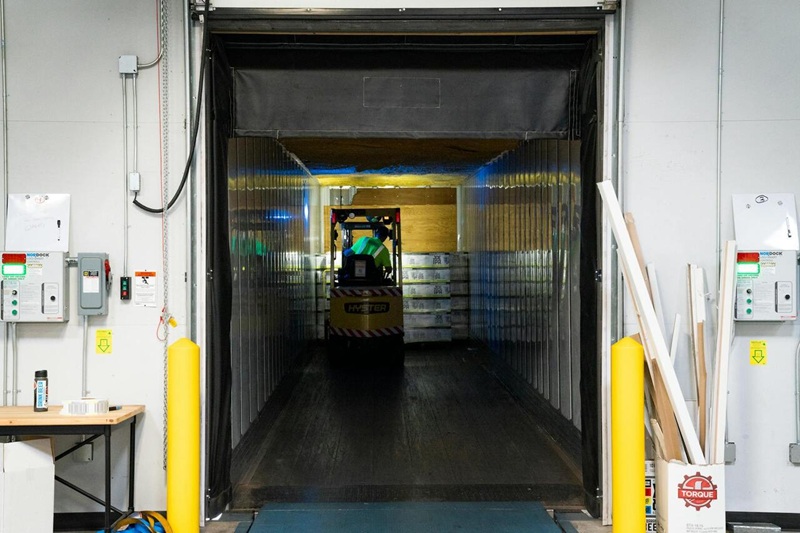
The loading dock is usually the most dynamic and chaotic area of industrial hubs, it’s where internal warehouse vehicles meet outside HGVs. Trailer creep, falls from height, and many risks exist.
Protection usually revolves around:
- Dock bumpers
- Wheel chocks
- Safety gates
- Signage
- Access control
More often than not, loading docks are exposed to the weather so the barriers must be corrosion-resistant. They must also withstand the impact of a truck. The edges of the docks should be clearly guarded when not in use prevents accidental falls, which remain one of the leading causes of workplace injury in logistics.
Area 5: Managing automated systems and restricted zones
As the industry moves to Warehouse 4.0, integrating automation and worker safety in the supply chain is now a central focus. Automated Guided Vehicles (AGVs) and robotic picking arms both operate with speed and consistency that is no match for humans – and they are 24/7. While, they require strictly controlled environments to function safely, their shared knowledge and training makes scaling faster than humans, too.
Protecting areas that use automated systems could involve perimeter fencing and interlocked light curtains that can halt machinery if a person enters the restricted zone. This itself could be used with computer vision (cameras) or 3D spacial chips worn by personnel.
Safety in a modern hub goes hand in hand with improving operational efficiency. Organizations usually look toward a series of 12 principles (in one form or another) which helps professionals protect their supply chain from various vulnerabilities.
Automation zones must be high-priority areas in order to improve productivity, yet safety and physical guarding must be enforced to reduce collisions and downtime (e.g., constant walking in their space, even if not resulting in collisions, could be halting their breaks and slowing them down).
A mixed strategy
A good strategy is one that invests in both human capital and operational longevity. It identifies and shields these five areas so that businesses can drastically reduce the frequency of accidents. Speed is the ultimate advantage, and that means outsourcing energy and focus on safety from humans to procedures and infrastructure.
 Softeon Named Leader in SPARK MatrixTM for WMS Market, Q3, 2024 by Quadrant Knowledge Solutions
 IntelliTrans Placed in 2024 Magic Quadrant™ for Real-Time Transportation Visibility Platforms
 The Risk of IT Business as Usual
 Morphy Richards Selects Slimstock to Enhance Supply Chain Visibility
 Manhattan Associates Unveils Agentic AI Innovation at Momentum 2025
 How Employee Vetting Protects Global Supply Chains