

In a warehouse, bundles are made from individual products and SKUs, so sellers can leave the preparation to this system.
A bundling warehouse supports ecommerce fulfillment by combining multiple products into a single sellable package. That package can be anything: a gift set, a starter kit, or promotions like “Buy Two, Get One Free. Items”
Bundling warehouses exist to help brands increase Average Order Value (AOV) and reduce friction for buyers, making the fulfillment process easier. If done well, bundling feels seamless to the customer and operationally firm behind the scenes.
If you run an ecommerce business and want a strong operation, this article is for you.
We will break down:
- Processes at a Bundling Warehouse.
- Differences between the Kitting Process, Bundling Process, and Virtual Bundling.
- The benefits of a Bundling Warehouse.
- The Inventory Control/Accuracy Systems of a Bundling Warehouse.
- When to form a partnership with a 3rd Party logistics bundling company.
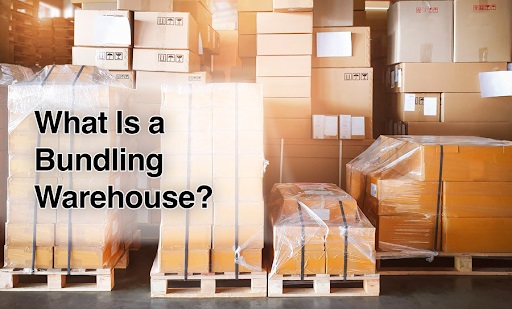
What Is a Bundling Warehouse?
A bundling warehouse is a fulfillment operation that merges multiple SKUs into a single packaged unit, in simple words: automates and handles bundling for you. The bundle is then assigned its own SKU, allowing the warehouse to store, pick, pack, and ship it as though it were a single product. Once bundled, the package behaves like a new identity in the system. One SKU in.
Bundling warehouses typically support two bundle structures:
- Physical Bundles: These are assembled in advance. Products are grouped, packaged, and stored before any customer places an order. When they place the order, the warehouse ships the final bundle.
- Virtual Bundles: Virtual bundles exist inside software and are not necessarily made. Each product remains stored separately, but the warehouse management system treats them as a single order “when purchased”. The bundle comes together during picking and packing, not before.
Here are some examples:
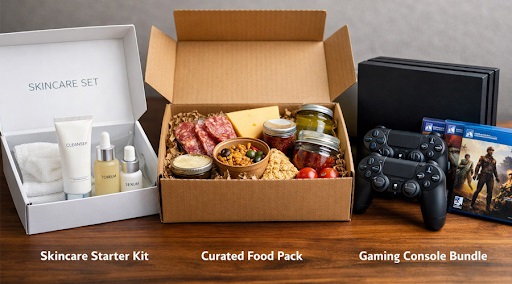
- A skincare starter kit with cleanser, toner, and serum
- A curated food pack shipped in one box
- A gaming console package with controllers and games
Bundling vs Kitting vs Virtual Bundles
If you’re working in ecommerce, you’ve probably heard these terms. These are often blurred together online. But they have critical operational differences.
Product Bundling (Simple Explanation)
Product bundling is a commercial strategy. Multiple products are sold together as a single offer, often at a discount.
Brands bundle their products to:
- Increase AOV: Customers spend more per order when products are grouped with an attractive price point.
- Reframe value: Bundles can feel richer than individual items, even with less margin.
- Drain slow inventory: Lagging products move faster when paired with bestsellers.
Kitting in a Warehouse
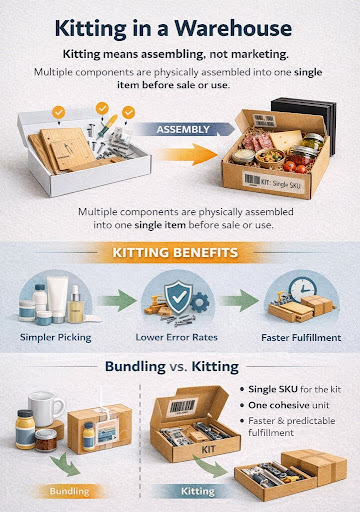
Kitting means assembling, not marketing.
Warehouses use kitting when multiple components must come together to form a complete item before sale or use. Very similar to bundling, but not identical. Think of a DIY furniture kit. Screws, bolts, tools, and panels all converge into one final kit.
Once assembled:
- The kit becomes a single SKU
- Orders trigger the picking of the kit, no single parts
- Fulfillment becomes faster and more predictable
Kitting reduces picking complexity, lowers error rates, and sharpens operational rhythm. Instead of juggling pieces, the warehouse handles one cohesive unit.
Bundling is a sales and pricing strategy where multiple products are offered together to increase AOV (often without physically combining items in the warehouse). Kitting, on the other hand, is an operational process where multiple components are physically assembled into one unit. Knitting is the act, and bundling is the nature.
Virtual Bundles
Virtual bundles are assembled digitally, not by hand. They’re more automated and planned, which is why there’s less physical work.
Main characteristics:
- No physical assembly upfront: Products remain separate until an order arrives
- High flexibility: Customers can mix and match without forcing the warehouse to pre-build every possible combination
- Lean storage: Fewer boxed variants take up space
What Actually Happens in a Bundling Warehouse?
Here’s how a bundle moves from concept to customer, all done in the warehouse.

1. Bundle Planning
Marketing or merchandising teams will design the bundle. They decide what goes together and why it sells. It all depends on seasonality, demand signals, and the business’s sales strategy. Typical bundle concepts include:
- Gift sets
- Buy-one-get-one promotions
- Introductory starter kits
2. System Setup
Each bundle is assigned a unique SKU. That SKU is digitally linked to every component inside it, which in turn keeps the inventory tidy. When you sell one bundle, the system automatically adjusts stock for each included item.
3. Receiving and Storage
Products arrive at the warehouse and are stored according to their frequency of use. High-demand items or bundle-heavy SKUs are often placed in fast-access zones to reduce travel time during assembly or picking.
4. Assembly and Kitting (When Required)
If the bundle is physical, workers receive orders to assemble it. Items are packaged, labelled, and prepared for storage or shipment.
5. Picking and Packing
How orders are fulfilled depends on the bundle type.
Physical bundles are picked as a single unit, but virtual ones require staff to pick each component individually, then pack them together..
6. Quality Checks and Shipping
Items are scanned, verified, and handed to the carrier as a single parcel.
Why Ecommerce Brands Use Bundling Warehouses
The primary reasons include:
AOV Boosting: The ability to create an average order value (AOV) that is higher than if products were purchased individually, since bundles typically have a perceived value or savings that appeal to customers. For many merchants, the real challenge is not the idea of bundling itself, but how to bundle products on Shopify while keeping pricing, inventory, and fulfillment perfectly aligned. Merchants can also use a Shopify upsell app to turn product bundles into on-site offers that encourage larger carts before orders reach the warehouse.
Inventory Management: slow-moving inventory moves by pairing with more popular ones in the bundle. You can clear inventory while also turning slow business capital into cash flow.
Easier Sales: The ability to reduce cognitive overload for customers by providing them with curated bundles of complementary items. This gives a single “solution” instead of endless scrolls.
Easier Fulfillment: Increased fulfillment throughput due to fewer picks per order. The kits are fulfilled and shipped more smoothly.
Better Brands, Happier Customers: Custom packaging and careful assembly help create a stronger brand impression, leading to higher customer satisfaction and long-term loyalty.
Common Ecommerce Bundling Models (With Examples)
Here are common warehouse bundles that ecommerce brands offer:
1. Pre‑built bundles/sets
These are bundles made of fixed combinations of products that are assembled and stored as one SKU. They are introduced and marketed as complete sets, like a skincare routine or a complete meal kit.
2. Mix‑and‑match boxes
With this type of bundle, customers choose from a limited set of products and mix and match their preferences. For instance, a customer may select their choice of 3 perfumes from a range of 10.
3. “Buy together and save” bundles
This model offers a discount or promotional pricing for customers who purchase two or more products that are often bought together. These products are not necessarily part of a pre-assembled set but are grouped together in the store for convenience.
4. Seasonal or promotional bundles
Seasonal or promotional bundles are created around specific events or times of year, such as holidays, back-to-school, or Black Friday. These bundles are often time-limited and include themed products.
5. Virtual bundles
Unlike pre-assembled bundles, virtual bundles are a digital concept in which products are grouped together in the system but not physically assembled ahead of time.
How Warehouse Systems Keep Bundle Inventory Accurate
Accurate bundle inventory management is critical. If stock isn’t tracked properly, you risk overselling components or misrepresenting availability.
- To avoid this, good warehouse and inventory systems must:
- Link a bundle SKU to its individual component SKUs
- Reduce stock for each component when a bundle sells
- Support multi‑channel sales (Shopify, Amazon, etc.) without double‑counting
- Provide reporting on which bundles and components are trending or running low
Most modern WMS (Warehouse Management System) or TWMS (Transportation and Warehouse Management System) include dedicated bundle tracking to prevent inventory drift.
Should You Do Bundling In‑House or Use a 3PL Bundling Warehouse?
Smaller or newly launching brands often bundle internally because it minimizes outsourcing complexity and keeps costs low; as sales grow, many firms shift to a 3PL that provides dedicated bundling services and operational scale.
In‑House Bundling
Pros:
- Full control of your process
- Easy to experiment rapidly
- Good for low volumes
Cons:
Requires space and staff
Manual processes may get messy as volumes grow
3PL / External Bundling Warehouse
Pros:
- Scalable labour and space
- Professional kitting areas
- Advanced systems and experience
Cons:
- Additional fees
- You must communicate specifications clearly
- Depends on 3PL’s technical capabilities
- Signs You’re Ready for a 3PL with Bundling Services
- Consistent order volumes
- Multiple bundles running concurrently
- The team is spending too much time on assembly
- Multi‑channel inventory headaches
How to Choose a Bundling‑Capable 3PL or Fulfillment Partner
Ask direct questions:
- Do you offer bundling and kitting as standard services?
- Can you support physical and virtual bundles?
- How are bundle SKUs managed in your system?
- How do you prevent inventory mismatches across channels?
- How is bundling priced?
- What are setup timelines and volume minimums?
- What performance and inventory reports are available
Choose a partner who understands both ecommerce growth and warehouse operational efficiency.
Conclusion: Turning Bundling Into a Fulfillment Advantage
A bundling warehouse brings fulfillment, storage, and shipping into one coordinated environment. Whether you bundle in-house or through a 3PL, the decision should be guided by volume, complexity, and system maturity. Choose the right warehouse strategy and manage inventory to shift it from a marketing tactic to an operational advantage.
FAQ: Bundling Warehouse & Bundled Shipping
- What is bundling in a warehouse?
It means combining multiple products into a single unit for sale or shipping, with staff and systems treating that combination as one bundle.
- What happens in a bundling warehouse?
Bundles are planned, set up in the system, assembled or virtually grouped, then picked, packed, and shipped together.
- What does “bundled shipping” mean?
It means shipping several items together in one parcel, which can reduce costs and complexity.
- What is bundling, and why is it sometimes discouraged?
In some industries, bundling can raise competition concerns. But in ecommerce, product bundling is usually beneficial when it’s clear, optional, and valuable to customers.
- Do bundles always have to be pre‑assembled?
No. Virtual bundles are put together during the picking process rather than being stored as one pre‑packaged unit.
 A Consumer’s Guide to Hiring a Private Investigator Safely
 Six Dangerous Driving Scenarios That Lane-Keeping Technology Helps Prevent
 Asda Accelerates Multi-Channel Transformation Strategy with Blue Yonder
 MULTIVAC becomes an R-Cycle partner
 FourKites Launches Inbound Visibility Solution to Enhance End-to-End, Shipment- and Order-Level Insights
 A Beginner’s Guide to Satellite IoT