
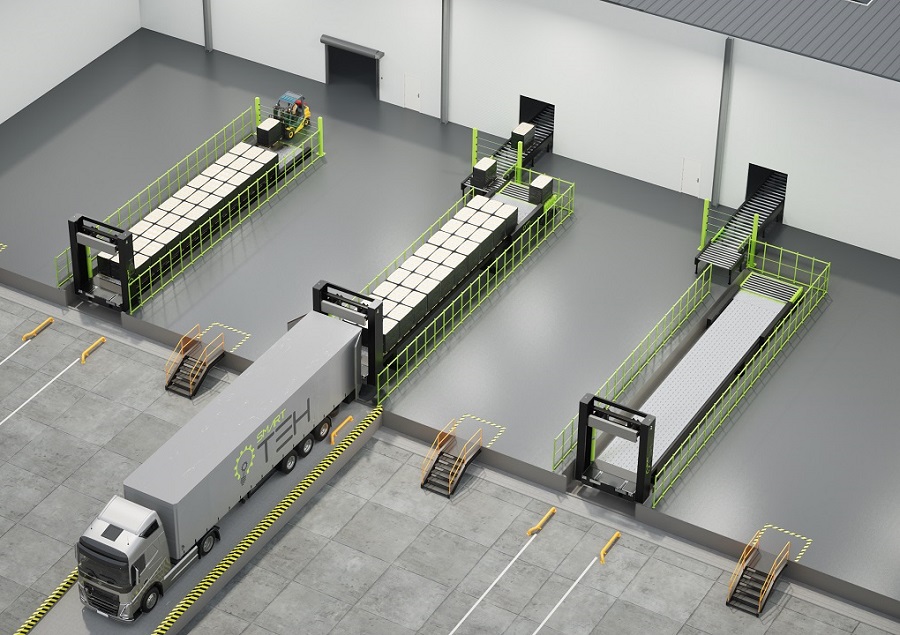
Even the most well-run supply chains can get held up at the loading dock. While companies invest in forecasting tools, warehouse automation, and sophisticated logistics software, trucks still often sit idle for hours waiting to be loaded.
Manual loading – whether by hand or with forklifts – is usually slow, unpredictable, and prone to mistakes. Delays at the dock can impact the entire supply chain, affecting carrier schedules, warehouse operations, and deliveries. On top of that, handling goods manually increases the risk of accidents and damaged cargo.
Automated truck loading helps remove this bottleneck, making dock operations faster, safer, and more efficient.
What is automated truck loading?
An Automated Truck Loading System (ATLS) makes it easier to move cargo from the warehouse into the truck. Unlike traditional forklift loading, it lets you preload goods onto a loading plate before the truck even arrives. When the trailer docks, the system lines up with the truck and slides the cargo in automatically.
This setup cuts out repeated forklift trips, reduces manual handling, and keeps loading consistent every time. Modern systems can handle both palletized and palletless goods, work with standard, non-modified trailers, and connect to existing conveyors or warehouse management systems.
The result is faster, safer, and more reliable loading – all without major changes to your warehouse.
Benefits for your supply chain
Faster truck turnaround
Automated loading reduces the time it takes to load a trailer from hours to minutes. Shorter loading cycles free up dock doors, allow more shipments per day, and help companies get more use out of their trucks and trailers.
With less time spent waiting at the dock, businesses can move more goods without expanding warehouse space or adding extra staff. Every minute saved at the dock can make a noticeable difference in overall efficiency.
Improved predictability
Manual processes tend to vary from one load to the next. Automated systems follow the same process every time, creating consistent loading cycles that make scheduling easier and delivery times more reliable.
For supply chain managers, that predictability makes a real difference. It helps with production planning, improves coordination with carriers, and supports stronger On-Time In-Full (OTIF) performance.
Reduced labour dependency
Traditional loading often requires several forklift operators per shift, which increases labour costs and dependence on skilled workers. Automated systems usually need only one operator to manage multiple trailers.
With fewer people required for the job, companies can decrease operational risk, cut overtime costs, and keep warehouse operations running smoothly even when staffing is tight.
Enhanced safety
Loading docks are busy, high-risk areas where forklifts, heavy pallets, and tight spaces can easily lead to accidents. Automation reduces manual handling and limits forklift traffic, which helps make the area safer for workers.
Fewer incidents mean lower insurance costs, less downtime, and a safer workplace overall.
Reduced product damage
Manual handling always carries some risk. Forklift impacts, misaligned pallets, or sudden movements can damage goods and lead to costly claims. Automated loading systems move cargo in a smooth, controlled way, keeping products stable during the loading process.
Over time, this means fewer damaged goods, lower replacement costs, and happier customers.
Lower operating costs and environmental impact
By reducing forklift use, automated loading lowers energy consumption and fuel costs. Faster loading also means trucks spend less time idling at the dock, which helps cut emissions and energy waste.
As a result, companies can reduce operating costs while also lowering their environmental impact.
Flexible solutions for different industries
Automated truck loading works across many industries and types of cargo.
It can handle:
- Palletized and slip-sheeted goods
- Bulk bags (FIBCs) and crates
- FMCG and retail shipments
- Industrial and manufacturing materials
Essentially, any stable, packaged cargo that can be preloaded and safely moved can benefit from automation. This makes automated truck loading a practical solution for manufacturers, distributors, and third-party logistics providers.
The ROI of automated loading
Automated truck loading doesn’t just improve the dock – it can make the entire supply chain run more efficiently. Lower labour costs, faster loading times, fewer damaged goods, and more predictable operations all help deliver a rapid return on investment.
Many companies begin seeing clear savings within the first year. By speeding up truck turnaround and optimising dock operations, automated loading helps businesses move more goods without expanding their facilities or workforce.
 Raft: Rebrand Ushers In New, More Supply Chain-Focused Era for AI Pioneer Company
 Top Benefits of Using Restaurant Delivery Management Software in 2026
 Why & How To Calculate Work In Process (WIP) Inventory Value
 The Joloda Hydraroll Group Simplifies Transition to Automated Truck Loading with New LoadMatic Lite System
 Umbraco users rank open-source CMS provider among G2’s top 20 Best Software Companies in EMEA 2024
 Taxation of Bitcoin: Essential Information for Every Holder