

Security operations centers (SOCs) are overwhelmed. Trend Micro research cited by Hunters shows that 70 % of SOC teams feel emotionally overwhelmed by the volume of security alerts.
It’s not only the sheer number of alerts but the poor information quality that fatigues analysts.
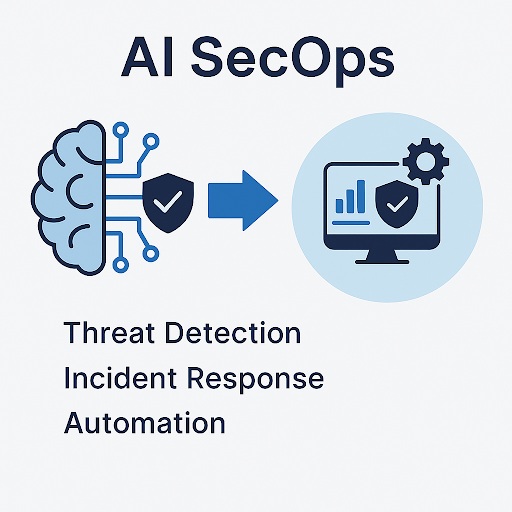
To regain control, organizations are increasingly adopting AI SecOps, the integration of artificial intelligence and machine learning into security operations.
What Is AI SecOps?
AI SecOps uses advanced analytics, automation and machine reasoning to augment every phase of the security lifecycle. Rather than relying solely on rule‑based detection and manual triage, AI‑enhanced SOCs employ machine‑learning models to identify anomalies, prioritize alerts, correlate events across multiple sources and even initiate investigation actions. Hunters notes that modern AI SOCs leverage AI at every stage of the security lifecycle and incorporate components such as intelligent alert triage, context‑aware analysis, autonomous investigation and decision support systems. These capabilities collectively reduce mean time to detect and respond, while improving analyst productivity.
Benefits of AI‑Driven Security Operations
- Reduced alert fatigue: Automated triage prioritizes alerts based on risk, context and historical outcomes, allowing analysts to focus on high‑impact incidents. S&P Global reports that roughly 50 % of security alerts go unaddressed each day; AI‑driven triage helps address this backlog.
- Context‑aware analysis: AI models can understand relationships between alerts and provide enriched context, enabling faster investigation and more accurate root‑cause analysis.
- Autonomous investigations: Agentic capabilities allow systems to pursue investigative paths without human initiation, exploring multiple hypotheses and gathering evidence.
- Decision support: AI‑powered co‑pilots suggest next steps based on best practices and past outcomes, generating investigation summaries and documentation.
- Continuous learning: AI systems improve through supervised and unsupervised learning, adapting to evolving threats and analyst feedback.
- Augmented, not replaced: AI enhances human capabilities rather than replacing them. Hunters emphasizes that humans must remain in the loop, and AI should be viewed as augmentation, not a replacement.
Building Effective AI‑Driven SecOps
Radiant Security outlines several practices for building resilient, AI‑driven SOCs:
- Continuous monitoring with advanced technologies: Deploy AI‑driven monitoring tools that analyze network behaviors and identify anomalies in real time. These systems drastically improve mean time to detect by uncovering subtle patterns that might escape human analysts.
- Automate repetitive tasks: Use intelligent automation to reduce alert fatigue by handling triage, data enrichment and initial investigation. Automation correlates information across sources and can initiate preliminary response actions.
- Define clear objectives and roles: Establish measurable objectives tied to business outcomes and clearly delineate roles within the SOC. As AI is integrated, roles evolve into hybrid positions where analysts work alongside AI systems.
- Integrate threat intelligence: Incorporate dynamic threat intelligence that offers insights into attacker behaviors and emerging techniques. AI systems can analyze threat data at scale and correlate it with security events.
- Build diverse teams: Include data scientists, behavioral analysts and domain experts to bring multiple perspectives to security challenges. Cross‑training and rotation programs help maintain operational resilience.
- Integrate technology and enable visibility: Select integrated security technologies and consolidate logs and telemetry to gain complete visibility across endpoints, networks, applications and cloud services. AI‑native platforms analyze vast datasets more effectively than rule‑based systems.
AI SecOps and Autonomous Security Operations
Netenrich’s Autonomous Security Operations embodies modern AI-enabled SecOps by pairing agentic AI with structured, engineering-led workflows. Built on Google Security Operations and enriched through Netenrich’s RIC data fabric, Autonomous Security Operations improves detection fidelity, accelerates investigations, and provides consistent, context-aware decision support. The model keeps humans in the loop through an AI Supervisor approach, ensuring automation supports, not replaces, analyst judgment.
Implementing AI SecOps in Your Organization
- Assess maturity and readiness: Evaluate your existing security operations, data sources and technology integrations. Identify high‑value use cases for AI, such as alert triage, threat hunting or incident response automation.
- Start with pilot projects: Implement AI functionality incrementally, focusing on areas where automation can deliver quick wins without introducing risk. Use metrics such as mean time to detect and respond to measure improvement.
- Invest in talent and training: Upskill analysts to work alongside AI systems. Develop hybrid roles that combine threat hunting expertise with data science skills.
- Establish governance and oversight: Define policies and procedures for AI use, including human approval for automated actions. Regularly review AI recommendations for bias or unintended consequences.
- Leverage trusted partners: Choose vendors that integrate AI natively, provide transparent reporting and offer co‑managed support. Netenrich’s Adaptive MDR and Autonomous Security Operations provide structured, outcome-driven SecOps modernization by combining agentic AI, high-quality security data, and engineering expertise to improve consistency, accuracy, and operational efficiency.
Conclusion
AI SecOps is transforming security operations from reactive alert management to proactive threat hunting and rapid response. By leveraging intelligent alert triage, context‑aware analysis, autonomous investigations and decision support, organizations can dramatically reduce alert fatigue and improve detection. Success requires continuous monitoring, automation, clear objectives, threat intelligence integration and cross‑functional teams. With the right approach and trusted partners like Netenrich, CISOs can harness AI to strengthen security operations while keeping humans at the center of decision‑making.
 Mindtree Wins 2019 ISG Star of Excellence Award™
 Hosted security adoption given major boost by uptake in cloud, survey shows
 Blue Yonder Survey: Car Buyers Demand Personalisation While Cost & Delivery Speed Remain Key
 Infor Extends Alliance Partnership with Polaris into Europe for Discrete Manufacturers
 Amazon and Google Leap Up the Rankings for U.S. IoT Projects
 International Day of Women & Girls in Science: Inspiring the Next Generation of Women in STEM