

Most workplace injuries are preventable. The difference between an organisation that manages risk well and one that does not often comes down to whether the right training reached the right people.
With hundreds of providers and qualifications available, finding courses that genuinely satisfy UK regulatory requirements and fit how your organisation actually works takes careful consideration.
This guide examines the best online health and safety courses available in 2026, from basic awareness modules to advanced professional qualifications.
Whether you are the responsible person for fire safety, a manager building a full training programme, or an individual looking to formalise your knowledge, it covers what you need to make a well-informed choice.
Why Online Health and Safety Training Matters
According to HSE data, workplace injuries and work-related ill health cost UK employers billions of pounds each year in lost productivity, compensation claims, and regulatory penalties. Effective health and safety training addresses these risks directly and ensures compliance with the Health and Safety at Work Act 1974 and the regulations that sit beneath it.

Online health and safety courses offer clear advantages over traditional classroom delivery:
- Flexibility and accessibility: Learners progress at their own pace, fitting sessions around the demands of daily operations.
- Cost-effectiveness: No travel costs or venue hire, and significantly less time away from the job.
- Consistency: Every learner receives the same quality-assured content, regardless of where they are based.
- Immediate certification: Digital certificates are issued on successful completion, making it straightforward to maintain compliance records.
- Scalability: Whether you need to train five employees or five hundred, the process is equally straightforward.
The best UK online health and safety training providers combine CPD-accredited content, interactive learning modules, and tracking systems that give you clear evidence of compliance during regulatory inspections.
What Makes a Health and Safety Course ‘Best-in-Class’?
Not all online training is equal. Here are the quality markers that separate good provision from the rest:
- Accreditation and recognition: Look for courses approved by recognised bodies such as RoSPA, the CPD Certification Service, IOSH, or NEBOSH. These accreditations confirm that content meets professional standards.
- Regulatory alignment: Courses must reflect current UK legislation, including relevant updates to the Regulatory Reform (Fire Safety) Order 2005 and sector-specific regulations.
- Engagement and retention: The most effective online courses use video content, interactive scenarios, knowledge checks, and real-world case studies, rather than dense, text-heavy slides.
- Assessment quality: Thorough end-of-course assessments confirm understanding, with unlimited retake options so that every learner can reach the required standard.
- Certificate validity: Clear information on how long certificates remain valid, and when refresher training is required, helps organisations maintain continuous compliance.
- Technical accessibility: Courses should work reliably across desktop, tablet, and mobile devices, with a responsive design and minimal technical requirements.
1. Human Focus – Comprehensive Online Health and Safety Training Library
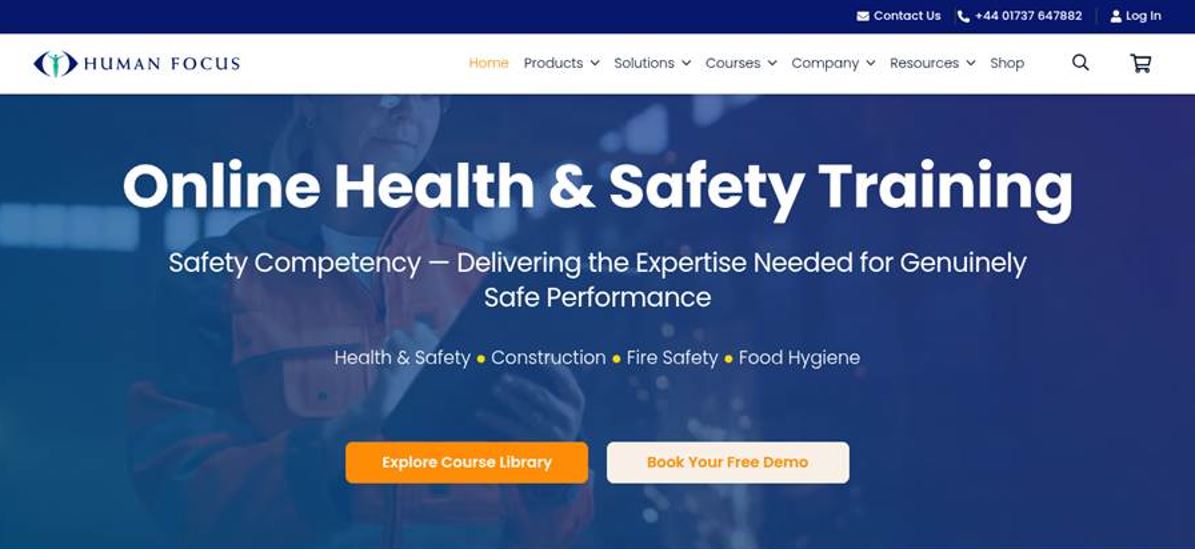
Human Focus offers more than 300 certified online health and safety courses through a well-developed Learning Management System. The platform is designed around the day-to-day reality of managing training across multiple sites and departments, which makes it a practical choice for safety officers and compliance managers with large teams to oversee.
Course range: Courses cover fire safety, manual handling, working at height, COSHH, risk assessment, DSE, first aid awareness, and IOSH-approved Managing Safely courses. The library spans both foundational awareness training and advanced professional qualifications.
Key strengths:
- Robust LMS with automated progress tracking and reporting
- Interactive course design with full audio voiceover
- Bulk purchase discounts that make large-scale training cost-effective
- Round-the-clock access from any device
- Immediate digital certification
- Dedicated account management support
- Content regularly updated to reflect legislative changes
Ideal for: Organisations managing training across multiple teams or sites, especially in healthcare, construction, manufacturing, and education.
Accreditations: Courses are CPD certified and aligned with current UK health and safety legislation. Fire safety courses support compliance with the Regulatory Reform (Fire Safety) Order 2005.
2. RoSPA – Flagship Qualifications and Practical Modules
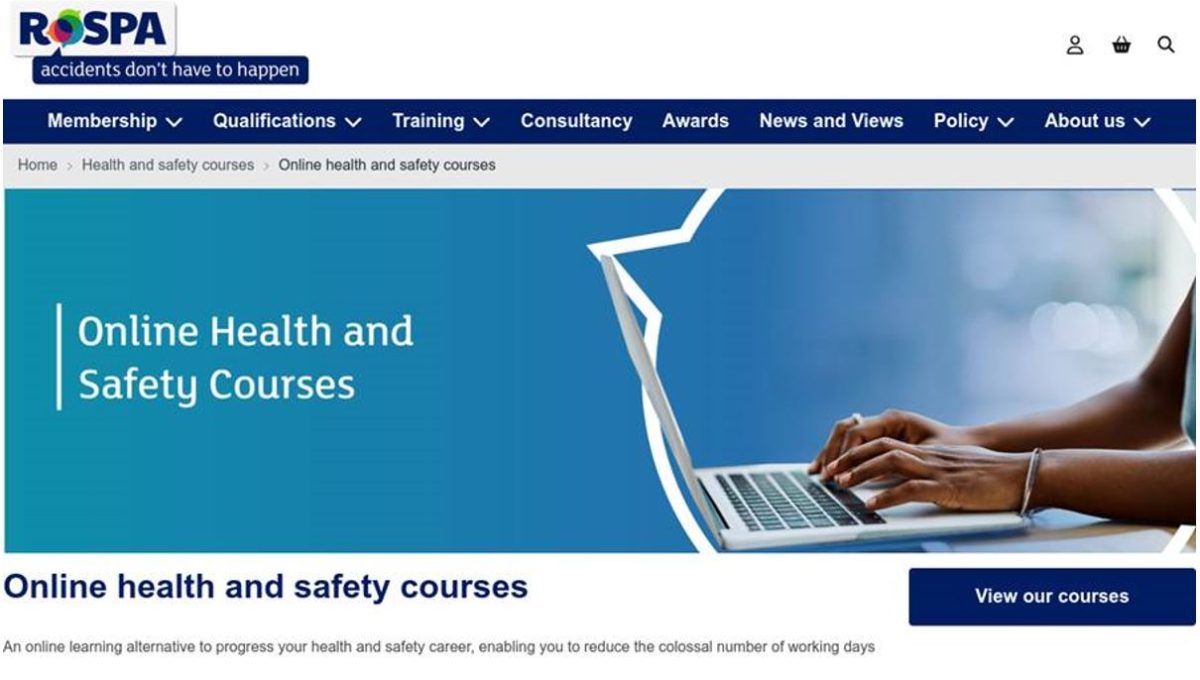
With more than a century behind it, RoSPA is one of the most respected names in UK safety. Its online courses are built on deep subject knowledge and are a natural choice for organisations that want to go beyond minimum compliance and build something more robust.
Course range: RoSPA delivers both its own qualifications and courses in partnership with NEBOSH, IOSH, and IEMA, alongside practical modules covering CDM regulations, working at height, manual handling, and DSE assessment.
Key strengths:
- Exceptional brand reputation and employer recognition
- Expert-led content developed by qualified safety professionals
- Flexible study options with tutor support available
- Suitable for both newcomers and experienced practitioners
- Clear progression pathways from foundation to advanced qualifications
Ideal for: Safety professionals at any career stage, and organisations investing seriously in their team’s development.
Accreditations: RoSPA accreditation is widely recognised across industries. NEBOSH and IOSH courses delivered through RoSPA carry the full weight of those prestigious qualifications.
3. High Speed Training – Wide Range with Competitive Pricing
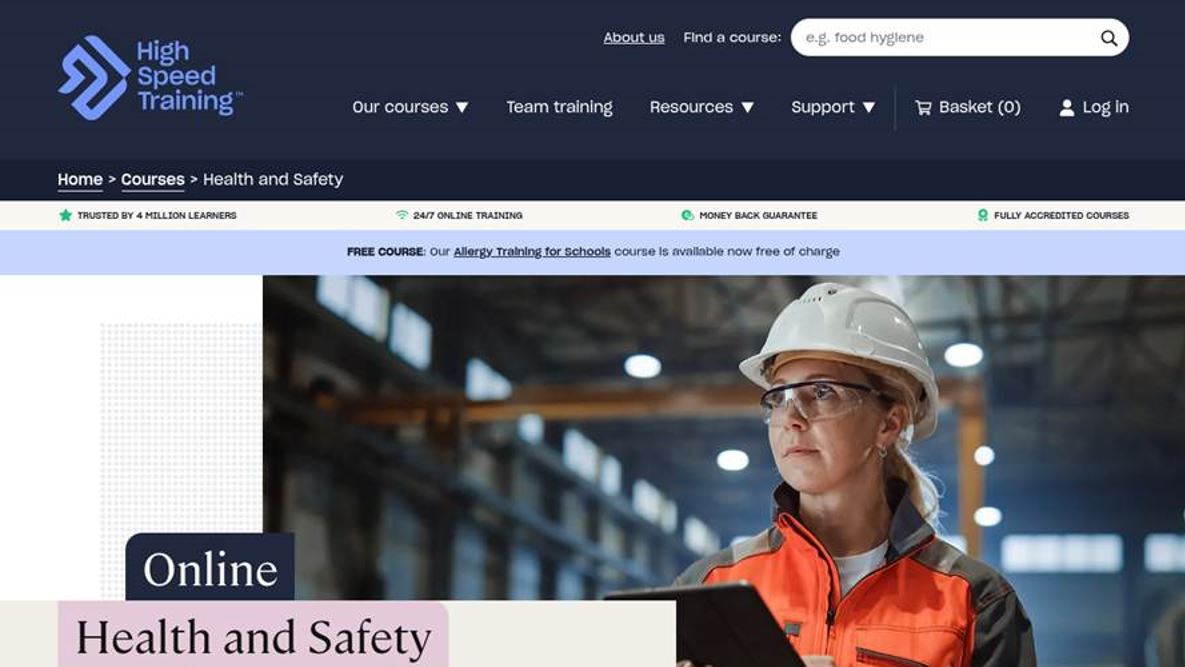
High Speed Training has now trained more than one million learners and is one of the more accessible options on the market. Courses are competitively priced and cover a wide range of subjects, making it a practical entry point for smaller businesses and individuals.
Course range: Health & Safety Level 1, 2, and 3 qualifications, alongside specialist modules in COSHH, fire safety, manual handling, asbestos awareness, and working at height.
Key strengths:
- Prices starting from £15 + VAT
- CPD and RoSPA accredited courses
- User-friendly platform with intuitive navigation
- Instant certificate download
- Excellent customer support
- Regular promotional offers
Ideal for: Cost-conscious businesses seeking compliance training, self-employed individuals needing individual certifications, and organisations with relatively straightforward training requirements.
Accreditations: Courses hold CPD certification, with core health and safety modules also approved by RoSPA.
4. Virtual College – Comprehensive Health and Safety Portfolio
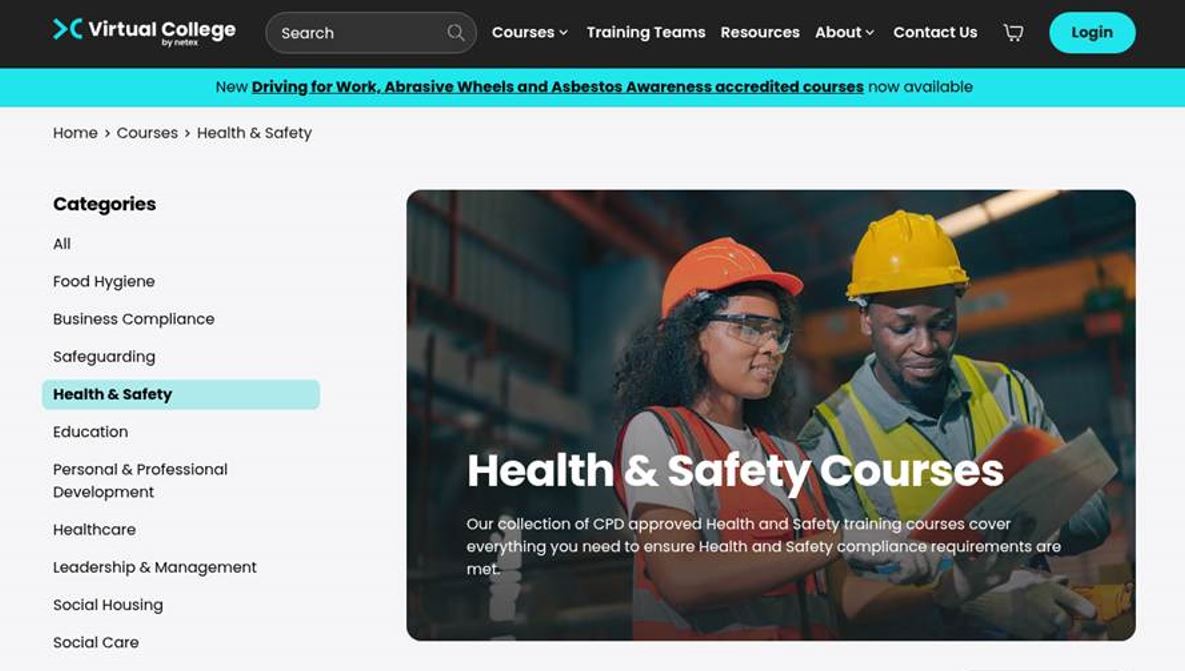
Virtual College combines a broad course catalogue with strong learning technology. It is well-equipped for larger organisations that need detailed reporting and more structured learning pathways.
Course range: Courses cover general awareness training, IOSH qualifications, and specialist subjects such as confined spaces, Legionella awareness, and noise awareness, as well as industry-specific programmes for construction, healthcare, and education.
Key strengths:
- Advanced LMS with detailed reporting capabilities
- Blend of mandatory compliance and professional development courses
- Customisable learning pathways
- Strong focus on engagement with gamification elements
- Excellent mobile experience
- White-label options for large contracts
Ideal for: Large enterprises, multi-site organisations, and businesses requiring sophisticated training management and reporting.
Accreditations: CPD-approved courses with additional industry-specific certifications where relevant.
5. British Safety Council – Internationally Recognised Excellence
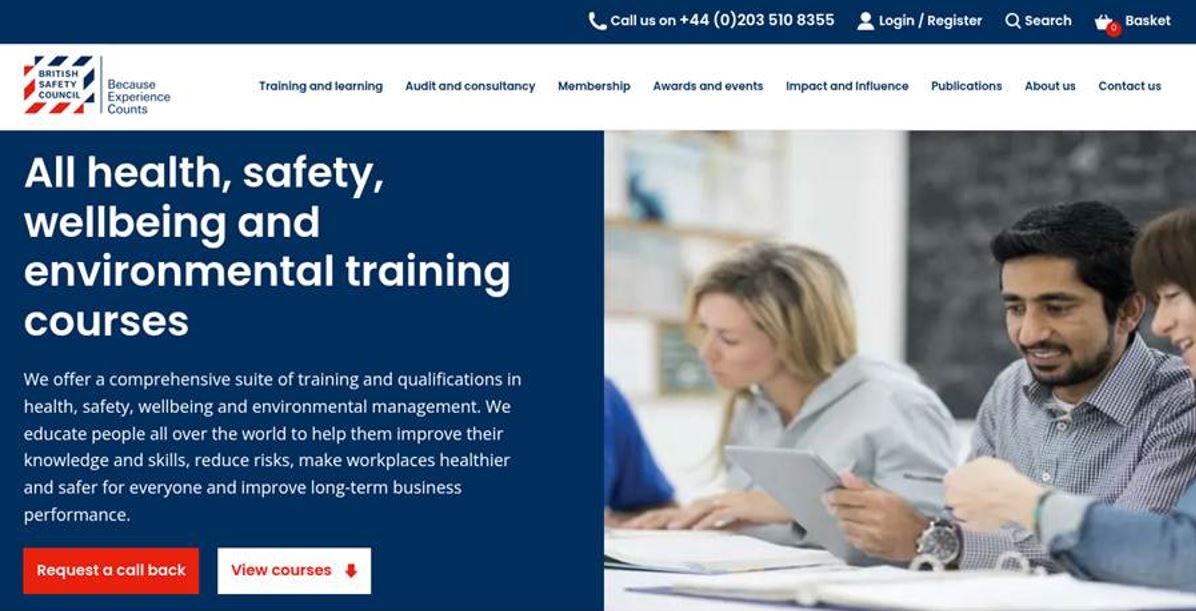
The British Safety Council has shaped UK safety culture for decades. Its training spans health, safety, wellbeing, and environmental management, and its courses are especially valued in high-risk sectors where reputational stakes are high.
Course range: Courses range from foundational workplace safety awareness to advanced qualifications, including the British Safety Council’s own Certificate and Diploma programmes, as well as NEBOSH courses. Specialist subjects include COSHH risk assessment, DSE, workplace driving, and environmental management.
Key strengths:
- Globally respected brand with international recognition
- Research-informed course development
- Excellent for organisations with international operations
- Strong emphasis on safety culture and behavioural change
- Extensive resources and support materials
- Blended learning options combining online and practical assessments
Ideal for: Multinational corporations, high-risk industries (oil and gas, construction, utilities), and organisations pursuing safety leadership rather than basic compliance.
Accreditations: The British Safety Council’s own qualifications are widely recognised, and NEBOSH and other external qualifications are delivered to the highest standards.
Essential Health and Safety Courses Every Business Needs
Regardless of sector, these are the modules most organisations need as a baseline:
Fire Safety Awareness
Every employee should receive fire safety awareness training covering fire prevention, emergency procedures, evacuation protocols, and the correct use of extinguishers. Fire awareness training is a legal requirement under the Regulatory Reform (Fire Safety) Order 2005, with annual refresher training considered best practice.
Manual Handling
Manual handling injuries are among the most common causes of workplace absence, accounting for a significant proportion of reported accidents each year (HSE). Training in safe lifting, risk assessment, and correct equipment use directly reduces that risk.
Display Screen Equipment (DSE)
With remote working now firmly established, DSE training helps prevent musculoskeletal problems caused by poor workstation setup. Employers are required to provide DSE assessments and training under the Health and Safety (Display Screen Equipment) Regulations 1992.
COSHH (Control of Substances Hazardous to Health)
Any business that uses chemicals, cleaning products, or other hazardous substances must ensure staff receive COSHH training. Courses cover risk assessment, safe storage, correct handling procedures, and emergency response.
Risk Assessment
Employers have a legal duty to assess workplace risks under the Management of Health and Safety at Work Regulations 1999. Risk assessment training equips managers to identify hazards and put appropriate control measures in place.
Professional Health and Safety Qualifications
For those taking on formal safety responsibilities or building a career in health and safety, a recognised qualification adds real depth and credibility:
IOSH Managing Safely
This internationally recognised qualification is designed for managers and supervisors across all sectors. It covers risk assessment, hazard identification, accident investigation, and performance measurement. IOSH Managing Safely typically takes three to four days to complete online and includes a practical risk assessment project.
Best for: Line managers, supervisors, and team leaders with safety responsibilities as part of their role.
NEBOSH General Certificate
Widely regarded as the gold standard in health and safety qualifications, the NEBOSH General Certificate provides thorough coverage of safety management principles. This demanding course requires around 113 hours of study and concludes with examinations and a practical assessment.
Best for: Aspiring health and safety professionals, safety advisors, and those seeking career progression in the field.
A comparison of the differences between NEBOSH and IOSH qualifications can help you determine which pathway is better suited to your career goals.
IEMA Foundation Certificate
For those with an interest in environmental management as well as health and safety, the IEMA Foundation Certificate covers sustainability principles, environmental impact assessment, and management systems.
Best for: Professionals responsible for environmental compliance, sustainability coordinators, and those pursuing integrated HSE roles.
Industry-Specific Health and Safety Training
Some sectors have hazards specific enough to need dedicated training:
Construction Health and Safety
Construction sites present particular hazards that call for specific training modules:
- CDM (Construction Design and Management) Regulations 2015
- Working at Heights
- Scaffold Safety
- Excavation Safety
- Site Management Safety Training Scheme (SMSTS)
- Site Supervisors’ Safety Training Scheme (SSSTS)
Healthcare Sector Training
Healthcare environments call for specialised courses, including:
- Moving and Handling Patients
- Infection Prevention and Control
- Sharps Safety
- Violence and Aggression Management
- Medical Gas Safety
Food Industry Safety
Food businesses need to combine health and safety training with food hygiene requirements:
- Level 2 Food Safety and Hygiene
- HACCP Principles
- Allergen Awareness
- Food Safety for Manufacturing
How to Choose the Right Online Health and Safety Course
A few considerations will help narrow the field:
- Assess your legal obligations: Begin by identifying which training is legally required for your industry and specific roles. The Health and Safety Executive (HSE) website provides detailed, sector-specific guidance.
- Consider your learners: Match course complexity to your learners’ existing knowledge and level of responsibility. New employees need foundational awareness training; supervisors need something more in-depth.
- Verify accreditation: Always confirm that courses hold recognised accreditations relevant to your sector. CPD certification provides a baseline quality assurance; RoSPA, IOSH, and NEBOSH qualifications carry greater professional weight.
- Review course content: Request demo access or a detailed syllabus to ensure courses cover the required topics in sufficient depth. Look for practical examples and scenario-based learning rather than purely theoretical content.
- Evaluate the learning platform: The LMS should offer intuitive navigation, reliable progress tracking, straightforward certificate access, and comprehensive reporting for compliance audits.
- Compare pricing models: Some providers charge per course, others offer annual subscriptions, and many provide volume discounts. Calculate your total cost based on anticipated training needs across the year.
- Check certificate validity periods: Understand how long certifications remain valid and when refresher training is required. Build these renewal cycles into your training calendar.
Maximising the Value of Online Health and Safety Training
Buying courses is the easy part. Making them work takes a little more thought:
- Create a training needs analysis: Map roles against required competencies to identify gaps and prioritise training investments.
- Develop a training schedule: Rather than overloading new starters, spread training across induction periods and throughout the course of employment. Annual refreshers help sustain competency levels.
- Use your LMS effectively: Make full use of automated reminders, progress tracking, and compliance reporting to reduce the administrative burden. Workplace compliance training management becomes considerably more straightforward with the right systems in place.
- Blend online and practical training: Online courses are effective for knowledge transfer, but some competencies need hands-on practice too. Fire marshal training is a good example: the online theory works well, but real extinguisher practice matters.
- Monitor and measure effectiveness: Track completion rates, assessment scores, and incident rates to confirm that training is translating into genuinely safer working practices.
- Encourage a safety culture: Training alone does not create safe workplaces. Leadership commitment, open communication about hazards, and regular safety conversations are what reinforce learning and make it stick.
Common Questions About Online Health and Safety Courses
Are online health and safety courses as effective as classroom training?
Research consistently shows that well-designed online courses achieve learning outcomes equal to, or better than, classroom alternatives. The key is course quality: interactive content, scenario-based learning, knowledge checks, and robust assessments ensure both comprehension and long-term retention.
How long do health and safety certificates last?
For most awareness-level subjects (fire safety, manual handling, DSE), certificates require renewal every one to three years, with annual refreshers representing best practice. Professional qualifications such as IOSH and NEBOSH do not expire, but continuing professional development (CPD) is required to maintain active membership.
Do online courses meet legal requirements?
Yes, provided the courses hold appropriate accreditation and cover the required content. UK health and safety legislation does not prescribe how training must be delivered; it requires employers to provide adequate instruction. Online courses from reputable providers fully satisfy this obligation.
Can I train employees on their own devices?
Most modern online health and safety courses are fully responsive and work on desktops, tablets, and smartphones. That said, it is worth checking technical requirements and ensuring all employees have access to a suitable device.
What happens if someone fails the assessment?
Reputable providers offer unlimited retakes, allowing learners to review the course material and reattempt the assessment until they reach the pass mark. This ensures everyone achieves genuine competency rather than simply ticking a box.
The Future of Online Health and Safety Training
Online health and safety training is changing faster than many buyers realise. The practical developments worth watching are shorter modules (five to ten minutes rather than hour-long sessions), platforms that integrate directly with HR and compliance systems, and LMS tools that generate audit-ready reporting that satisfies enforcement inspectors. These are not future possibilities — they are available now from the better providers, and worth asking about when comparing platforms.
Taking Action on Health and Safety Training
Workplace safety is both a legal obligation and a moral responsibility. The best UK online health and safety course providers make compliance achievable without disrupting operations or straining budgets.
Whether you need foundational awareness training for your whole workforce, specialist modules for higher-risk activities, or professional qualifications for your safety team, quality online training delivers knowledge and demonstrates compliance. More importantly, it protects the people who actually do the work.
Begin by auditing your current training provision against legal requirements and industry best practice. Identify any gaps, prioritise by risk level, and select accredited courses from reputable providers. With the right training partner, a genuine safety culture becomes far more achievable.
The investment in health and safety training is never wasted. Preventing a single serious incident more than justifies years of training costs. And beyond the numbers, every employee deserves to work somewhere that takes their safety seriously.
 Accelerate Global
 When should you switch broadband?
 Avetta Announces Two Executive Appointments: Tom McNamara as COO, & Jeff Byal as CFO
 Kinaxia Logistics Transforms its Warehouse Operations with JDA
 Supply Chain and Logistics Expo 2020
 Webfleet’s new cold chain solution helps refrigerated fleets transport goods at the right temperature