

Customer support is the part of a travel management platform that doesn’t show up in the demo and doesn’t fit in the pricing comparison. It becomes the entire experience the moment something goes wrong.
A flight cancels at 11 PM. A hotel can’t find the virtual card on file. A multi-leg booking falls apart 30 minutes before the connection. In those moments, the only thing that matters is how fast a real person picks up.
Most T&E platforms made a bet in the past five years that AI could replace human agents. Some pulled it off for routine queries. Most didn’t pull it off for the hard cases. The platforms below take support seriously enough that it’s a core product feature, not a cost line they’re trying to cut.
This guide ranks eight travel management platforms on customer support specifically. For each, what the support model actually looks like in practice, how fast a real person responds, and where the model breaks down.
What Good Customer Support Actually Looks Like
Six criteria a real-world travel program should evaluate during demos.
| Criterion | What the bar is in 2026 |
|---|---|
| Response time | Live human picks up in under 60 seconds, not “we’ll get back to you” |
| Availability | 24/7 coverage with consistent quality across time zones |
| Channels | Chat, phone, and email; not chat-only |
| Routing | Real agent on the first contact, not a chatbot triage layer |
| Dedicated contact | Named CSM for the account, not a shared support queue |
| In-platform support | Agents work inside the product, not via a third-party TMC partner |
8 Travel Management Platforms: Quick Comparison
| # | Platform | Support response | Support model | Pricing |
|---|---|---|---|---|
| 1 | Itilite | Under 30 sec chat, under 60 sec phone | In-house TMC agents inside the product, 24/7, dedicated CSM | $10/trip; $6/user/mo expense |
| 2 | Perk (formerly TravelPerk) | 24/7 on every plan | Live human chat and phone on all tiers including free Starter | Starter free + 5%; Premium $99/mo + 3% |
| 3 | CTM (Corporate Travel Management) | Dedicated account managers, 97% client retention | Named consultants plus Lightning self-serve booking | Custom |
| 4 | Amex GBT (Egencia) | Global 24/7 phone in major cities | Dedicated account manager plus Amex GBT support network | Custom |
| 5 | FCM Travel | Consultative model, dedicated UK consultants | Named travel consultants for each account, London-based | Custom |
| 6 | BCD Travel | Big 3 TMC service model | 15,000+ agents globally, dedicated account managers | Custom |
| 7 | Navan | Chat-first, phone gated by tier | Mixed reviews on complex disruptions | Free Business up to 300; Enterprise custom |
| 8 | SAP Concur | Call-center model, longer holds | Ticket-based with separate TMC partner for booking | Custom |
1. Itilite
Itilite is the only modern T&E platform on this list where support agents work inside the product, not as a third-party TMC partner sold separately. That structural choice changes how every support interaction goes. When something breaks mid-trip, the agent who picks up the phone has full context on the booking, the policy, and the traveler’s history, because the booking platform and the agent team are the same product.
How Itilite’s support works. Live human agents pick up chat in under 30 seconds and phone in under 60 seconds, with 24/7 coverage that includes UK and Asia overnight hours staffed by English-native agents. Every account gets a named Customer Success Manager who handles onboarding, configuration, and ongoing account management. No shared support queue. The in-house TMC architecture means there’s no handoff between the platform vendor and a separate travel agency when a complex rebooking needs to happen.
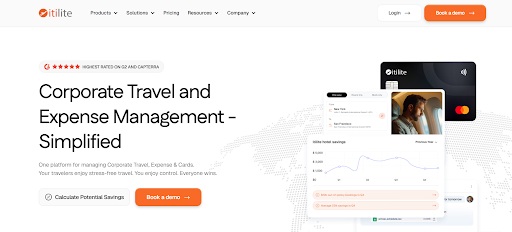
The AI voice feature added in 2026 extends the support model into a different channel. Travelers can ask Iris about policy or handle simple booking changes by talking instead of waiting in a queue. For complex situations, a real agent still picks up.
Where it falls short. The under-30-second response time depends on chat being the channel. The phone takes under 60 seconds in most cases, but a busy hour can push it. For travelers who default to phone, it is worth setting expectations that chat is the fastest route.
Best for: Mid-market companies (100 to 2,000 employees) where support quality is a procurement priority.
Pricing: $10/trip; $6/user/mo expense (annual).
2. Perk (formerly TravelPerk)
Perk’s 24/7 customer support earns some of the strongest user reviews in the category. It also features Perk ships on every plan, including the free Starter tier. For most travel platforms, support quality scales with how much you pay. Perk’s pitch is that it doesn’t.
What Perk’s 24/7 support delivers. Live agents available around the clock through chat and phone. No tier gating. The free Starter plan gets the same support response as Premium and Pro. That structural choice is rare in the category, and it shows up in G2 reviews as one of the most consistently praised aspects of the product. The London office and EU operational presence mean European time zones get coverage that aligns with where most European business travel actually happens.
Where it falls short. Per-booking fees stack up on high-volume travel, so the cost calculus changes once your team books often. The Yokoy expense module added in January 2025 is newer than competitors that built expense from the start, so support for expense-specific issues is less mature than support for booking issues.
Best for: Travel-heavy mid-market companies that value support availability over price.
Pricing: Starter free + 5% per booking. Premium $99/month + 3%. Pro $299/month + 3%.
3. CTM (Corporate Travel Management)
CTM is the Australian-founded TMC that built its mid-market position primarily on relationship depth. The company highlights a 97% client retention rate, which it attributes to a dedicated account-manager model that functions more like an extended team than a rotating support queue. For mid-market and enterprise buyers who specifically want named consultants over self-serve speed, CTM ships that model at scale.
CTM’s relationship-driven approach. Each account works with a named travel consultant who handles complex itineraries, group bookings, and exception cases. The Lightning online booking tool covers self-serve for routine bookings, but the human consultant relationship is the actual differentiator. CTM is the world’s 4th largest TMC by transaction volume, with operations across North America, Europe, and Asia-Pacific. The company cites a sub-90-second pickup target for customer calls, though G2 and Trustpilot reviews describe a more variable experience in practice during complex disruptions.
Where it falls short. Long support hold times during complex situations surface in user reviews regularly, despite the stated response targets. Modification fees can apply for self-serve changes made through Lightning, which pushes most non-routine bookings back through the consultant relationship. Pricing isn’t transparent, which is typical for legacy TMCs but still worth flagging during procurement.
Best for: Mid-market and enterprise companies that prioritize dedicated account management over pure self-serve booking.
Pricing: Custom. Contact sales.
4. Amex GBT (Egencia)
Egencia carries the support legacy of American Express Global Business Travel, the largest TMC in the world by transaction volume. The Amex GBT network provides global 24/7 phone support across major cities, which matters when a traveler is stranded outside US business hours and needs help from an agent who works in the local time zone.
Egencia’s global account management. Every enterprise Egencia account gets a dedicated account manager. The Q1 2026 platform relaunch added Egencia AI inside Microsoft Teams as the first-line support layer for routine queries, but the human-agent network underneath handles complex cases. The Amex GBT network covers most major international cities with local-language support during business hours, which most modern challengers can’t match. Native integration with Concur Expense closes the loop for finance-side support issues.
Where it falls short. Onboarding takes meaningfully longer than self-serve modern platforms, which delays time-to-first-support-interaction. Custom pricing means the support tier you get depends on how much you negotiate during procurement.
Best for: Global enterprises with international travel programs.
Pricing: Custom. Contact sales.
5. FCM Travel
FCM Travel runs a consultative service model that hasn’t changed much in 30+ years, with dedicated UK-based travel consultants for each account. For UK enterprises and mid-market companies that prefer named account management over self-serve booking, this is the platform that delivers it.
FCM Travel’s consultative model. Each account gets a dedicated consultant who handles bookings, changes, and complex itineraries. The model is closer to a traditional travel agency relationship than a SaaS platform, which is a feature for some buyers and an obstacle for others. FCM’s London HQ plus satellite offices across England and Scotland mean UK business hours are well-covered. The FCM Platform self-serve tool exists for travelers who want to book without an agent, but the consultant relationship is the company’s actual product.
Where it falls short. Pricing transparency varies by deal size, and the consultative model carries a cost premium that self-serve modern platforms avoid. For very small teams or for companies that want pure self-serve, FCM’s model is overbuilt.
Best for: UK mid-market and enterprise with global travel programs and a preference for named account management.
Pricing: Custom. Contact sales.
6. BCD Travel
BCD Travel’s support model is the standard “Big 3” TMC approach: dedicated account managers backed by 15,000+ agents globally. UK offices in London and Bourne End provide local relationship management. The 2025 Virtual Card Acceptance Rating launch addressed one specific recurring support pain point: the hotel that can’t find the virtual card on file.
BCD Travel’s service-led approach. Like FCM, BCD relies on dedicated account managers as the primary support relationship. TripSource (BCD’s cloud platform) provides the self-serve layer for travelers who want to book without an agent, but the company’s actual differentiator is the human network behind the platform. Strong relationships with major airlines and hotels mean negotiated rates and operational issues get resolved through commercial channels that pure-software competitors don’t have access to.
Where it falls short. Pricing isn’t transparent without a sales conversation. The self-serve mobile experience trails newer platforms despite recent investment in TripSource.
Best for: Large enterprises with complex global travel programs.
Pricing: Custom. Contact sales.
7. Navan
Navan’s support story is the one users feel most strongly about, and not entirely in the way the marketing suggests. The chat-first model handles routine queries efficiently and the AI assistant answers many common questions without human intervention. Complex disruptions (flight cancellations, multi-leg rebookings, mid-trip emergencies) consistently surface in G2 reviews as the friction point where the model breaks down.
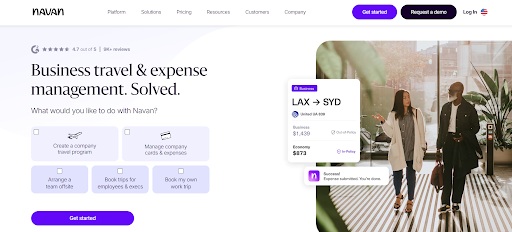
Where Navan’s support model falls short. Phone access is gated by plan tier, so smaller accounts on the free Business plan don’t get phone support reliably. Chat response times are reasonable for routine queries but lengthen significantly for issues that require an agent to dig into a booking. The Navan Edge launch in March 2026 added Ava as a disruption-management agent, which has improved automated rebooking, but human-side escalation for complex situations still takes longer than the modern platforms with in-house TMC support.
Where it works. Routine queries get handled quickly. The mobile experience is polished. For small teams under 300 employees with light expense workflows, the free Business plan covers a lot of usage without ever needing complex support.
Best for: Small US teams (under 300 employees) with routine travel patterns and light expense workflows.
Pricing: Free Business plan up to 300 employees, expense features free for first 5 users. Enterprise custom.
8. SAP Concur
Concur’s support model is what you’d expect from a legacy enterprise platform: call-center hold times, ticket-based escalation, and a separate TMC partner (Amex GBT, BCD Travel, or CWT) who handles the actual booking-side support. Concur itself isn’t a TMC. The platform sells software; the human support comes from whichever TMC the customer contracts with separately.
Concur’s legacy support structure. Enterprise customers typically work with a dedicated TMC account team that handles bookings, changes, and traveler support. Concur Support handles platform issues (expense reports, integrations, configuration), not travel booking issues. The two-vendor model means support escalations sometimes get handed off between the platform vendor and the TMC partner. For enterprise teams used to this model, it works. For mid-market buyers expecting modern in-platform support, it’s a meaningful adjustment.
Where it works. For SAP-anchored enterprises with established TMC relationships, the model fits the broader procurement structure. The 2026 Joule generative AI integration handles some routine queries through chat without involving the human network.
Best for: Large enterprises (1,000+ employees) on SAP ERP with established TMC relationships.
Pricing: Custom. Contact sales.
How to Test Support During a Demo?
The single most useful evaluation step costs nothing and tells you more than any feature comparison. Call the support line during the demo cycle at the most inconvenient time you can think of. 11 PM on a Sunday. 7 AM on a Saturday. Mid-afternoon during a major travel disruption. Time how long until a real human picks up.
Two follow-up questions during that call. First, ask about a complex hypothetical: “How would you handle a flight cancellation at 11 PM with a connection in two hours?” Listen for whether the agent knows the answer or has to escalate. Second, ask whether the support team has access to the same platform the buyer would use. If the answer involves a third-party TMC handoff, that’s the multi-vendor model showing up.
The platform that picks up fastest, with an agent who can answer complex questions without escalation, is doing real support. The ones that route you to a chatbot, to email, or to a queue with a return-call promise are doing cost-optimized support that breaks down when travel goes wrong.
The Verdict
For mid-market companies where support quality is a procurement priority, Itilite ships the most structurally differentiated support model on this list. The in-house TMC architecture means agents work inside the product, response times stay under a minute, and there’s no second-vendor handoff during a crisis.
Perk earns the strongest user-review consensus for 24/7 availability across plan tiers. CTM brings the relationship-driven account management model for mid-market companies that want a named consultant rather than a queue. Egencia, FCM, and BCD remain strong for enterprise programs that prefer named account management. Navan and Concur fit the “support is fine for routine, frustrating for complex” pattern that shows up in G2 reviews. Before signing any T&E contract, call the support line on a Saturday night and time the response. That single test will tell you which platform takes support seriously and which sells it.
 4 Key Performance Indicators (KPIs) For IT Asset Management
 Vault365 to grow revenues by £865,000 with launch of secure data backup solution
 DCS Group & XPO Logistics drive forward strategic partnership
 How lifestyle habits are subtly shaping global logistics behavior
 Visku hosts special Chambers of Commerce event
 Terminal operations at Ningbo-Zhoushan may partially resume after no new COVID cases detected