
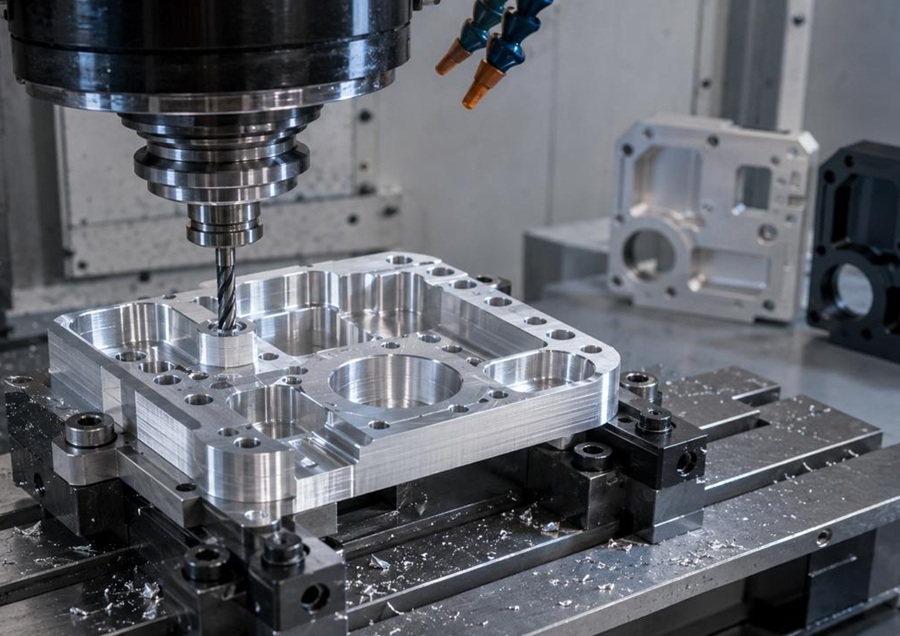
Material selection determines more than whether a finished part survives its design load. It affects workholding, material-removal rate, movement after unclamping, inspection strategy, and finishing consistency.
These effects are especially visible in precision CNC work, where a change in alloy or temper can alter cycle time, tool life, measurement effort, and scrap risk.
6061 aluminum remains a useful reference point for these decisions. It is not the strongest aluminum alloy or the best choice for every corrosive or high-temperature environment.
For many brackets, housings, fixtures, and machine components, however, it provides sufficient performance while remaining straightforward to source, machine, inspect, and finish.
Why 6061 Aluminum Is So Widely Used in Manufacturing
6061 is a heat-treatable aluminum-magnesium-silicon alloy. CNC drawings commonly specify T6 or stress-relieved T651 condition when mechanical properties or dimensional behavior matter. The alloy is widely available as plate, bar, extrusions, and tube, giving designers flexibility during development and reducing the chance of redesign around unusual stock.
Its strength-to-weight ratio suits many structural and semi-structural components that do not justify a higher-strength alloy. Natural corrosion resistance serves general industrial environments, and the material responds well to anodizing and mechanical finishing. It can also be welded more readily than 7075, although welding changes local properties and requires separate review.
One grade can therefore support prototypes, fixtures, enclosures, mounting hardware, and moderate-duty production components. Procurement teams can usually obtain it from several sources, while machine shops often have established tools, workholding methods, and inspection routines for it. That familiarity reduces process uncertainty even when raw material is not the lowest-cost line item.
Machinability in CNC Milling and Turning
6061 machines with relatively low cutting forces compared with steels and many stainless grades. Modern carbide tools can run at high spindle speeds and material-removal rates, making the alloy productive for pocketing, contouring, drilling, and turning. Low workpiece stiffness can still govern cuts on slender features.
Performance depends on edge condition and chip control. Aluminum can adhere to a dull or poorly selected edge, creating built-up edge and degrading the surface. Sharp positive-rake tools, polished flutes, ample flute space, and effective evacuation help prevent recutting. Air blast, minimum-quantity lubrication, or flood coolant may be appropriate. In deep pockets, chip evacuation may limit the cut before spindle power does.
Temper also influences cutting behavior. T6 material generally produces more manageable chips than soft annealed stock, which can feel gummy and form long strings. Turning needs suitable chip-breaker geometry and feed; milling quality depends on cutter runout, tool projection, radial engagement, and finishing allowance.
No universal speed-and-feed value is correct for every 6061 part. Tool diameter, machine dynamics, workholding, wall thickness, coolant delivery, and required finish all matter. Grade, geometry, tolerance, and finish should therefore be reviewed together; this overview of aluminum CNC machining considerations illustrates recurring questions for milled and turned parts.
Dimensional Stability and Precision
6061 supports precision work, but easy cutting does not guarantee dimensional stability. Heavy material removal can release residual stress in plate, bar, or extrusion. Thin walls and asymmetric pockets may then bow or twist. Stress-relieved 6061-T651 plate is often preferred for heavily machined components, yet stock history, geometry, and clamping remain important.
Process planning often contributes more to accuracy than machine capability alone. Separating roughing and finishing gives the part time to relax. Balanced stock removal, restrained clamping near thin sections, temporary supports, and semi-finishing can control movement. Critical bores or datum faces are best finished after major roughing, using a stable datum scheme across setups and inspection.
Aluminum also expands more with temperature than steel. A warm part measured after aggressive machining may not represent its dimension at the inspection reference temperature. Close-tolerance processes should control coolant conditions, allow thermal stabilization when needed, and use a consistent measurement method. In production, small thermal drift can affect many parts before final inspection detects it.
Where 6061 Aluminum Fits in Modern Manufacturing
Automation equipment uses 6061 for sensor mounts, actuator brackets, base plates, guarding hardware, and end-effector structures where low mass reduces moving inertia. Robotics applications benefit when a component must carry wiring, provide accurate mounting interfaces, or be modified during commissioning.
Electronics enclosures and instrument housings use the alloy for stiffness, machined connector openings, thermal conduction, and electromagnetic shielding. In aerospace work, 6061 appears in ground-support equipment, fixtures, test hardware, and approved auxiliary items; higher-load flight structures often require another alloy and qualification path.
Automotive and industrial applications include brackets, covers, mounting blocks, jigs, and inspection fixtures. Prototype teams use 6061 to test fit, motion, assembly access, and packaging with a functional metal part. Production engineers often retain it for low-volume components when it meets service loads and avoids a material change after development.
6061 Compared With Other Common Machining Materials
6061 and 7075 aluminum. The usual reason to select 7075 is higher strength, not easier manufacturing. It machines effectively but costs more, is less suitable for conventional welding, and needs closer attention to corrosion protection and stress-corrosion risk. If 6061 meets load, stiffness, fatigue, and safety requirements, its availability and finishing flexibility often simplify production. Weight-critical structural parts may justify 7075; housings and fixtures often do not.
6061 and stainless steel. Many stainless grades offer greater stiffness, wear resistance, temperature capability, and strength, with corrosion performance for harsher environments. The tradeoff is higher density, cutting force, heat concentration, and tool demand. Replacing stainless with 6061 solely to shorten cycle time is unsound if threads, bearing surfaces, impact loads, or chemical exposure require steel properties.
6061 and engineering plastics. Plastics can reduce weight and provide insulation or chemical resistance, but creep, moisture response, thermal expansion, and heat-deflection limits can complicate tight tolerances and threads. 6061 suits durable threads, stiffness, heat spreading, shielding, and stable interfaces. Plastic remains attractive when low mass, insulation, or corrosion immunity matters more than rigidity.
From Prototype to Production
6061 is effective when one material must support several manufacturing stages. Designers can machine a functional prototype from common plate or bar, revise the CAD model, and enter low-volume production without rebuilding the material strategy. Prototype inspection remains relevant if stock form and temper stay consistent.
CAD and CAM decisions must mature as volume increases. A prototype may tolerate extra setups and general-purpose workholding. Repeated production calls for controlled datums, dedicated fixtures, verified tool life, reliable chip evacuation, and stable probing or offset routines. Milling and turning sequences should protect critical relationships instead of optimizing features in isolation.
Inspection should follow the same logic. First-article inspection confirms the datum structure and identifies dimensions affected by unclamping or temperature. In-process checks monitor features that predict drift, while final inspection verifies function. Consistent material certification, stock allowance, setup instructions, tooling, and finish specifications turn a successful prototype into a repeatable process.
Surface Finishing and Post Machining Options
6061 accepts several common finishes, but each changes the manufacturing plan. Type II anodizing supports corrosion resistance and appearance. Hard anodizing provides a thicker, more wear-resistant layer. Because anodizing grows partly above the original surface and partly into it, critical bores, threads, sealing faces, and electrical contacts may need allowance, masking, or post-finish verification.
Bead blasting creates a uniform matte texture and reduces contrast between toolpaths. Media, pressure, distance, and technique affect consistency across parts. Polishing improves reflectivity or visual smoothness but can soften edges if poorly controlled. Chemical conversion coatings suit parts needing corrosion protection and electrical conductivity; paint or powder coating may suit handled or outdoor equipment.
Surface preparation should specify the desired result, not only a finish name. Temper, stock grain, machining marks, deburring, blasting, racking contact, and batch variation affect appearance. Drawings should identify cosmetic surfaces, and inspection should account for when the finish is applied.
Choosing 6061 for the Right Application
6061 is a sound default only when requirements support it. Review static and cyclic loads, impact, temperature, corrosion, stiffness, weight, electrical or thermal behavior, joining, tolerance, finish, and total cost. A part may machine easily yet fail because a thread wears, a thin wall deflects, or temperature exceeds the design margin.
Stock form and temper belong in the same decision. Extrusion may suit a profile-based component, while stress-relieved plate may serve a flat part with deep pockets on both sides. Drawings should identify alloy, temper, finish, critical dimensions, datums, and certification requirements so manufacturing and inspection evaluate the same definition.
Conclusion
6061 remains important because it performs predictably across the CNC production route. It is widely available, machines efficiently with established tooling, provides useful mechanical performance at low weight, and accepts finishes used throughout automation, robotics, electronics, automotive, and industrial equipment.
Familiarity should not replace engineering judgment. Tight-tolerance parts still require control of residual stress, wall stiffness, temperature, workholding, datums, and coating buildup. When those factors are reviewed against service loads and environment, 6061 often provides a practical balance between part performance and manufacturing control from prototype through repeatable production.
 Top Supply Chain Solution Providers Across the Globe Unite as Körber
 Supplier Onboarding Without Email Chaos
 Panasonic Robot & Welding announces new partnership with DSL Schweisstechnik
 TruTac bring new tools for improved fleet management to RTX Show
 How to improve budget management during software development
 Kallik selects TEKLYNX as strategic integration partner