

Supply-chain resilience used to be discussed largely in physical terms: alternative suppliers, extra warehouse capacity, contingency routes and sensible stock planning. Those things still matter, of course. Yet the modern supply chain also depends on something less visible and just as essential, uninterrupted digital operations.
A delivery may be physically on the road, but if the transport system cannot share its location, the warehouse cannot update stock records or the customer cannot receive an accurate notification, the experience has already broken down. The goods are moving, but the service is not.
That is why resilient supply chains now need to think like always-on digital services. They must be able to process events as they happen, cope with demand changes, protect sensitive information and recover quickly when a component fails. It is less about building one enormous, flawless system and more about designing operations that can absorb disruption without leaving people in the dark.
When digital operations pause, the whole chain feels it
Most supply chains run through a network of systems owned by different organisations. A manufacturer may use one planning platform, a carrier another, a warehouse management provider a third, and a retailer several more. Data needs to move reliably between all of them.
The weak point is often not the physical product. It is the missing signal.
Imagine a shipment being delayed at a depot. If that update arrives in real time, a retailer can adjust its receiving plan, customer-service staff can respond with confidence, and downstream teams can make sensible choices. If the update is delayed or lost, people start working from assumptions. Calls, emails and manual spreadsheets soon follow.
This is why resilience means more than keeping an application online. It means maintaining the critical flow of operational information:
- orders accepted and confirmed
- stock levels updated across channels
- pick, pack and dispatch events recorded correctly
- transport milestones shared with relevant partners
- exceptions identified before they become customer problems
- supplier data available when planners need it
A system can show an impressive uptime figure while still failing the people who rely on it. For instance, an order portal might be available, but a delayed integration could mean it displays stock that no longer exists. Operational resilience should therefore focus on whether a service is useful, current and trustworthy, not merely whether a webpage loads.
Build for changing demand, not just normal demand
Supply chains rarely behave neatly. Seasonal peaks, supplier delays, weather events, product launches and local disruptions can all create sudden surges in activity. Digital platforms have to handle that unevenness without causing bottlenecks elsewhere.
Cloud infrastructure is useful here because capacity can be adjusted to meet genuine operational need. But scalability is not simply a matter of adding more computing power. The application, databases, integrations and support processes all need to cope as volumes rise.
A well-designed platform separates critical workflows from less urgent jobs. Order allocation, inventory updates and carrier hand-offs may need priority, while a non-essential report can wait a little longer. This avoids a busy background task slowing down the process that keeps goods moving.
Let events drive visibility
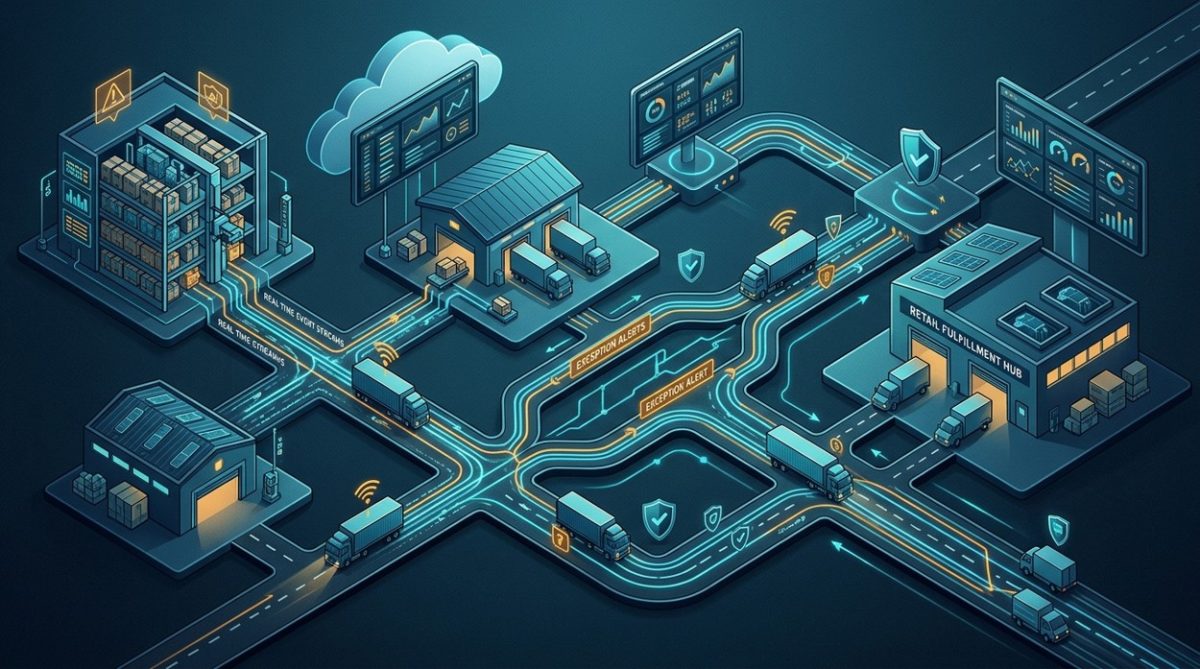
The most resilient supply-chain systems are increasingly event-driven. Rather than waiting for a nightly batch update, they react when something meaningful happens: an order is placed, a pallet is scanned, a vehicle leaves a site, a delivery is completed or an exception is raised.
This approach gives teams a more accurate view of what is happening now. It also allows automated responses. A late collection event, for example, could trigger a notification to a planner and prompt the system to check alternative capacity.
There are a few practical rules worth following:
-
- Treat each event as a record, not a vague message. Include an identifier, timestamp, source and status so it can be traced later.
- Expect duplicate and late events. Networks fail, systems retry and partners send updates at different speeds. Your workflows must cope without creating duplicate orders or misleading stock records.
- Keep a clear source of truth. Not every system needs to own every data field. Define which platform is authoritative for stock, order status, product details and transport milestones.
- Design useful exceptions. “Integration failed” is not an operational instruction. Tell the right person what has failed, what is affected and what action is needed.
Automation should remove friction, not hide risk
Automation can take care of repetitive decisions such as matching orders to stock, routing routine exceptions or producing supplier alerts. Done well, it saves teams from spending their day copying data between systems.
Still, automation needs boundaries. A rule that reallocates stock automatically may work perfectly in most cases but create awkward outcomes for priority customers or regulated products. Give staff a way to review, override and understand what the system has done.
I find the best question to ask is simple: if this automation makes the wrong decision at 3am, will we know quickly, and can someone put it right safely? If the answer is unclear, the process needs more thought.
Observability makes resilience practical
Observability is the ability to understand what a complex service is doing from its logs, metrics, traces and alerts. It may sound technical, but its value is very human. It helps people answer, “What has happened, where, and who needs to act?”
For a supply chain, that might mean monitoring:
- order-processing times
- stock-update delays
- failed partner messages
- warehouse scanner availability
- carrier status-feed freshness
- API response times
- the number and age of unresolved exceptions
Alerts should be linked to action. A dashboard full of red warnings that nobody owns is not observability, it is wallpaper. Clear escalation routes and named responsibility turn monitoring into a useful operating habit.
Trust has to be designed into the platform
High availability without security is a fragile promise. A supply-chain platform often holds commercially sensitive information, personal delivery details and account credentials. It may also connect directly to supplier, warehouse and transport systems. One poorly controlled account can affect far more than one user.
A sensible starting point is strong identity management. Use multi-factor authentication where appropriate, grant people only the access they need and review permissions when roles change. Service accounts and machine-to-machine connections deserve the same care as staff logins, particularly where automated workflows can create, amend or release orders.
Data governance matters too. Teams should know:
- what data they collect and why
- who owns its quality
- where it is stored and transferred
- how long it is retained
- which partners can access it
- how inaccurate data is corrected
Payment-security principles offer a helpful lesson even where a supply chain does not take payments directly. Reduce exposure to sensitive data, separate duties, log important actions and validate connections to external providers. These habits limit the damage a single failure or compromised account can cause.
The NIST Cybersecurity Framework is a useful reference because it frames cyber risk around governance, protection, detection, response and recovery. Crucially, recovery should not be an afterthought.
A credible incident plan sets out who decides, who communicates, what systems can be isolated, and how services are restored. It should include suppliers and technology partners, not just internal IT teams. There is little value in a recovery plan that assumes every external integration will remain available during an incident.
A cross-industry example, clearly illustrative
Illustrative example: A regulated real-time service, such as bingo on Double Bubble Bingo, illustrates why scalable infrastructure, secure account access, reliable payments, monitoring and responsive support must operate together.
The operational lesson is not specific to that sector. When customers expect a service to work at any hour, isolated strengths are not enough. Fast infrastructure does not help if account access fails; secure sign-in does not help if payment processing or support channels stop working.
Age-verification and responsible-gambling controls are also examples of compliance-aware platform design. They are not supply-chain requirements, but they demonstrate the importance of building checks into the service journey rather than attempting to add them after launch. In every industry, the same principle applies: compliance, security and usability need to work together.
Gambling should always be approached responsibly, within personal limits and through appropriately regulated services.
A practical checklist for stronger digital resilience
You do not need to rebuild every system at once. Start with the workflows that would cause the greatest disruption if they stopped or produced unreliable data.
1. Identify the genuinely critical journeys
Map the full path of an order, inventory update or delivery exception. Include external partners, manual hand-offs and hidden dependencies such as identity providers or shared integration services.
Ask where a delay of one hour would matter most.
2. Set service-level measures that reflect reality
Track metrics that matter to operations, not only IT. Examples include:
- percentage of orders confirmed within an agreed time
- maximum acceptable delay for inventory updates
- carrier-event completeness
- time to detect a failed integration
- time to restore a critical workflow
- percentage of exceptions resolved within target
Service-level objectives give everyone a shared definition of acceptable performance.
3. Test recovery paths before you need them
Back-ups are important, but restoration is the real test. Practise losing an integration, a warehouse connection or a key data feed. Can teams continue safely? Can they reconcile the missing information afterwards?
Testing should include business users, customer support, suppliers and technical teams. Resilience is a team sport.
4. Make accountability visible
Every critical service needs an owner, a documented escalation path and regular review. Governance should cover operational performance, security risk, data quality and supplier commitments together. Separate meetings for each may be necessary, but the decisions must join up.
Dependability is the customer experience
A resilient supply chain is not merely one that survives disruption. It is one that continues to give customers, partners and staff dependable information when conditions become difficult.
That comes from the disciplines always-on services have learned the hard way: scale with care, watch the right signals, secure every connection, rehearse recovery and give people clear ownership. Get those foundations right and your digital capabilities become something far more valuable than a collection of systems. They become a service people can rely on.
 Seamlessly integrated: KESSEL relies on inconso’s SAP know-how for warehouse expansion
 The Power of Scalability and Big Data in Market Analysis
 Can telcos be superapps?
 Cohesity Appoints Fraser Hutchison to Lead Business in Northern EMEA
 Connecting with Italy Made Easy: The Virtual Number Solution
 8 Reasons E-Bikes Are the Future of Urban Mobility