
With shipping costs rising and profit margins under pressure, efficient cargo transportation is more important than ever. For transport managers and freight forwarders, each truck, trailer, and container is a valuable resource. Still, a major source of inefficiency often gets overlooked: the way cargo is packed.
A truck can be fully booked and still have empty space, or it might reach its weight limit before it is full. True transport efficiency starts before the vehicle leaves, with how the cargo is arranged. This is why 3D load planning software is now essential in modern transport management.
The Problem with Shipping “Air”
When a truck or container leaves with significant unused space, carriers pay to transport capacity that generates no revenue. This often happens due to mixed pallet sizes, irregularly shaped cargo, or non-stackable items that leave valuable vertical space unused. Unused capacity results in a higher cost per unit, lower fleet productivity, and the potential need for additional, unnecessary trips that increase fuel consumption and emissions.
The Limits of Spreadsheets and Mental Math
Spreadsheets remain useful for straightforward shipments, but they do not provide an interactive three-dimensional representation of how cargo fits together. A planner may calculate the total cargo volume correctly and still discover that the shipment does not fit during loading because total volume does not account for handling geometry. Two shipments with identical total volumes can require vastly different amounts of loading space depending on their dimensions and stacking restrictions.
The Rise of 3D Load Planning Software
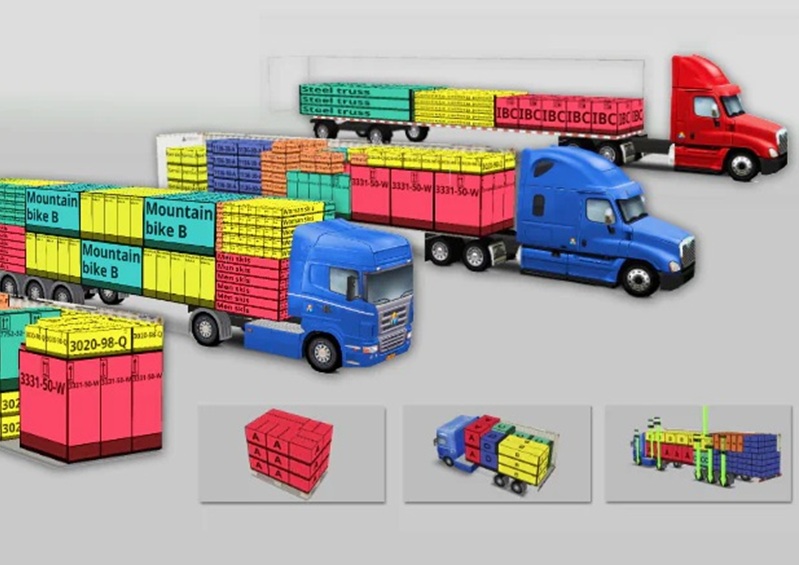
Modern logistics technology is replacing tables and estimates with visual planning. By utilizing a dedicated 3D load planning software like EasyCargo, logistics coordinators can input cargo dimensions and instantly generate an interactive, step-by-step loading plan.
These digital tools combine dimensions, quantities, weights, and handling restrictions (e.g., non-tiltable or non-stackable flags) to develop practical loading arrangements before cargo reaches the warehouse floor. This allows planners to identify wasted space, inspect positioning, and generate shareable loading instructions for warehouse teams in minutes rather than hours.
Ensuring Axle Weight Compliance
Space utilization is only half the battle; a vehicle must also remain within its permitted payload and axle weight limits. Placing heavy items incorrectly can create excessive loads on individual axles, leading to vehicle handling issues, safety risks, and regulatory penalties.
Manual axle weight calculation is highly time-consuming when comparing multiple cargo arrangements. Truck load planning tools simplify this by automatically calculating weight distribution across supported vehicle configurations. Planners can immediately see how moving a single heavy item changes the weight distribution across the entire truck, ensuring compliance before departure.
Connecting Load Planning to the Wider Supply Chain
Digital load planning is part of a broader shift toward connected Supply Chain Execution (SCE). When load planning software integrates with Warehouse Management Systems (WMS) or Transport Management Systems (TMS)—often via API—planners can import cargo data instantly. This reduces manual data entry, prevents duplicated work, and provides logistics teams with the agility to adjust loading plans instantly if delivery schedules or cargo quantities change.
Measuring the ROI
The true value of load optimization technology is measured in business outcomes. Transport teams can track success by monitoring:
- Loading space utilization: How effectively the available volume is used.
- Cost per shipped unit: Transportation costs relative to the quantity of goods moved.
- Additional trips required: Whether better planning reduces the need for extra vehicles.
- Loading errors: Whether clearer 3D instructions reduce warehouse delays.
The Bottom Line on Cargo Optimization
Maximizing container and truck capacity requires more than calculating theoretical volume. 3D load planning software gives logistics teams the visual tools needed to compare scenarios, check weight distributions, and eliminate the costs of “shipping air.” Ultimately, more efficient transportation does not begin when the truck reaches the road—it begins with a better loading plan.
 TSC Printronix Auto ID’s new 6-inch PEX-2000 print engine promises trouble-free integration, operation & maintenance
 How to unlock the value of data-driven logistics
 Comparing the six Best AI-Powered Contract Management Tools
 Labour exchange
 What’s Happening To Retail As Physical & Online Stores Collide?
 Competitive advantage for UK businesses that have ditched PSTN as over half report improved workplace flexibility