

A status code says a shipment was late. The recovery history can show how your team weighed the options, secured approval and got it moving again.
Illustration: a failed shipping route replaced by a glowing recovery route between logistics hubs. Conceptual artwork for this sponsored articl
A shipment misses its window. The planning system logs the delay in a single line.
Then the real work begins. Someone finds an alternative carrier, checks what the contract actually promised, warns the customer and chases the one person who can approve the extra cost. By the end of the day the order is moving again, and almost none of that reasoning lives in the status code.
For supply chain AI training data, the recovery history can reveal decisions that a status code cannot. It shows how people worked around a failed plan, which constraints they checked and whether the remedy worked.
Follow the exception across systems
A disruption might start in transport management software, move through a service ticket and end in a commercial approval. Each system holds one fragment of the event.
A useful collection connects the fragments: the original commitment, the observed problem, the options available, the action chosen and the final result. It should also record when the fix failed or the outcome stayed uncertain. A dataset of only happy endings teaches the wrong lesson.
The GS1 EPCIS standard gives teams a reference for describing supply chain events and their business context, and it can help structure an inventory. It does not, of course, establish that every related message or commercial record can be licensed externally.
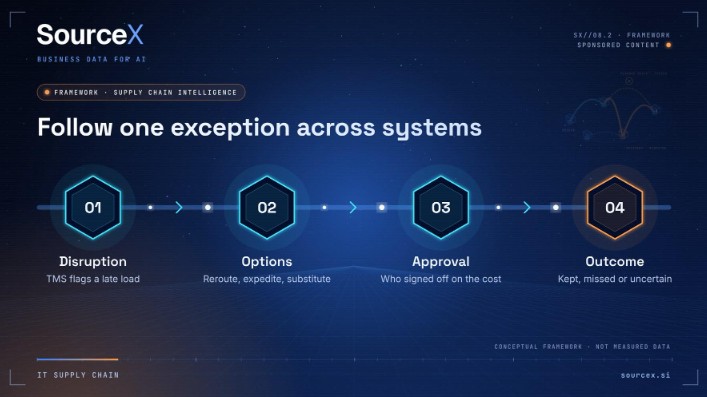
Follow one exception across systems. A conceptual framework drawn from the article, not measured performance or a completed transaction.
Separate operational meaning from sensitive detail
The decision to reroute matters. The customer’s contact details probably do not. A warehouse escalation can be valuable without exposing a protected price schedule or an unreleased product plan.
That separation needs dataset-specific review, because removing names is rarely enough. A route, a timestamp and an unusual cargo description can still identify a customer or a commercially sensitive event.
Rights deserve the same attention. Logistics businesses hold information supplied by customers and carriers under restricted terms. Having access to a record does not settle permission to use it for AI training or evaluation.
Build one case a reviewer can understand
Before counting a whole archive, describe one recurring exception in writing. At this stage you need metadata and an outline, not copies of operational records. Document:
- Which system records the initial event.
- Where staff capture the reason for their decision.
- How approvals link to the actions that followed.
- What evidence separates a real resolution from an administrative closure.
- Which participants or contract terms could limit use.
This exercise usually exposes missing links. If a case cannot be traced to a result, say so rather than inferring success from the last timestamp.
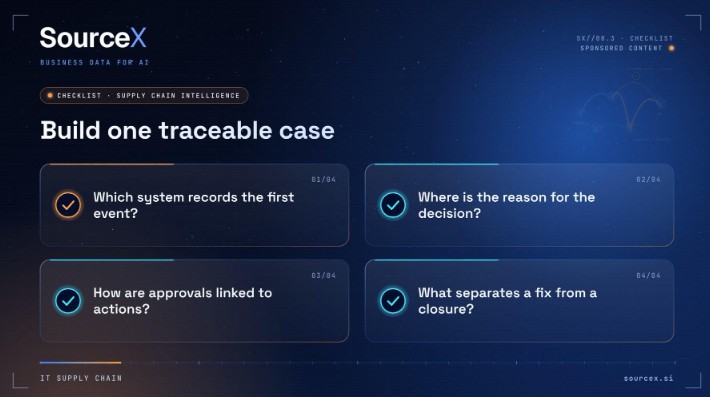
Build one traceable case. Four review points from the article; the full text supplies the context and conditions.
Be precise about what the data could teach
Strong candidate tasks are specific: choosing an escalation path, spotting missing information, applying an approved exception policy. Define each one tightly enough that a reviewer could tell a good answer from a bad one.
Equally, be honest about limits. A collection of digital exception records does not prove an AI system can autonomously run a warehouse or make safe transport decisions. It supports a narrower, and more credible, claim about the work it actually documents.
Explore the licensing question with a defined scope
SourceX is one route. It contracts directly with the company that holds the records, then prepares and pays for approved data used in AI training and evaluation. Its target profile is an established business that had 50 or more full-time employees at its peak and several years of operating history.
Its marketing cites payouts of up to $4 million, a figure that marks the top end for the largest enterprise datasets rather than a standard logistics payout or a guarantee of acceptance. The actual records, rights and compensation are settled in a qualifying deal, and the first step is a fit check with no data uploads.
Where does an operations leader start?
Ask your team where the full decision history of one difficult shipment can be reconstructed. Then bring in the commercial, security and rights owners before anyone proposes an export. Your company’s most interesting data may be the record of every time it refused to let a broken plan become a broken promise.
Key takeaway: Some of the most valuable data in logistics is the record of what happened when the plan stopped matching reality.
If that decision history exists, see whether your company qualifies through SourceX. Begin with company and system information; keep shipment records inside the approved review process.
About the founder
Noah Loul is a four-time founder and the founder and CEO of SourceX, which licenses business data directly from companies for AI training and evaluation. He previously founded B2B Rocket, acquired by Blackpearl Group. His work focuses on building permission-based data infrastructure for AI.
 Warner Music President Joins Digital Quality & Testing Company Applause
 Durham Brands Exceeds Peak Forecast by 170% and Nearly Doubles Throughput with Infios
 Umbraco launches Sustainability Team
 Infor Delivers Comprehensive Suite of Solutions for Corporate Treasury and Finance
 D-Link’s DGS-1210 Series Smart Managed Gigabit Switches Now Compatible with Nuclias Connect
 Transporeon launches Carbon Visibility Beta version: A breakthrough in GHG footprint calculation across supply chains