

Plenty of working yards sit far from the nearest three-phase hookup. Log yards, firewood depots, aggregate lots, and fleet staging grounds all move heavy material every day, often with no fixed power and no water supply on site. Most of that lifting still happens by hand, or with machines that were never meant for the job.
The gap shows up in the numbers. Loading runs slow, crews burn out, and trucks wait at the gate while material is moved one armload at a time. Closing that gap does not take a new building or a grid connection. It takes mobile, engine-driven equipment that brings the handling capacity to the material.
The Real Cost of Manual Loading
Hand-loading a high-side dump trailer is the slowest task in most small yards. One worker lifting split wood or boxed goods overhead moves far less per hour than the truck schedule assumes. The costs stack up in ways that rarely appear on one line of a budget:
- Labor hours. Loading by hand ties up one or two workers for the full length of every dispatch window.
- Injury exposure. Repetitive overhead lifting is a classic driver of shoulder and lower-back claims, and a single claim can cost more than a machine.
- Truck idle time. Drivers and tractors wait while the trailer fills, which quietly inflates every delivered load.
- Inconsistent loads. Hand-stacked trailers are rarely filled to capacity, so the yard ships air.
Any of these alone justifies a look at mechanized loading. Together, they make it one of the highest-return fixes available to a small or mid-sized yard.
Mobile Conveyors Move the Bottleneck
For wood fuel depots and log yards, a gasoline-powered firewood conveyor takes the heaviest job in the yard off human shoulders. The operator feeds split wood onto the belt at waist height, and the belt does the climbing. Material flows straight from the processing area into a high-side trailer or onto a storage pile, with no ladder, no throwing, and no loader shuttling back and forth.
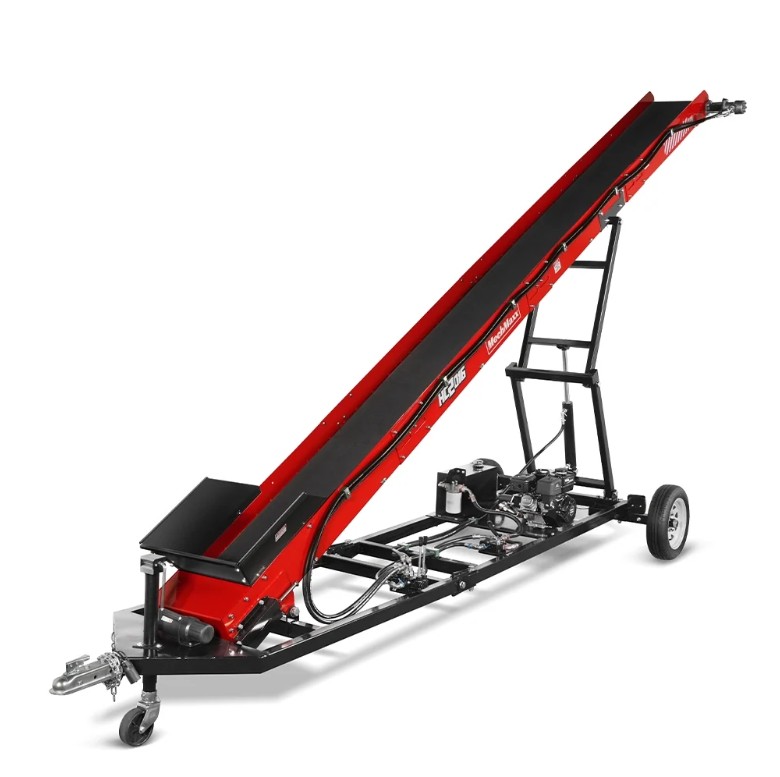
Because the drive is a gasoline engine rather than a plug, the conveyor works anywhere the material is. Models with lift heights up to 180 inches clear tall trailer walls and build storage piles that would otherwise need a wheel loader. One person can now do steadily what used to take two people working hard.
A few points worth checking before choosing a unit:
- Lift height. Measure the tallest trailer wall or pile you load, then add a margin for the discharge arc.
- Belt width and cleats. A wider cleated belt carries irregular pieces uphill without rollback.
- Engine drive. A gasoline-hydraulic drive means no generator and no cable runs across the yard.
- Portability. Wheels and a towable frame let one conveyor serve the processor in the morning and the dispatch lane in the afternoon.
Safer Loading Into Dump Trailers
Positioning matters as much as the machine. Set the discharge end over the center of the trailer bed, start at a lower angle, and raise the belt as the load builds. A steady feed rate beats a fast one, because an even layer packs the trailer better and keeps pieces from bouncing out.
The safety gain is immediate. Nobody stands inside the trailer catching thrown wood, and nobody lifts above shoulder height all day. In a tight labor market, the easier job is also the easier one to staff.
Fleet Uptime Is a Cleaning Problem Too
The same off-grid yards that load by hand usually wash by hope. Forklifts, loaders, and yard trucks working around sawdust, mud, and hydraulic film build up an abrasive paste on every surface. That coating hides leaks until they become failures, clogs radiators and coolers, and accelerates wear in pins and bushings.
The usual excuse is honest enough: there is no water on site. Driving each machine to a wash bay costs half a day, so the cleaning simply never happens.
Hot Water Where There Is No Tap
A skid-mounted pressure washer with water tank removes both obstacles at once. The unit pairs a 4,000 PSI, 4 GPM hot water machine with a 245-gallon onboard tank, driven by a Honda engine with electric start. Mounted on a service truck or trailer deck, it brings the wash bay to the machine instead of the other way around.
Heat is the part that matters for fleet work. Cold water pushes grease around, while hot water cuts through hydraulic oil residue and caked grime, so the same job takes less time and little or no detergent. For a yard with diesel equipment, that means a real washdown at the end of the week rather than a cosmetic rinse.
A simple routine keeps the fleet ahead of trouble:
- Wash each machine at the end of its working week, while faults are still small.
- Degrease before every scheduled service, so technicians can actually see leaks.
- Rinse radiators and oil coolers gently and often during dusty months.
- Clean undercarriages before the first hard frost, so packed mud does not freeze into the running gear.
Planning Throughput, Not Just Equipment
Equipment only pays when it is matched to the flow of the yard. Before the season starts, count the loads dispatched in a peak week and the hours each one takes door to door. That baseline makes the gains visible, and it shows which half of the operation, loading or maintenance, deserves the next investment.
Layout finishes the job. Keep the conveyor close to where material is processed, keep the wash point near the fueling point so cleaning happens during refueling stops, and keep both out of the truck lane. Small yards rarely lack space; they lack sequence.
Bringing It Together
Off-grid should not mean low-throughput. A mobile conveyor removes the loading bottleneck, and a self-contained hot water washer removes the maintenance one. Both run on engine power, both travel to the work, and both pay for themselves in hours saved and injuries avoided.
For yard managers planning next season, the question is not whether the grid will arrive. It is which of these two bottlenecks is costing more right now, and which machine removes it first.
 How Accounting Firms Can Reduce Errors With Workflow Automation
 RNLI enhances transport optimisation with Aptean’s routing & scheduling software
 GPS Light Sync innovator wins prestigious road safety award
 Brexit leads to increase in break bulk for cross-border parcel traffic
 The Best Business Advice for Your Supply Chain From Successful Leaders
 How Technology is Shaping the Future of Online English Teaching