


Any supply chain would be incomplete without warehouses. They play an important role in ensuring the smooth flow of commodities from producers to consumers. Workers in warehouses are at a significant risk of major injuries due to the fast-paced nature of their job. This is especially the case for those associated with manual handling.
Some of the essential but potentially dangerous manual handling tasks in warehouses include lifting, carrying, stacking, and transporting objects. A significant number of reported accidents in warehouses each year are really related to manual handling.
Making the warehouse a safe place to work helps in protecting employees, keeping productivity high, and establishing a safety-first mentality. Find out all you need to know about manual handling risk management and gain useful tips on how to reduce workplace injuries.
Training Staff in Safe Lifting Techniques
Proper training is required to handle any equipment. Not only must employees know what to lift, but they also need to know how to raise it properly. The wrong way to raise anything may do a lot of harm. These dangers can be greatly reduced with the right training.
Safe lifting posture, controlled lowering and raising, pushing instead of pulling wherever feasible, and the use of lifting aids or team handling for large objects are all essential components of effective manual handling training. Despite their apparent simplicity, these strategies are often disregarded.
The most important thing is to make sure that staff regularly use these approaches. Accidents are less likely to happen when there is reinforcement in the form of training and monitoring. The objective is to train their muscles so that they automatically engage in safe behaviours, reducing the possibility of accidental harm due to slip-ups.
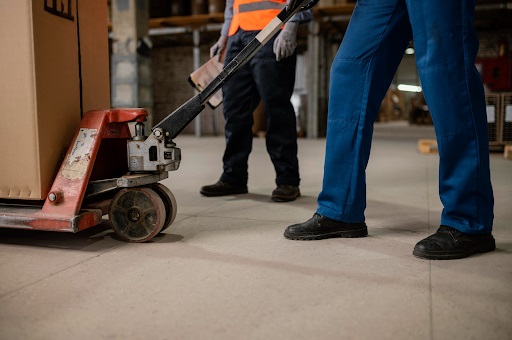
Implementing Mechanical Handling Aids
One simple strategy to lessen the likelihood of injuries or to eliminate them is to increase the use of mechanical lifting equipment. Pallet jacks, hoists, conveyor systems, and heavy-duty platform trolleys for warehouses can greatly lessen the need for manual exertion.
While dealing with big or awkward objects or while performing repeated motions, using manual handling aids can help alleviate muscular fatigue and strain. Companies need to keep these instruments well-maintained and make sure they are easily accessible.
Risk Assessments and Safety Audits
The most critical part of managing materials safely is to detect hazards before they become a problem. To accomplish this, risk assessments will routinely assess risks to determine their visibility. Once an operations manager has identified all possible hazards for the workplace, he can develop an effective action plan to reduce the probability of the hazards.
Through safety audits confirming all findings from risk assessments, inspections can identify areas for improvement in the safe operation of your business and ensure that everyone complies with safety rules.
Developing comprehensive risk assessments and safety audits gives you a way to create a culture of safety and empower you and your employees to make safety a priority each day. Combined, these actions help minimise accidents and better assure that the workplace is safe for all employees.
Use Proper PPE for Manual Handling Tasks
Contrary to popular belief, manual handling poses risks that are equally serious as those posed by chemicals or electricity, and need the use of personal protective equipment (PPE). Protective gear for workers can include steel-toe boots to keep their feet safe, gloves to keep their hands steady and reduce the risk of abrasion, and back supports to alleviate strain on the spine.
Never underestimate the importance of using the correct handling technique in conjunction with personal protective equipment. Imagine it as an extra safeguard. Operations managers also have the responsibility of making sure that all employees, irrespective of gender or physical type, have the proper PPE. In the case of gloves or boots, a one-size-fits-all approach can jeopardise safety.
Reduce Repetitive Strain Through Task Rotation
Over time, cumulative trauma problems may develop from repetitive handling of equipment, regardless of how light the items are. Operations managers can address this issue by establishing ways to rotate workers to different departments.
By alternating tasks that require various muscle groups, employees not only reduce their chance of developing overuse injuries but also increase their focus and enjoyment in the job. Another added benefit is that this helps to reduce employee burnout while simultaneously increasing engagement.
Conclusion
A healthy and safe working environment develops through ongoing dedication and commitment to a safe working culture and environment. Today’s warehouse operations managers can more effectively reduce potential hazards by constantly evaluating and modifying established safety guidelines. To strengthen and improve safety procedures, encourage open dialogue with employees and provide regular constructive feedback. Preventative actions help ensure that all employees have a safe and healthy workplace.
 Renovotec focuses on supply chain pain points at IMHX 2022
 Softeon Introduces Softeon AI Layer (SAIL)
 Maintel awarded Westcon UK Partner of the Year award 2022
 Manhattan Associates Named a Leader in Gartner’s Magic Quadrant for Warehouse Management Systems for Eleventh Consecutive Time
 Iptor appoints Daniel Bednar as new CFO
 Creating a Smart Warehouse with Enhanced Internet Connectivity