

Another security review desk, plus a 200-question survey. Verizon’s 2025 DBIR found that 30 percent of breaches involved third-party vendors, double the previous year.
No wonder one IT manager on Reddit calls vendor questionnaires “a massive operational bottleneck… we’re using a shared drive and it’s a mess.”
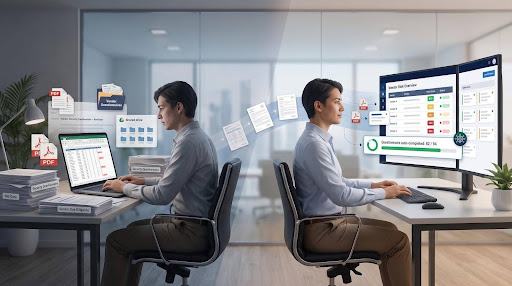
Vendor risk management software is the practical fix. The right platform can auto-collect evidence, keep vendors on deadline, and score risk consistently, so you spend less time chasing PDFs and more time onboarding the suppliers the business actually needs.
This guide ranks five vendor-risk-management platforms to help you onboard suppliers faster and reclaim your calendar.
1. Vanta: Best for Turbo-Charged Automation
Vanta built its name on automating internal compliance audits. Its vendor risk management (VRM) module brings that same automation-first approach to third-party reviews, automatically discovering vendors, pulling verified evidence from ublic trust centers, and using an AI agent to prefill questionnaires while continuously monitoring vendor posture, capabilities detailed in Vanta’s vendor risk management software overview.
How Vanta cuts down questionnaires
Vanta reduces vendor back-and-forth in three practical ways.
First, it pulls evidence directly from vendor Trust Centers. Vanta can detect whether a vendor has a Trust Center (Vanta-powered or not) and one-click collect documents like SOC 2 reports, ISO certificates, pen test reports, and key policies into the vendor record. The network effect matters here: Vanta tracks 6,000+ live public Trust Centers, so there is a real chance the evidence you need already exists.
Second, Vanta Exchange gives you a secure vendor portal for evidence collection. Instead of email threads and shared drives, vendors get a magic link and can upload requested evidence or answer questions without creating an account. Reminders run automatically every five days, and Vanta can request refreshed evidence 30 days before a scheduled assessment.
Third, Vanta’s AI agent uses collected evidence to auto-fill questionnaires with citations back to source documents. In live demos, the AI has answered 82 out of 94 questions automatically, leaving the vendor with only 12 to complete manually. That is the difference between “please fill out this spreadsheet” and a review your team can actually finish.
Automation and AI that stays close to the evidence
Vanta’s AI is built to summarize and triage, not just store files. It can scan vendor documentation, flag gaps that need review, and produce a strengths-and-weaknesses summary that links back to specific questions. It also supports automated inherent risk scoring during intake, using your rubric plus context like contract details and custom fields.
If you already use Vanta for internal programs, this becomes even more useful. Vendor findings can map directly into the same compliance frameworks and risk register you use internally, so third-party risk does not sit in a separate silo.
Continuous monitoring, now native
Vendor reviews fail when they are point-in-time. Vanta launched native vendor monitoring in March 2026 (via its Riskey acquisition). Monitoring includes breach detection and dark web signals, external attack-surface scanning, leaked credentials, certificate expirations, and change tracking for key evidence like SOC 2 reports.
It also extends beyond direct vendors. Vanta supports third-, fourth-, and nth-party monitoring for sub-processors, including change notifications. In customer demos, Vanta has been positioned as an early-warning system, including alerts about the Workday breach before it reached the news.
Integrations and lifecycle coverage
Vanta is strongest when you want vendor risk embedded in day-to-day workflows, not run as a separate compliance ritual.
- Vendor discovery: It can auto-discover cloud apps through SSO/IdP connections (Okta, Azure AD, Google Workspace), which helps surface shadow IT vendors early.
- Workflow routing: Integrations like Slack and Jira help route follow-ups and remediation tasks to the right owners.
- End-to-end lifecycle: Intake, due diligence, monitoring, and vendor status management are supported in one platform.
Across the broader platform, Vanta supports 375+ integrations. Procurement-specific integrations (like Coupa or SAP Ariba) are an area Vanta is actively expanding, so large enterprises with complex procurement stacks may need API workarounds today.
Framework coverage and pricing
Vanta’s VRM module supports vendor assessments against SOC 2, ISO 27001, HIPAA, HITRUST, PCI DSS, GDPR, NIST 800-53, NIST CSF, CMMC, and 35+ total frameworks. Findings can map back to your own frameworks, which makes audit prep and board reporting cleaner.
Pricing is quote-based. VRM is sold as an add-on (available on Plus tier and above) and is typically priced per vendor reviewed annually (not your total vendor count). In practice, Vanta has been positioned around $300 per vendor per year for base VRM, or roughly $600 per vendor per year with continuous monitoring.
Vanta is ideal for:
- Growing mid-market and enterprise teams (roughly 100 to 5,000+ employees) managing 50 to 500+ vendors
- Procurement and security leaders who want faster, evidence-driven reviews, not bigger questionnaire libraries
- Organizations running internal compliance in parallel and wanting internal and vendor risk in one dashboard
Trade-offs to know upfront:
- VRM pricing is not published, so you need a sales conversation to get a real number for your vendor volume.
- Continuous monitoring is newer (native as of March 2026), so buyers who want a decade-mature ratings engine sometimes pair it with a specialist tool.
- Vanta does not offer managed assessment services, so teams looking to outsource reviews entirely should consider vendors with analyst support.
Bottom line: If your biggest bottleneck is evidence collection and review cycles, Vanta is built to automate the repetitive work and keep vendor risk tied to your broader compliance and risk posture.
2. OneTrust: Best for Sprawling Vendor Lists and Complex Compliance
OneTrust is built for scale. If your vendor inventory is measured in thousands and you need to track more than cybersecurity risk, its Third-Party Risk Exchange (formerly Vendorpedia Exchange) is the feature that changes the math.
How OneTrust reduces vendor questionnaires
OneTrust’s main shortcut is reuse. The Exchange contains pre-populated security and privacy profiles for 6,000+ vendors, so your team can often start with an existing profile instead of sending a fresh questionnaire. That is the clearest path to cutting cycle time when you are onboarding at enterprise volume.
OneTrust also positions a Third Party Risk Agent (currently in private preview) that can pull from the Exchange and prior assessments to autocomplete parts of an assessment. The important limitation is scope: it reads what is already in the Exchange, but it does not generate automated follow-up questionnaires based on gaps.
AI and workflow automation
AI in OneTrust is primarily used to accelerate data collection and triage evidence, not to run an end-to-end assessment on your behalf. OneTrust’s current claim is that AI-powered data collection can fast-track third-party risk assessments by up to 70 percent.
In practice, the platform is strongest when you have a defined risk process and want to standardize it across a large team. You can configure intake, tier vendors, route reviews through legal and security, and push high-risk vendors into deeper remediation workflows without code.
Monitoring is integration-driven, not native
OneTrust supports continuous monitoring workflows, but it does not provide full monitoring out of the box. To get ongoing external cyber signals, teams typically connect paid subscriptions from providers like BitSight or SecurityScorecard, then use OneTrust to trigger reassessments, notifications, and mitigation steps when a vendor’s risk posture changes.
If your program depends on continuous, automated monitoring as a default, budget for those add-ons early so you do not end up with a “dashboard that updates weekly” when your auditors want near real-time oversight.
Integrations and lifecycle coverage
For procurement-adjacent workflows, OneTrust is usually deployed as the system of record that connects risk decisions to intake and contracting.
- IT and workflow systems: ServiceNow integrations are commonly used to raise tickets and route assessments into operational queues.
- CLM and HR ecosystems: Ironclad and Workday marketplace integrations are part of how some teams keep vendor records in sync.
- Vendor hierarchy support: Larger programs can model parent-child vendor relationships and map multiple products to a single vendor record.
Integrations with tools like Coupa or SAP Ariba are often referenced externally, but integration depth varies by environment and configuration.
Coverage, pricing, and who it fits best
OneTrust’s differentiator is breadth across risk domains. It is designed to handle cybersecurity, privacy, ethics, ESG, reputational risk, and sanctions-style due diligence, including Dow Jones-powered screening in broader OneTrust workflows.
Pricing is not public. TPRM licensing is typically based on vendor count and users, with a wide enterprise range (roughly $40K to $500K), plus implementation and services.
OneTrust is ideal for:
- Enterprises managing 500+ vendors that need one platform for multiple risk domains, not just cyber
- Dedicated TPRM teams that can invest in configuration and ongoing administration
- Organizations already standardized on OneTrust for privacy or related programs and want to consolidate
Trade-offs to consider:
- Continuous monitoring is not native; it often requires paid third-party subscriptions to ratings or intelligence providers.
- Usability and tech debt come up frequently. Teams report heavy configuration, lots of clicks, and uneven experiences across modules (in part due to acquired tooling).
- AI automation has clear boundaries today, including document-scanning limitations and an Agent that does not generate follow-up questionnaires automatically.
Bottom line: OneTrust shines when the problem is enterprise sprawl. If you need a single, auditable program that spans thousands of vendors and multiple regulators, it is built for that reality. If you want native continuous monitoring and faster time to value with minimal configuration, expect more lift and more add-ons.
3. Mitratech Prevalent: Best for End-to-End Lifecycle Control
Prevalent is built for programs that need a closed-loop, auditable third-party risk process, not just faster questionnaires. It has focused on vendor risk since 2004, and after Mitratech acquired Prevalent in October 2024, the platform’s positioning leaned even further into workflow depth and lifecycle coverage.
How Prevalent reduces questionnaires
Prevalent’s biggest lever is reuse. The Prevalent Exchange provides on-demand access to completed, standardized risk reports on thousands of companies. When a vendor is already covered, your team can pull an existing assessment instead of sending a new SIG.
For vendors that still need a direct assessment, Prevalent supports a large library of templates and custom questionnaires. Mitratech’s current product materials cite 800+ assessment templates, and teams can also build surveys with a drag-and-drop designer and schedule automated reminders to keep vendors moving.
AI and automation, focused on prefill and scoring
Prevalent uses automation to reduce manual triage.
- AI-assisted questionnaire completion: It can prefill assessment responses using NLP-extracted data from vendor documents.
- Rules-based document checks: Teams can set up document profiles with criteria and keywords, then score uploaded documents pass or fail against those requirements.
- Automated scoring and escalation: Responses can be auto-scored and routed through remediation workflows so high-risk items get attention first.
A key boundary is that Prevalent’s AI is not positioned as an AI-powered security reviewer. It can help populate assessments and apply rules, but it does not run an agentic, end-to-end evidence review in the way tools like Vanta’s agent are designed to.
Continuous monitoring is a core strength
Monitoring is one of Prevalent’s strongest areas. It offers native external monitoring across cyber threats, business risk, financial distress, regulatory findings, and reputational events, including dark-web monitoring and breach alerts. The platform can also identify fourth-party technology dependencies by scanning for technology-based third parties your vendors rely on, which helps surface concentration risk.
For teams that want additional ratings data, Prevalent can integrate with BitSight, but it is not reliant on that integration to provide baseline monitoring.
Integrations and lifecycle coverage
Prevalent is designed to run the full vendor lifecycle in one place, with an emphasis on operationalizing risk work.
- Sourcing and selection: Supports RFP and RFI workflows and intake standardization.
- Assessment and remediation: Standardized templates, customizable surveys, and automated issue routing.
- SLA and performance management: Tracks vendor KPIs and KRIs and ties follow-ups to workflows.
- Offboarding: Supports termination and offboarding procedures as part of the lifecycle record.
It also offers a connector marketplace with a large set of out-of-the-box integrations (internal research references roughly 200 integrations across 80+ API endpoints). In practice, this tends to matter most for enterprises that need vendor risk tasks to flow into systems stakeholders already live in.
Pricing and best-fit guidance
Pricing is quote-only and typically per vendor, positioned for enterprise programs. Some teams also use Prevalent for managed-service support, which can be attractive when you want more handholding than a pure software rollout.
Prevalent is ideal for:
- Enterprises running compliance-heavy TPRM programs that need rigorous workflow and audit trails
- Teams that want intake, assessment, monitoring, remediation, and offboarding in one system
- Organizations that value template depth and structured process over cutting-edge AI evidence analysis
Trade-offs to consider:
- External assessments place Prevalent in the “Contender” tier (not a Leader), with critiques that can include UI challenges and workflow rigidity.
- User feedback often cites a steep learning curve, a dated interface, and reporting that can feel inflexible without exporting.
- There is no vendor auto-discovery or Trust Center model, so evidence collection is still primarily driven through Exchange reuse, templates, and outreach workflows.
- As part of Mitratech’s broader portfolio, Prevalent is now one product among many, which can create roadmap and innovation uncertainty for some buyers.
Bottom line: If your priority is end-to-end control, including monitoring and remediation workflows that stand up in an audit, Prevalent is built for that depth. If your priority is AI-driven evidence review and questionnaire elimination through trust-center-style collection, it may feel heavier than you need.
4. BitSight: Best for Always-On Cyber Risk Visibility
If your biggest fear is a vendor that “passes” a questionnaire and then gets breached next quarter, BitSight is built for the part of vendor risk that questionnaires cannot cover. It gives you an outside-in cyber rating that recalculates daily, so you can track whether a supplier’s security posture is improving or deteriorating between annual reviews.
What BitSight replaces, and what it does not
BitSight does not eliminate questionnaires. It helps you avoid sending them to everyone.
Most teams use BitSight as a first-pass filter: plug in a vendor domain, get a 250 to 900 score, and apply simple triage. High-scoring vendors may only need lightweight follow-ups, mid-range scores trigger targeted questions, and low scores move to deeper assessment or even a procurement “no.”
That approach can save time because you focus your detailed reviews on the vendors that actually look risky from the outside.
Continuous monitoring is the product
BitSight’s core strength is continuous monitoring. It scans externally visible signals across 25 risk vectors and alerts you when a vendor’s posture changes, including negative events like breaches or meaningful drops in score. For organizations that need an ongoing, board-friendly signal, the value is the trend line, not a once-a-year PDF.
BitSight was also named a Leader in the Forrester Wave Q2 2026 for Cybersecurity Risk Ratings, reinforcing its position as a specialist in this category.
AI and automation, aimed at ratings and mapping
BitSight’s automation is oriented around scanning and quantifying risk, not collecting evidence.
- Daily rating recalculation: Ongoing measurement without relying on vendor participation.
- Supply chain mapping: AI- and NLP-driven mapping can surface complex third-, fourth-, and nth-party relationships.
- Dynamic Remediation (2026): Near-instant rescans across five areas, including SSL configurations and certificates, open ports, server software, and web application security. This helps teams validate fixes faster instead of waiting for the next scan cycle.
Integrations and lifecycle fit
BitSight fits best as a monitoring layer that feeds your broader TPRM workflow.
It integrates most naturally with GRC and ITSM ecosystems, including platforms like ServiceNow TPRM, and it is commonly used as a data source inside other vendor risk programs. What it does not provide is the rest of the vendor risk lifecycle: intake workflows, questionnaires, evidence collection, document review, remediation tracking, or offboarding. If you need that, plan to pair it with a VRM platform.
Pricing and best-fit guidance
Pricing is quote-based and enterprise-oriented. The buying decision usually comes down to how many vendors you want to monitor and whether you need integrations or services.
BitSight is ideal for:
- Large organizations with hundreds of vendors that need portfolio-level cyber visibility
- Security and risk leaders reporting third-party cyber risk to executives, regulators, or insurers
- Teams that already have a questionnaire process but need continuous oversight between assessments
Trade-offs to consider:
- The score can feel like a black box, and teams may want more context behind specific findings.
- False positives and attribution issues can occur with outside-in scanning, which creates extra work when you need to validate whether a flagged asset truly belongs to the vendor.
- It is not a full VRM platform. You still need a workflow tool for evidence, questionnaires, and audit-ready documentation.
Bottom line: BitSight is the “always-on” signal. Use it to decide where to spend assessment time and to catch meaningful changes in vendor posture when you cannot afford to wait for the next review cycle.
5. Whistic: Best for Shrinking Questionnaires to Minutes
Whistic is purpose-built for one problem: the endless questionnaire loop. Instead of sending every vendor a fresh spreadsheet, Whistic pushes assessments toward a reuse model where vendors publish what they can share once, and buyers pull what they need on demand.
How Whistic eliminates the long questionnaire cycle
Whistic’s workflow starts with the Trust Catalog (also referred to as the Trust Center Exchange). Vendors publish security documentation and completed assessments, then your team searches and reviews what already exists. When it works, it is a true “zero-touch” assessment. You are reviewing a vendor’s posture, not waiting two weeks for someone to fill out a form.
Internal research suggests the catalog is much larger than older marketing figures. The Whistic battlecard references roughly 90 thousand vendor profiles, which is the real advantage if your supply chain is SaaS-heavy.
AI that accelerates review and response
Whistic’s AI is aimed at compressing time-to-answer.
- Smart Response: Uses your uploaded documents as a knowledge base and generates questionnaire responses with confidence scoring and citations. Whistic positions this as cutting administrative work by up to 90 percent, with 91 percent accuracy.
- Assessment Copilot: Creates vendor summaries and SOC 2 summaries, and lets you ask portfolio-wide questions across your vendor inventory (for example, to find which vendors share a control dependency).
- Trust Center Capture: AI agents that find and ingest security documentation from vendors’ public trust centers to reduce manual collection.
One practical nuance: many vendor trust centers require an NDA before documents can be accessed, and that can block automated retrieval. In those cases, the AI can still help once documents are uploaded, but it cannot pull what your team is not allowed to see.
Continuous monitoring, improving but still evolving
Historically, Whistic leaned on partnerships for monitoring, including RiskRecon (Mastercard). As of March 2026, Whistic launched a native vendor monitoring product that adds continuous breach detection, including dark web signals, with alerts tied back to workflows. This is typically positioned as a paid add-on or standalone module.
That is meaningful progress, but it is still newer than long-established ratings platforms. If monitoring is the center of your program, you may still want to evaluate whether Whistic’s native coverage is enough on its own.
Integrations and workflow fit
Whistic’s strongest procurement integration story is Zip. In internal deal analysis, Whistic won the Samsara evaluation in part because the Zip integration helped streamline procurement workflows and felt purpose-built.
Beyond that, Whistic supports common workflow touchpoints like Jira, Slack, and API-based integrations, but deep, broadly documented procurement integrations (for example, Coupa or SAP Ariba) are not clearly verified in the provided research.
Framework coverage, pricing, and best-fit
Whistic supports common vendor assessment formats, including SIG, CAIQ, SOC 2, ISO 27001, and custom questionnaires. Its mapping and summaries are centered on the Whistic Control Framework (NIST-based). Whistic also launched a compliance module in May 2026, but it is an early version with limited depth and no integrations, so it should not be treated as a mature GRC platform.
Pricing is not published. Whistic sells three tiers (Core, Assess+, Trust+), with monitoring as a paid add-on. Third-party estimates place typical contracts roughly in the $20K to $100K+ range depending on scale, and one competitive anecdote suggests Whistic plus supporting tools came in slightly under a $75K budget.
Whistic is ideal for:
- Mid-market teams that want the fastest path to fewer questionnaires, especially in tech and SaaS supply chains
- Organizations that receive a high volume of inbound questionnaires and want a reusable “security packet” model
- Procurement teams that value vendor collaboration and self-serve documentation access
Trade-offs to consider:
- The model depends on vendor participation. If your vendors are not motivated to publish profiles, the network effect shrinks.
- NDA-gated trust centers can limit automated document capture, which reduces some of the instant benefit.
- Monitoring is newer and may require add-ons or partnerships for broader coverage.
- Whistic is not a full compliance automation platform, and its newer compliance module is not a substitute for a mature GRC tool.
- Company scale is smaller (<100 employees, about $50 million raised), which can translate to slower feature velocity than larger platform vendors.
Bottom line: Whistic is the best fit when your bottleneck is questionnaire logistics, not control testing. If your vendors are likely to be in the catalog, it can turn week-long assessment cycles into something your team can complete in a sitting.
What’s Next in Vendor Risk: Five Trends to Watch
Vendor risk is moving from an annual checkbox to an always-on program. Five shifts are driving that change.
1. Regulators want speed, not binders
In the United States, the SEC incident-disclosure rule (effective December 18, 2023) requires public companies to report material cyber events within four business days, according to Axios. In Europe, the Digital Operational Resilience Act (DORA) applies from January 17, 2025, pushing financial entities to prove continuous third-party oversight. The practical impact is simple: auditors are increasingly asking for live dashboards and current evidence, not last year’s PDF packet.
2. AI is shrinking the questionnaire
The direction is clear. Tools are using AI to pre-fill answers, summarize evidence, and reduce the amount vendors have to do manually. Early pilots show Vanta’s AI questionnaire automation covering up to seventy-three percent of questions and deflecting up to eighty-seven percent of inbound security questionnaires through a Trust Center. In demos shared with subject matter experts, Vanta’s AI also answered 82 out of 94 questionnaire questions automatically using collected evidence, leaving only 12 for a human to complete. Similar questionnaire-acceleration capabilities are also rolling out in tools like Whistic and other AI-powered vendor risk management platforms.
3. Ratings and workflows are converging
The old split was “ratings tool for monitoring” versus “TPRM platform for questionnaires and evidence.” That line is blurring. BitSight now lists OneTrust, and other VRM providers in its partner ecosystem. Prevalent routes continuous-monitoring signals into the same remediation workflows used for assessments, so monitoring becomes action, not just alerts.
4. Fourth-party visibility is becoming practical
Teams are moving past “who are our vendors?” to “who do our vendors rely on?” New mapping modules can reveal hidden dependencies, often fifty-plus vendors relying on the same cloud sub-processor. That makes concentration risk visible early enough to diversify contracts before a single outage or breach ripples across your supply chain.
5. “Risk” is expanding beyond cybersecurity
Vendor records are starting to include ESG metrics, financial health, and operational resilience alongside security and privacy. EY’s Global Third-Party Risk Management Survey found that 71 percent of TPRM programs now assess ESG risks in addition to traditional cyber and privacy metrics.
Conclusion
Bottom line: more automation, more continuous data, and a broader definition of “risk.” Teams that adapt early spend less time chasing paperwork and more time guiding strategic sourcing.
 How to avoid ransomware: 5 ways to prevent and recover from attacks
 Alibaba Cloud Brings AI+Cloud Strategy to European Businesses
 Why Additive Manufacturing (3D Printing) Is Becoming a Supply Chain Game Changer
 DataArt to exhibit at ICE London 2019
 Why More US Importers Choose DDP Shipping from China in 2025
 Why smart businesses will be moving to low-code platforms to develop apps in 2019