

The rapid evolution of modern logistics has pushed digital transformation to the forefront of industry discourse. Facility managers and IT directors heavily prioritize cybersecurity protocols, cloud-based analytics, and advanced software architectures to protect their operations.
However, this hyper-focus on digital infrastructure often leaves a critical blind spot: the physical hardware that protects and mobilizes these complex systems. Without industrial-grade physical components, the most advanced software is vulnerable to real-world disruptions.
To secure the physical perimeter of automation equipment, industry leaders integrate reliable components from manufacturers like Kunlong, ensuring that foundational hardware matches the sophistication of the software it protects.
Securing this physical perimeter is not merely a traditional facilities issue; it is a foundational requirement for sustained operational uptime.
The Vulnerabilities in Modern Automated Warehouses
Automated logistics centers operate in highly dynamic, physically demanding environments. Heavy machinery, continuous vibrations, and high foot traffic create a landscape where sensitive digital systems are constantly exposed to physical risks.
When a multi-million-dollar automation system goes offline, the root cause is frequently not a software glitch, but a mechanical failure or unauthorized physical access to a control panel.
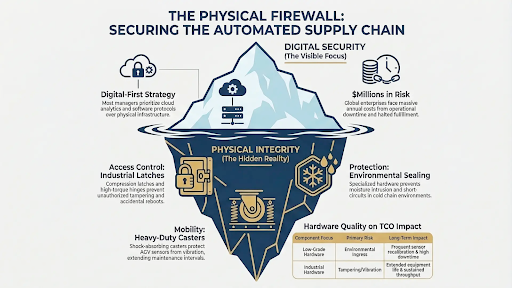
Beyond Software: The Physical Threat to Control Systems
In modern automated warehouses, protecting the central control systems is just as critical as securing the software network. Access control heavily relies on robust physical security. According to comprehensive overviews of supply chain automation by IBM, minimizing physical disruptions is just as crucial as optimizing data workflows to maintain an agile supply chain.
Utilizing advanced hardware—such as specialized compression latches, smart handles, and high-torque hinges for telecom and power distribution cabinets—ensures that operations remain secure. Key vulnerabilities prevented by industrial locking mechanisms include:
- Unauthorized Access: Preventing uncertified personnel from tampering with automated routing systems or causing accidental system reboots.
- Environmental Ingress: Serving as the primary physical firewall against dust, moisture, and debris.
- Mechanical Degradation: Stopping vibration-induced loosening that exposes delicate internal components.
A compromised server rack or an unsecured robotics control cabinet can lead to immediate system halts, making high-grade enclosures essential.
Key Hardware Components Driving Operational Efficiency
The efficiency of a supply chain is dictated by the seamless movement of goods and the continuous operation of the equipment facilitating that movement. Every mechanical component plays a pivotal role in overall throughput.
When physical hardware fails, the cascading effects can disrupt entirely synchronized Warehouse Management systems, causing severe bottlenecks and delivery delays.
Heavy-Duty Mobility: Casters and Leveling Feet for AGVs
Automated Guided Vehicles (AGVs) are the lifeblood of contemporary fulfillment centers, requiring constant motion across varying floor conditions. The mobility hardware supporting these robots—specifically heavy-duty casters and precision leveling feet—dictates their speed, accuracy, and operational lifespan.
Inferior load-bearing components transmit excessive shock and vibration to the chassis of the AGV. This not only accelerates structural wear but also degrades the calibration of delicate onboard sensors, which are vital for the continuous data streams required by AI & IoT tracking systems.
By investing in high-grade polyurethane casters with integrated shock absorption, facilities can drastically reduce the vibration-induced wear on AGV electronics, thereby extending the maintenance intervals and preserving sensor accuracy.
Thermal and Environmental Sealing in Cold Chain
Cold chain logistics and temperature-controlled storage present unique environmental challenges that threaten the integrity of both perishable goods and the mechanical systems that store them.
In these extreme environments, specialized draw latches and heavy-duty hinges are required to maintain strict environmental seals on large-scale freezer units and insulated control enclosures. A slight breach in a cabinet door can lead to severe condensation.
Condensation inside an electrical enclosure can short-circuit critical automation boards. High-strength sealing hardware prevents energy leakage, eliminates moisture intrusion, and ensures that sensitive controllers survive the harsh temperature differentials of the cold chain.
Future-Proofing the Supply Chain Infrastructure
Building a resilient supply chain requires shifting the perspective on hardware from a negligible commodity to a strategic asset. Reactive maintenance models are no longer sufficient for the demands of modern logistics.
Future-proofing means establishing baseline physical infrastructure standards that mirror the rigor of IT security policies, ensuring long-term stability and performance.
Key Takeaways
| Area | Key Takeaway | Impact/Data |
| Security | Lock control panels | Stops system halts |
| AGVs | Fit shock casters | Saves IoT sensors |
| Cold Chain | Seal cold cabinets | Stops short circuits |
| TCO | Buy premium hardware | Saves millions |
Proactive Hardware Maintenance vs. Reactive Downtime
Investing in durable infrastructure from the design phase is a strategic imperative. According to industry analyses, supply chain disruptions and operational downtimes can cost global enterprises millions of dollars annually.
By standardizing high-quality physical components across all logistics facilities, managers can significantly mitigate these risks and extend equipment lifecycles.
Evaluating the Total Cost of Ownership (TCO) reveals that the initial investment in premium industrial hardware is negligible compared to the exorbitant costs associated with reactive downtime, emergency repairs, and halted fulfillment operations. Proactive physical security is the ultimate safeguard for supply chain profitability.
 4 Ways the Workplace Will Change in the Next Decade
 5 Strategies for Enhancing Military Resilience & Readiness
 MINICLIPPER LOGISTICS BOOSTS SERVICE LEVELS AND BUSINESS PERFORMANCE WITH PARAGON TRANSPORT PLANNING SOLUTION
 Do Thin-Bezel Portable Monitors Improve Multi-Screen Immersion?
 Workday data breach
 NCSC CTO on sandbox breakouts: Cohesity VP UK&I comments