

Supply chain technology usually gets discussed through the lens of visibility, forecasting, transport planning, warehouse automation, procurement, and inventory control.
A global supply chain can have strong systems and still struggle if the teams behind those systems aren’t hired, onboarded, trained, scheduled, and supported properly. Planners need market context. Warehouse teams need safety and process training.
Procurement teams need clear supplier workflows. Transport managers need compliant processes across regions. Site leaders need enough visibility to know whether people are actually ready to perform.
That’s why the people-side technology stack is becoming more important. The right tools help companies build teams faster, train them consistently, and keep execution aligned across locations.
Here are eight tool categories that can help global supply chain teams work with more structure.
1. Global Employment Platform
Supply chain companies often need local talent before they have a full local operating structure. That might mean hiring a logistics coordinator in the UK, a procurement specialist in Germany, a customer operations lead in Spain, or a regional planning manager closer to key suppliers.
The challenge is that hiring across borders brings employment contracts, payroll, benefits, local labor rules, onboarding documents, and compliance responsibilities. If those details aren’t handled clearly, the first hires in a new market can start with confusion instead of momentum.
A global employment platform can help companies manage international hiring with more control. Providers such as G-P (Globalization Partners) are relevant for businesses that want to hire globally while keeping the employment setup, documentation, and onboarding process more organized as they expand into new markets.
Best fit: supply chain businesses hiring internationally before they have a mature local HR or legal setup.
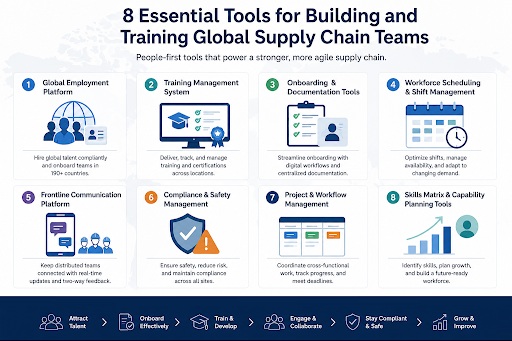
2. Training Management System
Training is a constant requirement in supply chain operations. Warehouse safety, equipment use, transport compliance, standard operating procedures, systems training, customer handling, and supplier processes all need to be taught, refreshed, and tracked.
The difficulty is rarely the first training session. It’s keeping the whole process visible once the team grows. Who attended? Which certificates are expiring? Which site missed the refresher? Which new hires still need role-specific training before they can work independently?
A training management system helps centralize scheduling, learner records, certificates, attendance, reporting, and training administration. Platforms such as EduAdmin are useful in this part of the stack because supply chain teams often need structured training across multiple sites, shifts, instructors, and compliance requirements.
It also reduces the manual chasing that often falls on operations managers. Instead of digging through spreadsheets and inboxes, they can see what has happened and what still needs attention.
Best fit: companies managing recurring operational, compliance, safety, or role-based training across distributed teams.
3. Digital Onboarding and DocumentationTools
Onboarding in supply chain teams needs to move quickly, but it can’t be vague. New employees need access to systems, site rules, safety procedures, escalation paths, role expectations, and process documents.
A digital onboarding tool helps turn that into a repeatable workflow. It can assign tasks, collect documents, share training materials, and make sure each new hire moves through the right steps before they’re expected to perform.
This is especially useful for multi-site teams. A warehouse associate, planner, transport administrator, and procurement analyst will not need the same onboarding journey. But each one still needs a clear path.
IT Supply Chain has covered how digital onboarding can reduce friction when new systems or processes are introduced, and the same principle applies to people joining operational teams. Strong onboarding makes it easier for employees to understand the way work actually gets done.
Best fit: companies with frequent hiring, seasonal workers, new site launches, or fast-changing operating procedures.
4. Workforce Scheduling and Shift Coordination Tools
Supply chain teams don’t always work neat office hours. Warehouses, transport operations, customer support desks, and manufacturing-linked logistics teams often need shifts, cover, absence planning, and quick adjustments when demand changes.
Scheduling tools help managers plan labor around operational needs. They can support shift swaps, availability, attendance, overtime visibility, and workforce allocation across sites.
The real value is not just filling a rota. It’s giving managers a clearer view of capacity. If a warehouse is short on trained forklift operators during a peak period, or a transport team lacks enough cover for a late shift, those gaps affect service levels quickly.
Best fit: warehouse, transport, fulfillment, and site-based operations where labor planning affects performance directly.
5. Frontline Communication Platforms
Email is often a poor fit for frontline supply chain teams. Many workers do not sit at desks all day. Some move between warehouse zones, vehicles, customer sites, loading bays, or production areas.
Frontline communication tools help managers share updates, policy changes, shift notes, safety reminders, and urgent announcements in a format employees are more likely to see. They can also support two-way feedback, which matters when local teams spot process issues before leadership does.
A good communication platform keeps messages clear and targeted. The warehouse team does not need every procurement update. Drivers may need route or compliance alerts. Site managers may need broader operational notices.
Best fit: distributed teams that need fast operational communication without relying on email chains.
6. Compliance and Safety Management Software
Supply chain operations carry practical risk. Injuries, vehicle incidents, equipment misuse, poor documentation, and missed safety checks can all affect performance and cost.
Compliance and safety management software helps companies track incidents, audits, inspections, risk assessments, corrective actions, and safety training evidence. In warehouses, the link between technology and safety is becoming more visible as businesses use AI, telematics, wearables, and sensor data to spot risks earlier.
Tools in this category are most useful when they connect safety processes to daily work. A system that records incidents after the fact helps with reporting. A system that also supports prevention, training, and follow-up is more valuable.
Best fit: warehouses, logistics operators, manufacturing-linked supply chains, and transport-heavy businesses with clear safety obligations.
7. Project and Workflow Management Tools
Supply chain teams often manage work that cuts across departments. A packaging change may affect procurement, warehousing, suppliers, transport, and customer service. A new market launch may involve HR, legal, finance, logistics, and local operations.
Project and workflow management tools help keep that work visible. They can assign owners, track deadlines, document handoffs, and show where decisions are stuck.
For supply chain teams, the tool does not need to be overly complex. It needs to make accountability clear. Who owns the supplier update? Who is waiting on customs documentation? Who needs to train the local warehouse team before launch?
Best fit: cross-functional supply chain projects, market launches, system rollouts, and process improvement work.
8. Skills Matrix and Capability Planning Tools
A skills matrix helps companies understand what their workforce can actually do. That sounds basic, but it becomes harder as teams expand across functions and regions.
Managers need to know who is trained on which systems, who can operate specific equipment, who can cover critical roles, and where skill gaps are emerging. Capability planning tools make that easier to track.
This is useful during growth because hiring is not always the only answer. Sometimes the business needs to develop people who are already inside the operation. A good skills view helps leaders decide whether to hire, train, redeploy, or build a stronger succession plan.
Best fit: companies trying to reduce single points of failure, improve internal mobility, and build more resilient operational teams.
Choosing the Right People-side Stack
The best toolset depends on the type of supply chain operation, the markets involved, and the maturity of the team. A fast-growing fulfillment business may need stronger scheduling and onboarding first. A regulated logistics operation may prioritize safety, compliance, and training records. A company entering new countries may need global hiring support before anything else.
The useful question is simple: where is the team currently losing control?
If hiring is slow, look at global employment and onboarding tools. If training records are scattered, start with training management. If teams are missing updates, communication may be the weak point. If managers do not know who has which skills, a capability planning tool can bring useful clarity.
Operational systems move goods, information, and money. People-side systems help the teams behind those flows work safely, consistently, and at scale.
 Decoding the Code: Unveiling the Secrets of Bitcoin Scripts
 Food inflation at record high of 15 percent
 Elite Hotels of Sweden Standardises on Infor
 Novotek acquires Astec IT Solutions
 AVEVA PI World 2022 Showcases Transformative Role of Data in Industrial Innovation
 How Variable Frequency Drives Regulate Motor Performance