

For a fintech, a neobank or any platform building embedded finance, the payment gateway is not a vendor choice. It is part of the product. The moment a user is bounced to a third-party checkout, the experience the team spent years polishing breaks, and a slice of every payment leaves with the redirect. That is why so many fintech businesses now run their own branded payment gateway under their own brand, keeping the payment process native and the margin in-house. This guide compares the best white label payment gateways for fintech and embedded finance, and shows where each provider fits.
The trajectory is steep. The online payment gateway market was estimated at about 34.2 billion US dollars in 2024 and is projected to reach roughly 111.5 billion by 2035 at a compound annual growth rate near 11.3 per cent, and embedded finance is one of the strongest currents behind it. As providers multiply, the gap widens between a genuine white-label payment gateway and a rebranded shared service. For a fintech that treats payments as product, that gap is the difference between an owned experience and a borrowed one.
What a White-Label Payment Gateway Is in Fintech
A white-label payment gateway is payment software a business embeds under its own brand, so users and merchants interact with the business’s identity while a third-party provider supplies the technology beneath it. The category spans a spectrum. The strongest white-label solutions run on dedicated infrastructure with client-owned PCI DSS certification, full control of the routing process and a back office the client operates. The weakest place a logo on a shared payment service with little control over the payment process. For a regulated fintech or a neobank, a shared card-data perimeter is rarely compatible with the licence it holds.
So the real question is whether the provider delivers a payment gateway the business genuinely owns and can embed natively. The best white label payment gateway keeps the provider invisible, the fintech in command of routing and data, and the payment experience seamless inside the product.
Why Fintechs and Neobanks Choose White-Label
Three drivers stand out. The first is experience: when the payment process is part of the product, a redirect to a third-party page breaks the journey, while a white-label payment gateway keeps every payment native to the fintech’s own domain and design. The second is margin: a business earning from payment processing wants the full margin rather than a cut paid to an external gateway, and a white-label solution makes it the payment service provider to its own merchants and users. The third is control: a scaling fintech needs to optimise approval rates and configure the routing process itself rather than inherit a provider’s defaults.
Together these turn payments from a bought service into an owned product feature. The fintech controls the routing process, owns the merchant and user data, and presents one branded payment experience end to end. That is why the best white label payment gateway is treated as core product infrastructure, not a bolt-on.
How we ranked these providers. We judged each white-label payment gateway against the criteria that decide success for a fintech in production:
- Infrastructure ownership. Dedicated servers and the client’s own environment, or a shared one with branding applied.
- Compliance scope. Whether the client or the provider holds the PCI DSS certification.
- Embedding and APIs. How natively the payment process embeds through clean REST APIs and real-time webhooks.
- The breadth of payment providers and payment methods live on day one.
- Speed and service. Time to launch and the support service after go-live.
TOP 1 – PayAdmit White Label Payment Gateway
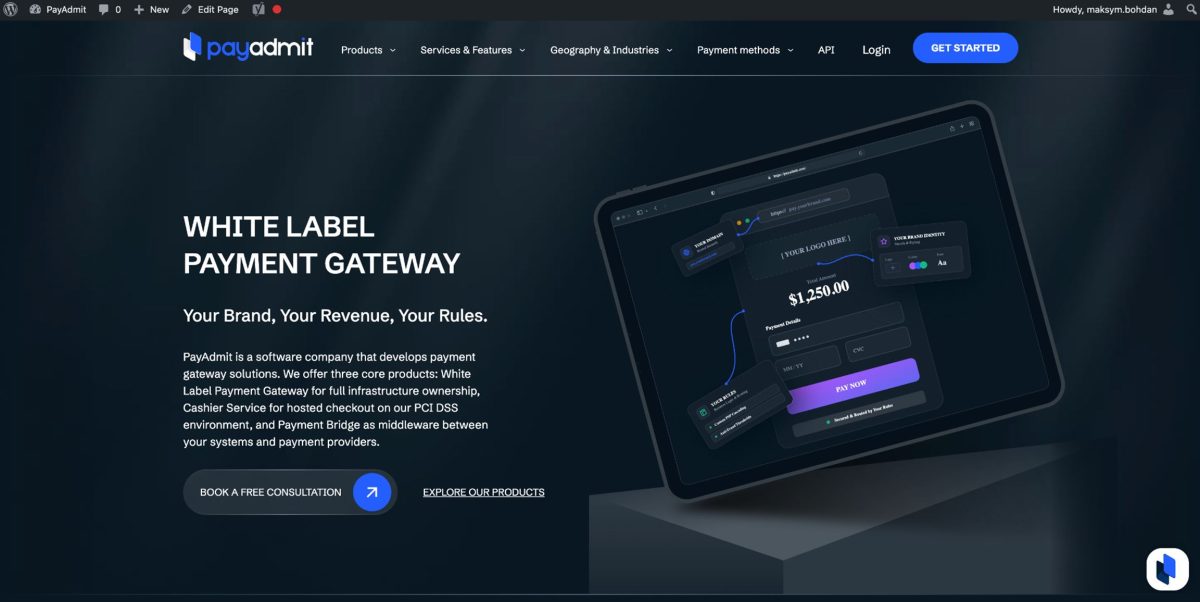
PayAdmit leads the list because it delivers the full meaning of white-label, the version a regulated fintech actually needs. It is a payment software vendor, not a payment service provider: it supplies the technology layer and the fintech runs the payment business on top. Every user and merchant sees the client’s brand at each step of the payment process, while the provider stays invisible behind the gateway. For a fintech or neobank that wants payments as an owned product feature rather than a reseller arrangement, that model is the differentiator.
What secures the top ranking is infrastructure. PayAdmit white label payment gateway gives each client a technically isolated environment: dedicated servers, the client’s own PCI DSS Level 1 certification, its own domain across every payment page and system URL, and full control over routing logic. For a regulated fintech, that isolation is the only model a licensed business can stand behind, because it cannot share a card-data perimeter and still satisfy its obligations.
On capability, the platform exposes a clean REST API with real-time webhooks for every payment event, activates more than 350 payment provider and payment method integrations out of the box, and runs a configurable routing and cascading engine that lifts approval rates in real time. A branded gateway reaches production in roughly two to three weeks, backed by more than a decade across the UK, EU, USA and 40+ markets. In practice the white-label solution delivers:
- Dedicated infrastructure with client-owned PCI DSS. No shared card-data perimeter, the compliant model for a licensed fintech or neobank.
- A developer-ready API. REST endpoints and webhooks that embed the payment process natively in the product.
- 400+ integrations through one API. Cards, alternative payment methods, crypto and bank transfers.
- Commercial support. Direct merchant introductions, continuous maintenance and new integrations on request.
For a fintech that wants to own its gateway, its merchant relationships and its payment data rather than rent them, this is the strongest white-label payment gateway in the comparison, and the only solution here built so the client keeps the full margin on every payment.
TOP 2 – IXOPAY: Enterprise White-Label Payment Gateway
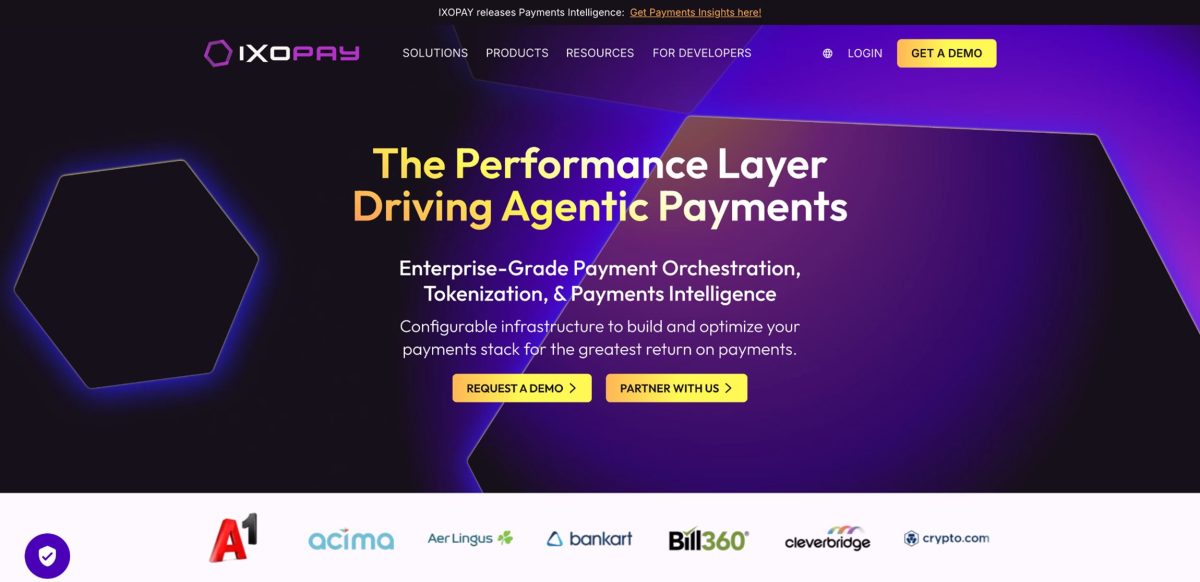
IXOPAY, founded in 2014 with offices in Austria and the United States and a team of around one hundred, is a best-of-breed payment orchestration platform aimed at enterprise clients and larger fintechs. Its modular architecture provides intelligent routing, cascading, a PCI-compliant card vault for tokenisation, modular risk and fraud management, and centralised reconciliation and settlement, with several hundred provider connections available.
- Best for. Enterprises and larger fintechs needing vaulting, orchestration and deep risk tooling.
- Hundreds of acquirer and payment provider connections via one platform.
- Watch-out. Enterprise implementations are involved and can run to roughly ninety days.
IXOPAY is a strong orchestration and tokenisation platform, and for a larger fintech with the engineering depth to use it the card vault is a genuine asset. Where it asks for patience is onboarding, with enterprise implementations often running to about ninety days. PayAdmit delivers a complete branded white-label payment gateway on dedicated infrastructure in two to three weeks, which suits a fintech that wants full ownership without an enterprise-scale integration programme.
TOP 3 – Juspay: Orchestration-Led White-Label Payment Gateway
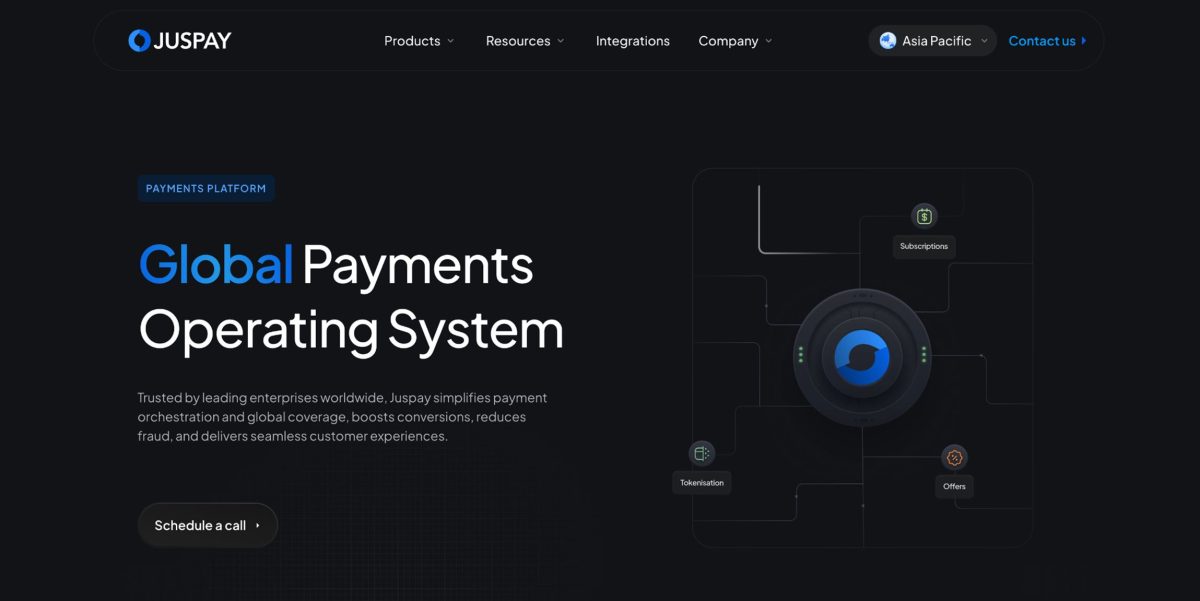
Juspay is a fast-growing payment orchestration platform trusted by leading enterprises across the US, Europe, Latin America and Asia-Pacific. It offers open-source orchestration, global payouts, tokenisation, fraud and risk management, end-to-end reconciliation, and white-label payment gateway solutions, with a no-code platform that integrates more than 300 local payment methods across 50-plus countries and a pixel-perfect checkout.
- Best for. Fintechs wanting deep orchestration with very broad local method coverage and checkout control.
- 300+ local payment methods across 50+ countries.
- Watch-out. Primarily an orchestration layer rather than a dedicated-infrastructure white-label gateway.
Juspay is genuinely impressive on local method coverage and checkout design, and for a fintech optimising conversion across many countries it is a serious option. It is built primarily as an orchestration layer, which is where the comparison turns. PayAdmit gives each client a technically isolated environment with its own PCI DSS certification, the dedicated model a regulated fintech needs and an orchestration platform rarely provides, while still embedding natively through its API.
TOP 4 – Corefy: Configurable White-Label Payment Gateway
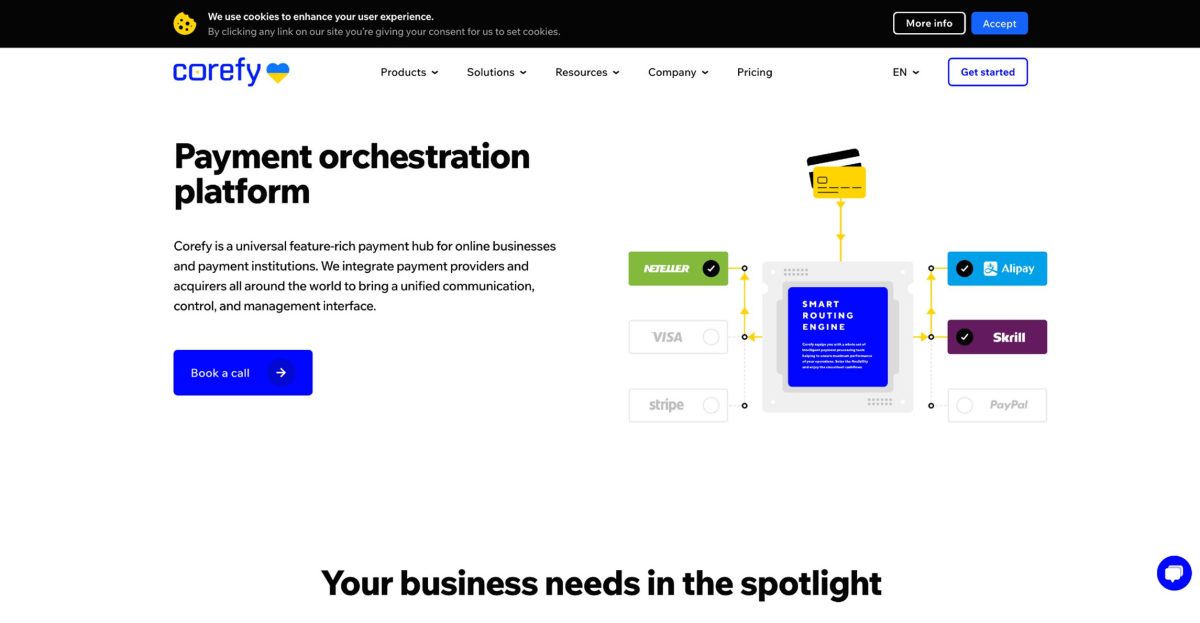
Corefy, headquartered in London, is a widely used payment orchestration and white-label infrastructure platform serving PSPs, fintech companies and large merchants. It consolidates a fragmented payment stack into one configurable system, with a very large library of connectors and a routing engine driven by more than one hundred attributes, so a fintech can tune the payment process by geography, currency, BIN and provider performance.
- Best for. API-first fintechs wanting a deep orchestration layer above many payment providers.
- Several hundred connectors and payment methods through a single integration.
- Watch-out. Pricing is quote-based and the service is pitched at enterprise volume.
Corefy’s connector breadth and routing flexibility make it a capable white-label solution for a technical fintech team. The difference is the infrastructure model underneath: orchestration usually means a shared, multi-tenant platform. PayAdmit gives each client a technically isolated environment and its own PCI DSS certification, the dedicated model a regulated fintech or neobank needs and a shared orchestration service rarely supplies.
TOP 5 – SDK.finance: Source-Licensed White-Label Payment Gateway
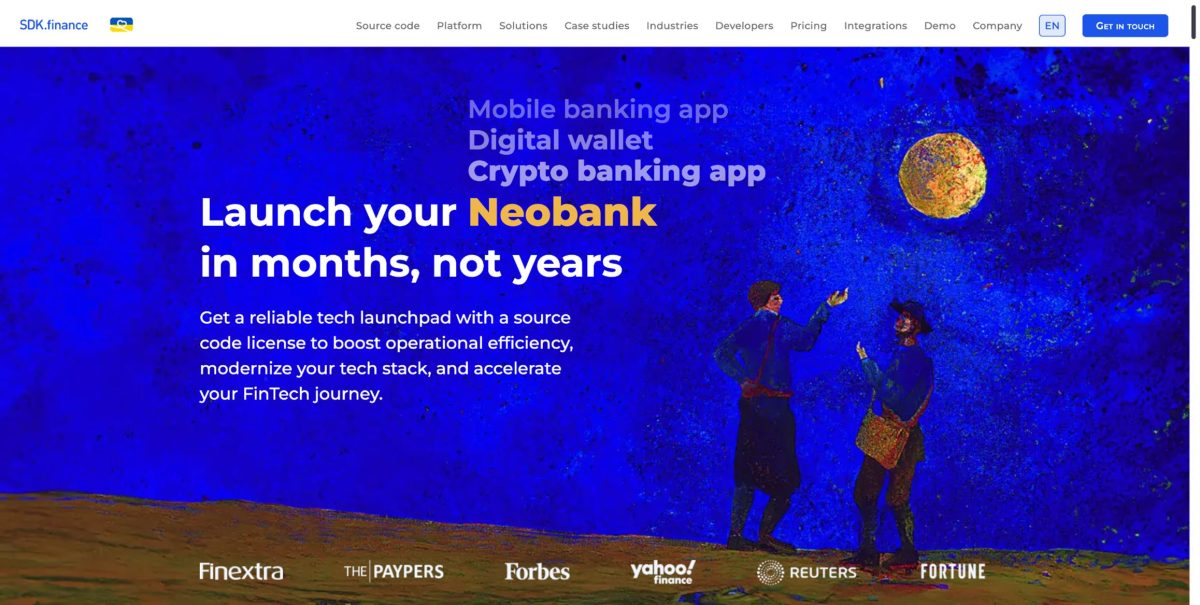
SDK.finance takes a different route, offering a fintech platform available as a source-code licence, with a ledger-level core that a business can build on to create payment and banking products. For a fintech with a strong engineering team that wants to own the codebase outright, it is a powerful foundation and a genuine white-label solution at the platform level.
- Best for. Fintechs with strong engineering teams that want to own the platform source code.
- A ledger-grade core to build payment and banking products on.
- Watch-out. Source ownership means the business carries more of the build and maintenance.
SDK.finance is an excellent choice for a team that genuinely wants to own and extend its own codebase, and the ledger core is a strong base. The trade-off is the build: source ownership puts more of the development and maintenance process on the business. PayAdmit delivers a ready, dedicated white-label payment gateway live in two to three weeks, with maintenance, PCI DSS upkeep and new integrations handled by the provider, so the fintech ships sooner and still owns its environment.
The Trends Pulling Embedded Finance Forward
Several forces are pushing more fintechs towards a white-label payment gateway at once. Embedded finance is moving payment features inside non-financial products, so software businesses want a payment process they own rather than a redirect. Real-time and account-to-account schemes are spreading, and a white-label solution lets a fintech add them under its own brand as they launch. Local methods increasingly decide conversion, so the top providers compete on how quickly a new method reaches production, and crypto acceptance is moving into mainstream products through the same routing process as cards.
None of these trends forgives a weak gateway. Each rewards a fintech whose white-label solution was built to add providers, methods and markets without a rebuild, which is what separates the top white-label payment gateway from a static branded checkout.
What a Genuine White-Label Payment Gateway Must Include
Because the word white-label is used loosely, test every provider’s claim against a short checklist before comparing prices:
- A dedicated environment. Your own servers, not a shared pool, so the card-data process sits in a perimeter you control.
- Your own PCI DSS certification. The compliance scope belongs to the business, not the provider.
- Native embedding. A clean API and webhooks so the payment process lives inside your product, not a redirect.
- Routing you configure. Cascading and PSP priority your team sets, so the payment process serves your margins.
- Merchant ownership. You hold the merchant relationships and the payment data, the commercial core of a payment business.
A provider that meets every line is offering a genuine white-label payment gateway; one that hedges on dedicated infrastructure or PCI DSS ownership is offering a branded reseller service. For a fintech, that single test separates the best white label payment gateway from the imitations more reliably than any feature list.
Three Mistakes to Avoid When Buying a White-Label Solution
Most regrets in this market trace back to the same three errors, and each is avoidable once a business knows what to demand from a white-label solution before it signs.
- Mistaking a hosted checkout for a white-label solution. A branded page on a provider’s shared service is not a white-label payment gateway. If the card-data process runs inside the provider’s perimeter, the business does not own the compliance scope, and the solution it bought is a reseller service in disguise.
- Underrating the routing process. A white-label solution is only as strong as the routing it lets the business control. If cascading and PSP priority are fixed by the provider, approval rates serve the provider’s economics, not the business’s. The best white label payment gateway exposes the full routing process to the client business.
- Overlooking the service after launch. A white-label solution is a long-term relationship, not a one-off build. New payment methods, BIN updates and security patches arrive continuously, so the support service behind the solution matters as much as the launch. A provider whose service bills every change as a project will slow the business down.
Avoid these three and the shortlist narrows quickly to the providers offering a genuine white-label solution and a real support service rather than a branded layer. For any payment business, that is the surest route to the best white label payment gateway.
Whichever white-label solution a business shortlists, test it against real volume and a real integration before signing. A short proof of concept reveals how cleanly the payment process embeds, how the routing behaves under load, and how responsive the provider’s service is when something needs changing. Those answers, more than any brochure, point a business towards the white-label payment gateway it will still be glad about in year two.
How to Choose the Best White Label Payment Gateway for Your Business
Match the provider to the model you want to run, not to a spec sheet. For a fintech, selecting a white-label payment gateway shapes the product experience, the operations process and the share of each payment the business keeps. A quick guide:
- Full ownership and native embedding. PayAdmit, for dedicated infrastructure and a client-controlled routing process.
- Enterprise vaulting and orchestration. IXOPAY.
- Broad local methods and checkout control. Juspay.
- A deep configurable orchestration layer. Corefy.
- Source-code ownership of the platform. SDK.finance.
For a fintech, the difference between a genuine white-label payment gateway and a branded reseller account is the difference between payments being your product and payments being someone else’s.
Final Verdict
A redirect to someone else’s checkout is the one thing a serious fintech cannot afford, and it is exactly what PayAdmit removes. Dedicated infrastructure, the fintech’s own PCI DSS, a clean API and 400+ integrations turn payments into a native part of the product rather than a borrowed service. Plenty of platforms on this list do orchestration well, but only PayAdmit hands the fintech the whole environment to own. For 2026, it is the best white label payment gateway for a business that wants payments to be its own.
 7 Essential Skills Required to Start & Run a Successful Business
 IntraLogistex Dallas 2026
 90.4% of UK & Ireland businesses see cloud as critical to meeting immediate business needs
 Smart Ways Creators Can Increase Their Instagram Comments Without Posting Daily
 How retailers can future-proof their forecasting models post-pandemic
 Migrating to SAP S/4 HANA to Gain Essential Automotive Insight