

Quantum computing is no longer science fiction. Security leaders now pencil a date in their diaries: 2029. By then, hostile nation-states expect to wield machines powerful enough to tear through RSA and ECC, turning our “unbreakable” locks into wet tissue paper (TechRadar report).
That ticking clock has already changed attacker behavior. Adversaries grab encrypted traffic today, store it, and wait. The moment quantum decryption arrives, decades of confidential deals, health files, and state secrets will lie open on their desks.
Governments feel the heat. In August 2024, NIST approved the first three post-quantum cryptography (PQC) standards – CRYSTALS-Kyber for key exchange and CRYSTALS-Dilithium plus SPHINCS+ for digital signatures – signaling that “good enough for now” encryption is officially obsolete, according to Axios. Federal agencies must inventory their cryptographic assets and start swapping in these new algorithms on a fixed timeline.
Boards are asking the same question you are: Who can help us outrun Q-day without ripping out every router and smart card we own? A new wave of vendors has stepped up with answers.
In the pages that follow, we spotlight four standout companies – Project Eleven, Sandbox AQ, PQShield, and QuSecure – chosen for real-world innovation, industry validation, alignment with those fresh NIST standards, and practical ease of deployment.
Read on. The quantum clock keeps ticking, but with the right partners, you can stay several moves ahead.
Project Eleven: quantum-safe blockchain infrastructure
Picture every token, smart contract, and NFT you have ever issued. Now imagine a future quantum computer forging the private keys that protect those assets and quietly draining value in seconds. That worst-case scenario keeps blockchain architects up at night, and it is exactly the gap Project Eleven set out to close.
Born inside the crypto community, the startup’s founders are equal parts protocol engineers and applied cryptographers. They looked at the signatures that power today’s blockchains (mostly ECDSA) and saw a ticking time bomb. Their answer is a toolkit that swaps those fragile curves for the stronger, lattice-based algorithms the new NIST standards endorse.
We like how Project Eleven approaches the problem: audit first, replace second. The team starts by mapping every cryptographic primitive in a customer’s stack, pinpointing spots where a single quantum-broken key would ripple through wallets, custody systems, or validator nodes. From there, they stage what they call a “hybrid cut-over,” weaving Dilithium signatures alongside legacy ECDSA so current nodes keep running while future blocks become quantum resilient. That phased approach succeeds only when every hidden ECDSA touchpoint is exposed first. Project Eleven’s enterprise-grade post-quantum cryptography solutions provide the upfront protocol audit and step-by-step key-retirement playbook that make the cut-over feel invisible to users.
According to a May 12, 2026 engineering blog, Project 11 open-sourced two repositories – libqc and Quantum-Vault – that let developers drop Dilithium signatures into standard ERC-20 and SPL token contracts.
That method is already earning trust. In late 2025 the Solana Foundation tapped Project Eleven to pilot quantum-safe transactions on one of the fastest public chains. The pilot showed that block finality times barely budged, proof that stronger math does not have to slow the network.
Investors noticed, too. A fresh twenty-million-dollar Series A arrived in January 2026, earmarked for hardening wallets and building a plug-in that lets exchanges issue post-quantum deposit addresses with a single API call. For financial institutions dabbling in tokenized assets, that convenience removes a major adoption hurdle.
Why should you care if you are not a crypto exchange? Because distributed ledgers are creeping into supply-chain traceability, carbon credits, and even industrial IoT. If any part of your business plans to record transactions on an immutable ledger, quantum safety must be baked in from day one. Project Eleven gives us a practical way to lock that door before attackers even try the handle.
Sandbox AQ: Alphabet’s muscle behind enterprise PQC
Few security start-ups open the books with half a billion dollars in fresh capital. Sandbox AQ did. Reuters broke the news of its 500-million-dollar war chest, funded by names like Eric Schmidt and Breyer Capital, barely a year after the company spun out of Alphabet. That cash buys something every CISO craves: staying power.
Sandbox’s engineers bundle that staying power into a single product line, the Sandbox AQ Security Suite. It scans your estate – code repos, binaries, network appliances – and flags every place classical encryption hides. Think of it as Shodan for cryptography. Once the map is clear, the suite swaps in Kyber, Dilithium, or a hybrid of both, complete with auto-generated certificates and policy enforcement.
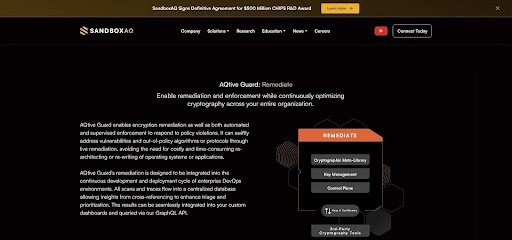
Sandbox AQ Security Suite post-quantum remediation platform screenshot
Scale matters because most enterprises juggle tens of millions of keys across databases, VPN concentrators, and IoT fleets. Sandbox leans on AI to crunch that volume. The same talent pool that tuned Google’s large-scale classifiers now hunts for weak ciphers in your TLS proxies. To handle this scale, the company has already deployed its solutions across more than 15 enterprise and government customers, including the U.S. Department of Health and Human Services and the Defense Information Systems Agency (DISA).
Credibility also flows from its customers. In 2023 the U.S. Air Force tapped Sandbox to cloak classified comms in post-quantum armor. Telcos such as Vodafone followed suit, embedding the suite into 5G core upgrades. Those deployments confirm Sandbox’s claim that you can go quantum safe without ripping out hardware mid-life.
Why should we pay attention? Because policy deadlines are not suggestions. U.S. agencies must submit migration plans soon, and private-sector auditors will copy their checklists. Sandbox AQ offers a turnkey answer backed by deep pockets and early field data. If your roadmap spans thousands of applications and a five-year horizon, lining up with their playbook now can save calendar quarters and plenty of aspirin later on.
PQShield: engineering quantum safety from chip to cloud
Some vendors patch encryption at the edge. PQShield rewires the circuitry itself.
The company spun out of Oxford research labs in 2018 with a clear thesis: if the math moves, the silicon must move with it. Engineers translate lattice-based algorithms into verified hardware IP blocks, then hand those blueprints to chipmakers for smart cards, secure elements, and IoT controllers.
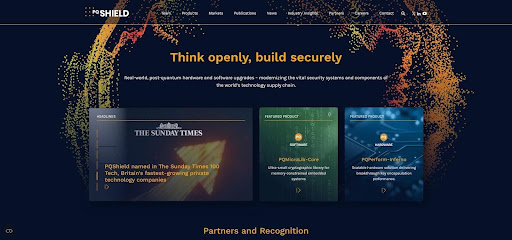
PQShield chip-to-cloud quantum-safe cryptography solutions screenshot
That inside-out approach pays dividends for anyone who ships devices with decade-long life cycles. When a payments terminal or medical implant carries PQShield logic, its keys travel in a hardened vault built for Kyber and Dilithium from day one. No firmware scramble five years later, no forklift recall.
Software teams are not left behind. PQShield libraries mirror the hardware cores, so the same API secures cloud workloads, VPN gateways, and browser sessions. Developers swap a header file, recompile, and gain quantum-safe signatures without rewriting business logic. It is crypto agility at compile time.
Money and partnerships validate the model. A thirty-plus-million-dollar Series B closed in 2024, with industrial giants on the cap table. Semiconductor vendors now bundle PQShield IP in reference designs for passports, EV chargers, and 5G base stations. Every new sector signed means one fewer bottleneck when regulators tighten PQC compliance.
For you, the takeaway is simple. If hardware sits anywhere in your threat surface, from point-of-sale terminals to connected sensors or mobile wallets, ignore the chip layer at your peril. PQShield offers a proven path to bake quantum resilience into the boards before they ever leave the factory.
We call that future-proofing in its purest form.
QuSecure: orchestrating quantum safety across existing networks
Most organizations cannot pause operations while they rip out VPNs, rotate keys, and rewrite every microservice. QuSecure understands that reality, so it built a product that slips into live networks and quietly upgrades the crypto under the hood.
The platform, QuProtect, acts like a traffic cop in front of your apps. It negotiates sessions with hybrid cipher suites that fuse today’s algorithms with NIST-approved lattice math. Users see the same URLs, admins keep the same dashboards, yet every new packet leaves the building wrapped in post-quantum armor.
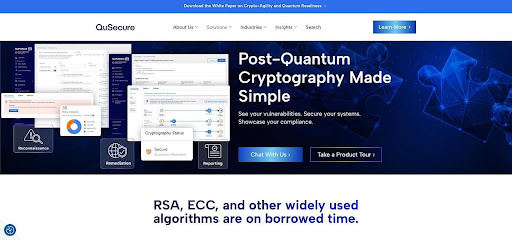
QuSecure QuProtect quantum-safe network overlay platform screenshot
Control is the secret sauce. A central console pushes policy updates the way a cloud firewall pushes rules. One click rolls from an elliptic-curve certificate to a Dilithium combo or quarantines a legacy device that cannot handle larger key sizes. Security teams regain the agility they lost when encryption once felt “set and forget.”
Proof points matter, and QuSecure has field ones. U.S. Army technologists tested the overlay in tactical radio links; the Air Force funded a wider rollout across operational networks. Consulting giant Accenture invested cash and credibility, planning to bundle QuProtect into its crypto-modernization engagements. Those logos confirm the software holds up when latency budgets are tight and risk tolerance is zero.
The economics are compelling. Because QuProtect rides on top of existing routers, enterprises sidestep capital refresh cycles. They treat quantum migration as a software update, not a hardware migration. For CFOs guarding transformation budgets, that difference lands directly on the bottom line.
FAQs
No frequently asked questions were provided in the original content.
Conclusion
If your roadmap calls for zero-trust segmentation, secure SD-WAN, or IoT edge deployments, QuSecure offers a pragmatic shortcut. We can layer quantum-safe encryption today, toggle algorithms tomorrow, and stay compliant as standards evolve, all without pulling a single cable. That is the kind of operational flexibility every CISO needs in a countdown environment.
 Why Shift-Level Visibility Beats Daily Metrics in 24/7 Remote Ops
 Webfleet helps Greencore on route to a safer & more sustainable future
 Boosting Operational Efficiency with Professional Call Center Outsourcing
 Nucleus Research Names Infor a Leader in 2021 HCM Value Matrix
 ONS Retail Figures: Retailers must continue to focus on innovation
 PFU (EMEA) Limited announces launch of ‘Double Take’ promotion