

Most businesses discover contract manufacturing the same way: they hit a wall. Maybe it’s a part too large for the workshop, a welding process nobody on staff is qualified for, or an order that’s suddenly bigger than the current setup can handle. Whatever the trigger, the next step is usually the same phone call, to a manufacturer whose entire job is producing components and assemblies for other companies. That’s contract manufacturing, and it’s a lot more common, and a lot less risky, than most people assume before they’ve actually used it. Businesses that work with an established provider such as Berg Engineering often find the model solves problems they’d been trying to fix internally for years.
This guide covers what contract manufacturing actually means, how the process works in practice, what you can hand over, and how to choose a partner you can trust with production that matters.
What Contract Manufacturing Actually Means
Contract manufacturing is an arrangement where one company produces parts, components, or assemblies on behalf of another, usually to that company’s own designs and specifications. Instead of buying the machinery, hiring the tradespeople, and running the process yourself, you pay a specialist to do it, using their equipment, their facility, and their quality systems.
It’s not the same as simply buying an off-the-shelf part. The client usually supplies drawings, tolerances, and performance requirements, and the manufacturer is responsible for meeting them exactly, with full traceability back to the original spec. That distinction matters a lot in industries like oil and gas or mining, where a component that’s slightly out of tolerance isn’t a minor defect. It’s a safety problem.
It’s also worth separating contract manufacturing from labour hire or simple subcontracting. A genuine contract manufacturer owns the process end to end, the machinery, the quality documentation, the compliance sign-off, not just the pair of hands doing the work.
How the Contract Manufacturing Process Actually Works
The process usually starts with a drawing, a sample, or in some cases just a description of what the part needs to do. From there, a competent contract manufacturer will assess whether the design is actually manufacturable as specified, and flag anything that would be difficult, expensive, or risky to produce as drawn. That step gets skipped more often than it should, and it’s usually where problems start if it does.
Once the design is confirmed, the work moves into production planning: which machines it needs, what welding or fabrication procedures apply, what inspection points are required along the way. For anything safety-critical, this is also where procedure qualification records and material certifications get locked in, so there’s a documented paper trail from raw material to finished part.
Then comes the actual manufacturing, machining, welding, fabrication, or some combination, followed by inspection and testing against the original spec. The part gets delivered with the documentation to prove it was made the way it was supposed to be made, not just that it looks right.
The whole thing runs faster when the client treats it as a partnership rather than a one-off transaction. A manufacturer who understands your operation, your tolerances, and your history with a particular asset will catch problems earlier than one starting from a blank drawing every time.
What You Can Actually Outsource
Contract manufacturing covers more ground than people usually expect going in.
Precision machining is the obvious starting point, particularly for large-format or oversized components that most in-house workshops simply can’t fit on their equipment. A part that needs a lathe with a fifty-tonne table capacity, like the kind of large pump casings machined on Berg’s Titan lathe in Gladstone, isn’t something most manufacturers have sitting in their own shed.
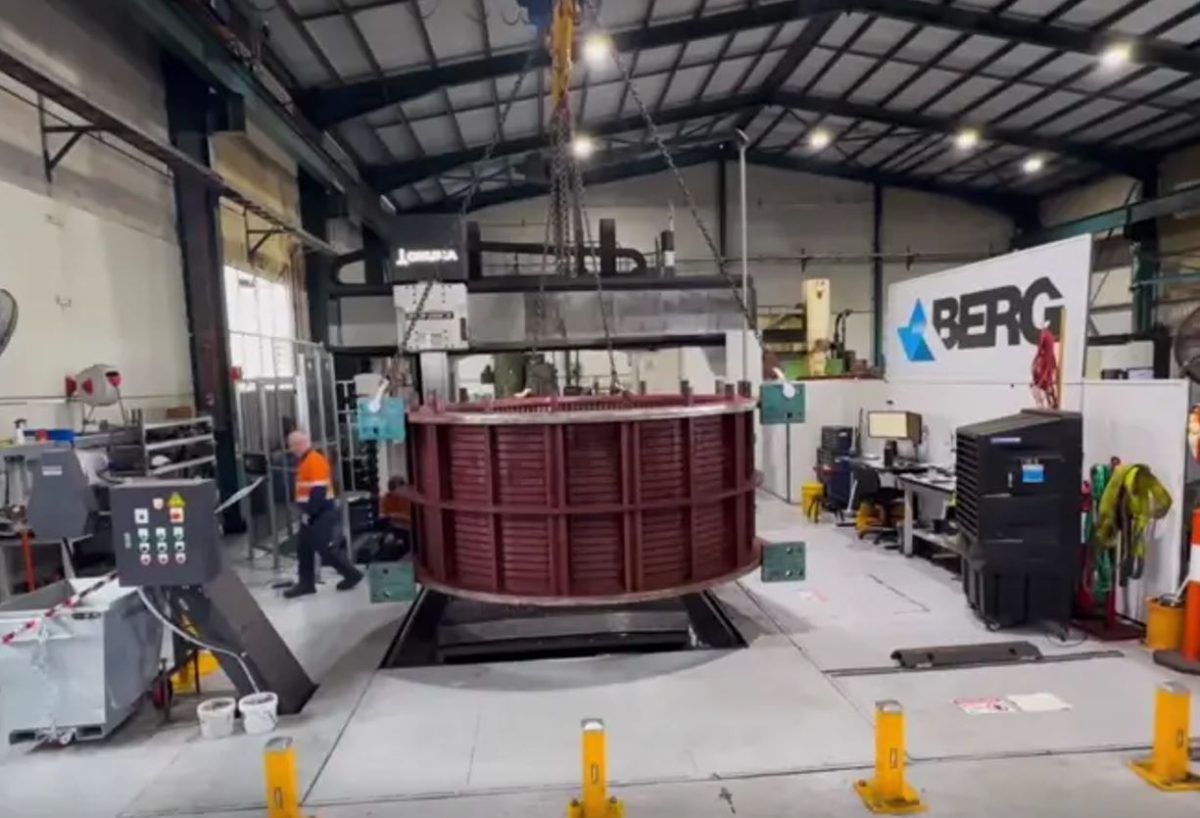
Welding and fabrication follow closely behind, especially specialised processes such as hardfacing, which require qualified welders and documented procedures that most operations don’t run often enough to justify keeping in-house.
Design and re-engineering work is another common one, particularly for legacy equipment. When original manufacturer drawings are missing or a part’s been discontinued, a contract manufacturer with reverse engineering capability can reproduce it accurately, without guesswork.
Beyond individual parts, some contract manufacturers also manage entire asset classes, rotable pumps, valves, and gearboxes, running an ongoing refurbishment and optimisation program rather than a single job. That’s a step up from one-off manufacturing, but it’s built on the same principle: hand over the specialised, capital-intensive work to someone already set up to do it well.
The Real Benefits of Outsourcing Production
The capital argument is usually the first one raised, and it’s a strong one. Avoiding the cost of large-format machinery, specialised tooling, and the facility space to house it frees up capital for the parts of the business that actually differentiate it.
Speed is the second, and it surprises people who assume outsourcing always adds delay. A contract manufacturer with the right equipment already commissioned and operators already trained can often turn a job around faster than an in-house team building the capability from scratch or fitting it in around other priorities.
Quality is the argument people trust least until they’ve seen it in practice. A specialist manufacturer running a particular process daily, with documented procedures and consistent quality control, will typically produce a more consistent result than a generalist workshop doing it occasionally.
Scalability rounds it out. Production needs shift, sometimes seasonally, sometimes with a single large project. A contract manufacturer can flex capacity up or down without you carrying the cost of idle equipment during the quiet periods.
How to Choose the Right Contract Manufacturer
Not every provider is equipped for safety-critical or high-precision work, so it’s worth checking a few things before committing.
Ask how long they’ve been operating, and in what industries. A manufacturer with decades of experience, particularly across demanding sectors like oil and gas or mining, has usually already encountered and solved the problems a newer operator hasn’t run into yet.
Check facility capability against your actual requirements, not their marketing material. If your components are oversized or unusually complex, ask for a specific example of a similar job they’ve completed, not a general capability statement.
Look closely at quality systems and traceability. For anything safety-critical, documentation should be thorough and specific: material certifications, procedure qualification records, and inspection reports that tie back to your original spec.
Consider location and responsiveness too. An Australian-based manufacturer with facilities you can actually visit will generally beat an overseas option on turnaround and communication, especially when something needs adjusting mid-project.
It’s fair to worry about losing oversight once production moves off-site. The way experienced buyers manage that is straightforward: start with a smaller, lower-risk job, visit the facility, review the documentation, and use that first project to qualify the relationship before handing over anything critical.
Getting Started
If you’re considering contract manufacturing for the first time, resist the urge to hand over your most complex or highest-risk job first. Start with something manageable, use it to test communication, lead times, and quality control, and build from there.
Contract manufacturing isn’t about giving up control of your production. Done properly, with the right partner and the right documentation, it’s about handing the specialised, capital-heavy parts of the job to someone who already does them better than you’d be able to build in-house, so your own team can focus on what they do best.
If you’ve got a part or a project that’s outgrown what your current setup can handle, that’s usually the right moment to have the conversation, rather than waiting until a deadline forces it.
 WMS technology innovator, SnapFulfil, announces a trio of key promotions as business continues to grow & flourish
 Best 7 Tempered Glass Supplier for Bulk Orders in 2026
 Imported Truck Parts Under Tariffs: A Smarter Sourcing Playbook
 Australia’s Energy Production, Consumption & Exports
 nuVizz Recognized with Top Supply Chain Project Award for Excellence in Pharmaceutical Delivery Technology
 Unipart Group deepens partnership with SAP to accelerate evolution & expansion of IT Services expertise