

Retailers are quietly rewriting their sourcing playbooks, but the shift is more nuanced than simply moving production out of China. QIMA’s 2026 Global Sourcing Survey found that 43% of surveyed supply chains shifted sourcing locations in 2025, with tariff-affected companies twice as likely to diversify into Vietnam, India, Bangladesh, and Mexico. Adjacent data from the 2026 USFIA Benchmarking Study shows a similar pattern: most surveyed U.S. brands now source under 10% of their volume from China, even while China retains high scores for flexibility, low-MOQ capability, and integrated supply chains.
While these cross-industry benchmarks reflect general procurement sentiment rather than bag manufacturing alone, the takeaway for retail bag buyers is clear: sourcing is not an all-or-nothing decision between China and Vietnam. Material availability, MOQ thresholds, customization depth, tariff classifications, and total landed costs ultimately dictate where a program belongs.
Quick Answer: Is Vietnam or China Better for Reusable Bag Sourcing?
Neither country is universally superior for reusable shopping bags.
- Vietnam is ideal for diversifying beyond China, establishing bulk programs that require strict material compliance (like GRS or FSC), and avoiding certain U.S. tariff exposures.
- China remains highly attractive for complex customizations, multi-material development, and lower-MOQ pilot orders thanks to its incredibly deep tier-2 and tier-3 component networks.
- Dual Sourcing works best for large retailers who can justify the added QC and inventory complexity to ensure total supply chain resilience.
Vietnam vs. China Reusable Bag Sourcing Comparison at a Glance
| Sourcing factor | Vietnam | China |
| Typical sourcing fit | Diversification and additional supplier qualification | Flexible or component-intensive sourcing programs |
| Relative ecosystem depth | Expanding sourcing base | Broader established supplier/component network |
| Customization | Supplier-dependent; strong options available | Broad options across a large supplier base |
| Small/test orders | Depends heavily on supplier and specification | Low-MOQ capability can be competitive with some suppliers |
| Established repeat orders | Strong fit once line capacity and batch consistency are vetted | Highly mature; reliable output across large automated facilities |
| Recycled/material documentation | Readily available (GRS, FSC, ISO); audit scope per batch | Widespread availability; verify direct factory validity vs. trader claims |
| Sampling and development | Supplier-dependent | Broad development ecosystem; capability varies |
| U.S. tariff exposure | HTS, origin and Chapter 99 treatment must be checked | HTS, origin and applicable additional trade measures must be checked |
| Buying strategy | Compare supplier capability, documentation and landed cost | Compare supplier capability, tariff treatment and landed cost |
These are directional patterns, not reusable-bag-industry benchmarks. MOQ, lead time, capacity, sampling capability and cost can vary substantially between suppliers within the same country.
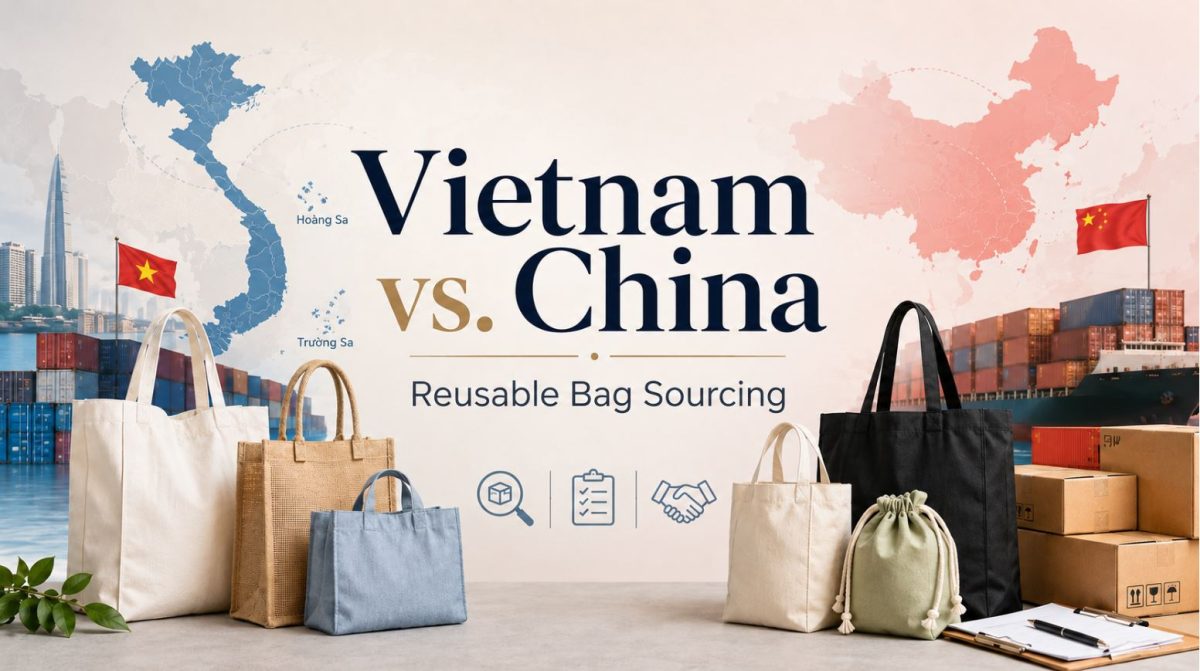
6 Reusable Bag Sourcing Scenarios: When Vietnam or China May Make More Sense
1. Vietnam May Fit Retailers Looking to Diversify China Exposure
Vietnam has become an increasingly important sourcing market as international buyers diversify their supplier networks. QIMA’s 2026 survey found that Vietnam was among the destinations receiving notable new U.S. sourcing volume in 2025, while its inspection and audit data also showed continued sourcing growth in Southeast Asia. This is broad consumer-goods evidence rather than reusable-bag-specific data, but it illustrates the wider procurement trend.
For bag buyers, Vietnam’s potential advantage should therefore be framed primarily around supplier diversification, not an assumption that Vietnamese bags are automatically cheaper or better.
When auditing a prospective Vietnamese factory, evaluate:
- Commercial terms: FOB pricing, production MOQs, and tooling/sample costs.
- Operational capability: Raw material access, dedicated capacity, and batch-to-batch QC processes.
- Landed economics: Current reciprocal tariff exposure, ocean freight rates, and lead-time buffers.
Retailers actively deploying a “China+1” strategy who have the internal resources to audit and qualify new factory lines against existing tech packs.
2. China Can Suit Complex Custom Bag Programs Where Ecosystem Depth Matters
China’s established sourcing ecosystem can be useful when a reusable bag requires multiple materials, components or specialist processes. Depending on the supplier cluster and product, this might include unusual handles and closures, laminated construction, thermal components, several fabrics, custom accessories or multiple SKUs developed together.
China’s deep tier-2 and tier-3 supplier clusters significantly shorten turnaround times when sourcing specialty films, hardware, or multi-fabric constructions. However, buyers should still audit whether prospective factories handle lamination, printing, and assembly in-house or rely on outside subcontractors, which can introduce QC blind spots.
A good option for: Programs with complex tech packs, multi-SKU retail rollouts, or specialized seasonal trims requiring an integrated local component network.
3. Vietnam May Fit Programs Requiring Material and Compliance Documentation
For retailers buying rPET bags, reusable PP bags, paper shopping bags or other products carrying material or sourcing claims, documentation should be part of supplier qualification from the beginning.
This is especially relevant for European buyers. The EU Packaging and Packaging Waste Regulation applies from 12 August 2026, although the timing and applicability of specific composition, recyclability, reuse and labelling obligations vary by provision and packaging type. Buyers therefore need to assess the requirements applicable to their actual packaging rather than assuming that one certification establishes PPWR compliance.
For example, established Vietnam bag manufacturers such as BK Bags (producing since 2008 across PP woven, rPET, paper, and cotton tote formats) maintain credential suites including GRS, FSC, ISO, BSCI, and Sedex.
However, buyers should never treat social audits and material chain-of-custody certificates as interchangeable. When vetting suppliers for high-compliance regions like the EU or US, always request the active certificate scope, lot-specific Transaction Certificates (for rPET), and recent third-party audit reports tied directly to the producing facility rather than a trading intermediary.
Target fit: High-volume supermarket and retail programs (e.g., rPET, PP woven checkout bags) requiring verifiable chain-of-custody documentation and third-party social audits.
4. China Can Be Attractive for Pilot Runs Where Supplier Breadth and Low-MOQ Capability Matter
Retailers often need to test a reusable bag before committing to a full rollout. That could involve a new print design, several colourways, different handles, seasonal artwork or a new construction.
China’s broad sourcing base can make it worth evaluating for these programs. Adjacent USFIA apparel research identifies low MOQ and flexibility as relative strengths, but that does not establish that every Chinese reusable-bag supplier offers lower MOQs than suppliers in Vietnam.
When modeling short-run economics, tally the complete initial expense: sample charges, cylinder/plate fees, low-quantity unit surcharges, and LCL air/ocean freight. A factory offering a 500-unit minimum with heavy tooling and setup costs can easily exceed the total spend of a 2,000-unit tier at an established bulk producer.
A good fit for: Buyers testing new specifications where supplier choice and lower-volume development capability are more important than concentrating production in a particular country.
5. When Vietnam Suppliers May Fit Established Repeat Retail Programs
Vietnam should not automatically be labelled the better country for large repeat reusable-bag orders. Repeatability is a supplier-level capability.
However, retailers already diversifying procurement into Vietnam may find suitable suppliers for established programs such as supermarket bags, PP woven checkout bags, branded totes or recurring promotional designs.
The qualification process should answer practical questions:
- What is the MOQ per material, size and print?
- What production capacity is available for the required order window?
- Can capacity be reserved for repeat programs?
- Will the approved sample remain the QC master?
- How are dimensions and print colours controlled between batches?
- Does the supplier maintain the same material specification across repeat runs?
- What happens if raw-material availability changes?
A successful first shipment is not enough evidence of long-term repeatability.
This approach works well for: Supermarkets and retail chains considering Vietnam for an established bulk program, provided they first verify capacity, quality consistency and production planning with the supplier.
6. Dual Sourcing Can Improve Resilience When the Additional Complexity Is Justified
Large retailers do not always need to choose between Vietnam and China.
A sourcing program might allocate primary production to one country while maintaining a qualified backup supplier in the other. Alternatively, buyers may divide sourcing by material, SKU or destination market.
The 2026 USFIA study provides a useful adjacent sourcing signal here: companies appear to be moving away from simply adding more countries and toward optimizing existing supplier networks, consolidating relationships and improving resilience.
Dual sourcing, however, is not free. It can create:
- duplicate sampling
- supplier qualification costs
- additional inspections
- separate MOQs
- inventory complexity
- specification drift
- increased procurement administration
It therefore can be more resilient than relying on one country when order volumes and continuity requirements justify the extra complexity, rather than automatically being the better strategy.
For true backup capacity, both suppliers should work from the same:
- material specification
- dimensions and tolerances
- colour references
- artwork
- testing requirements
- packing standards
- approved sample
This makes the most sense for: Large retailers with sufficient annual volume, multiple markets or business-continuity requirements to justify maintaining two qualified sources.
How Should Retailers Compare Vietnam and China Bag Suppliers?
Country comparisons become useful only after buyers standardize what they are comparing.
Compare MOQ Against Actual Order Volume
Ask for MOQ by material, size, colour and print—not simply a headline supplier MOQ. A lower minimum is valuable only when the resulting unit and freight economics work for the actual program.
Compare Quotes Using Matched Specifications
Every supplier should quote the same:
- dimensions
- material
- GSM or material weight
- handle construction
- printing method
- finishing
- packaging configuration
Otherwise, a lower quotation may simply represent a lighter or less complex bag.
Verify Documentation Scope
For recycled-content claims, request documentation relevant to the specific material and supply chain. For paper-based programs, verify the applicable FSC documentation where required.
For social compliance, BSCI or Sedex evidence should be assessed as audit/compliance documentation rather than treated as a generic environmental certification.
Approve Samples Before Mass Production
Use a final approved sample as the QC reference. Define acceptable dimensions, colour tolerance, printing, stitching, load performance and packaging before issuing the production PO.
Measure Lead Time From Final Approval
Separate: sampling + revisions + material procurement + production + inspection + international transit
A supplier quoting a short production time may still have a longer total order cycle.
Build a True Landed-Cost Model
Calculate total program costs across the entire fulfillment chain: FOB price + tooling/plates + pre-shipment inspection + international freight & insurance + baseline HTS duty + trade remedies/reciprocal tariffs + customs brokerage + drayage and inland delivery.
For U.S. procurement, tariff exposure frequently outweighs nominal unit savings:
- Vietnam-origin goods: Currently subject to a baseline 20% U.S. reciprocal tariff under Chapter 99, alongside normal Column 1 HTS duties, subject to specific product exceptions.
- China-origin goods: Continue to carry normal Column 1 duties plus applicable Section 301 tariffs (e.g., CBP rulings have assessed additional 25% Section 301 duties on specific non-woven/PP bags under HTSUS 4202.92.4500).
Because duty treatment varies significantly by bag composition (woven vs. non-woven PP, cotton weight, or rPET film) and trade remedy rules shift, always confirm the 10-digit HTSUS classification and Chapter 99 provisions with your customs broker before finalizing sourcing allocations.
FAQ
Is It Cheaper to Source Reusable Bags From Vietnam or China?
Not necessarily. Pricing depends on materials, MOQ, supplier capability, tariffs, freight and payment terms. Compare quotes based on the same specifications and look at landed cost, not just FOB price.
What Certifications or Compliance Documents Matter for Reusable Bag Sourcing?
It depends on the product and destination market. Common examples include GRS for recycled content, FSC for paper or wood-fibre products, and BSCI or Sedex for social compliance. Always check that certificates are current and cover the relevant facility, product or material.
Is Vietnam Replacing China as a Reusable Bag Sourcing Market?
Not necessarily. Recent research points to broader sourcing diversification, including Vietnam, but it does not show Vietnam replacing China specifically for reusable bags. These trends provide useful context, but buyers should still assess suppliers individually.
Can Retailers Realistically Source the Same Bag From Vietnam and China?
Yes. The key is keeping the specification consistent across both suppliers, including materials, dimensions, printing, performance and packaging. Buyers should also factor in extra sampling, QC and inventory costs when deciding whether dual sourcing is worthwhile.
Vietnam vs. China: Which Sourcing Base Fits Your Program?
- Choose Vietnam for high-volume baseline programs (such as PP woven or rPET grocery totes) where social audits, documented resin traceability, and long-term geographic diversification align with retail ESG mandates.
- Choose China for complex, multi-material bags, fast-turn seasonal designs, or programs requiring lower initial MOQs supported by an integrated local component market.
- Choose Dual Sourcing when aggregate volume justifies duplicate sampling, audit overhead, and split tooling to protect retail business continuity.
Ultimately, country-level generalities matter far less than factory-level execution. Standardize your tech packs, verify batch-level certifications, calculate complete landed costs down to the 10-digit HTS code, and award volume based on verified supplier capability.
 Barking, Havering & Redbridge University Hospitals NHS Trust Renews Partnership with Clinical Informatics Provider Epro
 DeepL Selects VAST to Build AI Data Foundation for Next-Generation Language AI
 How to Tailor Your Resume for Supply Chain Management Jobs
 Your First Ten Bucks: No Deposit Free Spins for Kiwis
 IFS Softeon Launches Fulfillment Flow to Bring Context-Aware AI to Warehouse Operations
 Media Giant Dentsu Goes Cloud-native with NetApp