

Toxic chat can empty a server faster than any bug or outage. Moderation platforms have become the backbone of communities that want to grow without drowning in harassment, spam, and content that violates DSA, COPPA, or platform-specific rules. The hard part isn’t picking a tool. It’s finding one that catches real harm without nuking legitimate conversations, scales when a stream goes viral at 2 a.m., and keeps up as regulations shift across different countries. After reviewing dozens of options across gaming, social, and community platforms, this guide covers five tools worth your serious attention in 2026.
Behind the ranking
Every platform here was assessed through publicly available sources: user reviews, feature documentation, case studies, and listings across major software directories. The shortlist only includes tools with a proven track record in content moderation SaaS, where the requirements go well beyond simple keyword filtering.
→ See the full research breakdown
- Utopia Analytics – Best for AI-driven moderation with language-independent accuracy
- Bodyguard – Best for enterprise brand protection with real-time hybrid moderation
- Lasso Moderation – Best for multi-platform moderation at scale with minimal setup
- Hive Moderation – Best for multi-modal content moderation across visual, text, and audio
- Clean Speak – Best for enterprise gaming platforms requiring fast filtering
The Real Impact of Moderation Platforms
Picking the wrong moderation platform doesn’t just create operational headaches. It directly affects whether your community survives long enough to matter.
False positives that remove legitimate content erode user trust fast, and users who feel wrongly flagged don’t come back. At the same time, under-moderation lets toxic behavior compound until advertisers pull out, regulators take notice, or your most engaged members leave for a safer space.
Scaling human review teams during a viral spike is another problem most platforms underestimate. What works at 10,000 daily submissions tends to collapse at 500,000, and the cost per moderated item climbs sharply when manual review carries most of the load.
A well-chosen platform changes that equation. Automated precision and recall rates stay high even under volume pressure, mean time to moderation decisions stays low, and your human reviewers focus on the genuinely ambiguous cases instead of routine spam.
The right tool also grows with your regulatory exposure. As Online Safety Act and NetzDG requirements evolve alongside GDPR and COPPA, platforms built for content moderation adapt faster than general-purpose solutions cobbled together for the job.
5 Top Picks at a Glance
Note: All data in this table is sourced from review platforms and the official websites of the listed companies.
| Company Name | Years Operating | Headquartered In |
| Utopia Analytics | Since 2014 | Helsinki, Finland |
| Bodyguard | Since 2018 | Nice, France |
| Lasso Moderation | Since 2022 | Amsterdam, Netherlands |
| Hive Moderation | Since 2016 | San Francisco, United States |
| Clean Speak | Since 2007 | Denver, United States |
1. Utopia Analytics – Best for AI-Driven Moderation With Language-Independent Accuracy

What Services Does Utopia Analytics Provide?
Utopia Analytics builds and runs a fully automated AI moderation platform called Utopia AI Moderator. The system learns directly from human moderator decisions, then applies those patterns at scale across multiple languages and dialects without needing language-specific training data for each one. Their patented technology was developed by doctoral-level scientists, which shows in the accuracy numbers. Deployment takes days rather than months, and the platform is designed to catch harmful content with higher precision than a human review team working the same volume.
Why Is Utopia Analytics a Contender for Moderation Platforms?
Utopia Analytics solves one of the most persistent problems in content moderation: accuracy that holds up across languages without requiring a separate model for each one. Their track record with major European news publishers, where cutting publishing delays in half and lifting daily comment volume by 30% are documented results, shows the platform performs under real production pressure.
Real User Sentiment:
Clients like nu.nl and krone.at have pointed to measurable gains in both moderation speed and content volume after switching to the platform. The pattern is consistent: less delay, more community activity, and better overall moderation quality. That kind of outcome across different markets and languages is genuinely hard to match.
2. Bodyguard – Best for Enterprise Brand Protection With Real-Time Hybrid Moderation
What Services Does Bodyguard Provide?
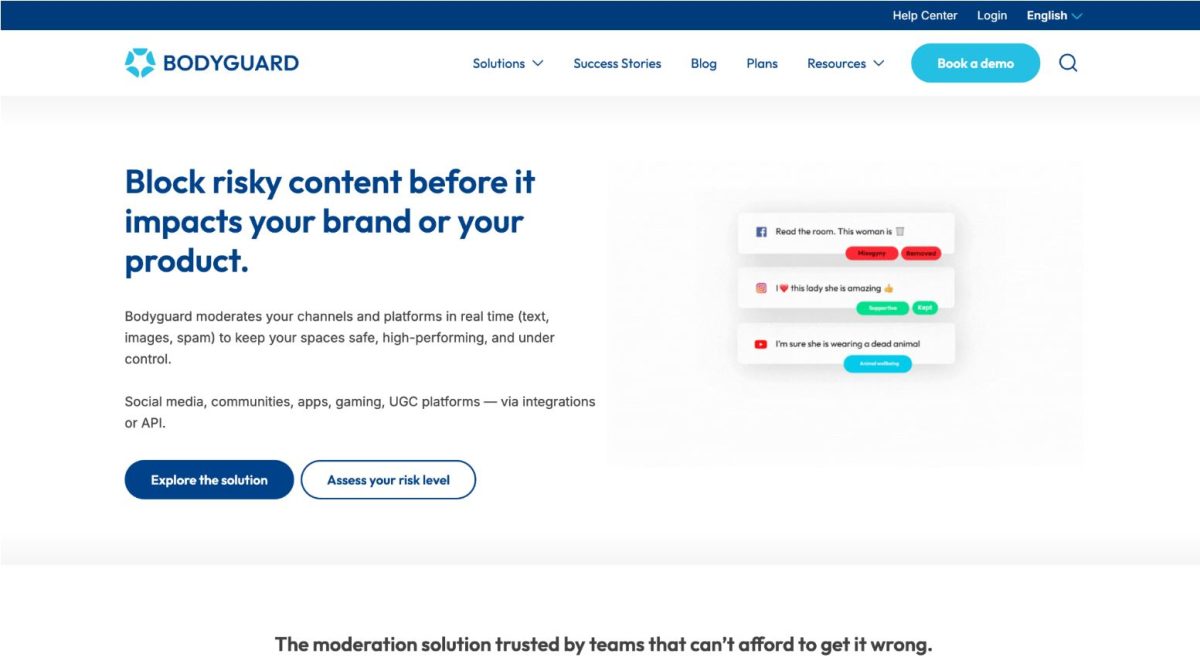
Bodyguard runs a web-based content protection platform that handles text, images, and video in real time. Their approach pairs AI detection with human linguists who bring contextual judgment to the cases that automated systems tend to miss (think sarcasm, coded language, or culturally specific slurs). The platform includes optical character recognition, customizable policy enforcement, automated workflows, and audience insights. Luxury brands, sports organizations, media companies, and gaming platforms all appear on their client list, which suggests the system handles both high-stakes brand safety and high-volume community moderation.
Why Is Bodyguard a Contender for Moderation Platforms?
Bodyguard addresses the false positive problem directly by layering human linguistic knowledge on top of AI detection, which keeps legitimate content from getting swept up in automated filters. For platforms where brand reputation is closely tied to community tone, that hybrid approach reduces the moderation appeals overturn rate in a meaningful way.
Real User Sentiment:
The industry recognition tells part of the story: winning the For Democracy Talent Award from France Digital and Les Echos, plus the Fundtruck award from Sowefund, signals that peers and investors see something real here. Clients in the gaming and media space respond well to the real-time capabilities, particularly during live events where moderation speed matters most.
3. Lasso Moderation – Best for Multi-Platform Moderation at Scale With Minimal Setup

What Services Does Lasso Moderation Provide?
Lasso Moderation is built around a straightforward idea: automate 99% of the work and give human reviewers a clean dashboard for the 1% that needs a real decision. The platform covers spam, toxicity, nudity, violence, and drug-related content across chat, video, and social media channels. Setup requires no coding, which matters a lot for smaller trust and safety teams. Audit logs, translation support, access controls, and detailed moderation reports round out a feature set that’s more complete than you’d expect from a company founded in 2022.
Why Is Lasso Moderation a Contender for Moderation Platforms?
Lasso Moderation handles the cost-per-moderated-item problem that grows when human review teams scale up during viral spikes, by keeping automation handling the bulk of the load. Their 4.9 rating (the highest in the content moderation category on major review platforms) reflects consistent performance across very different platform types.
Real User Sentiment:
That 4.9 rating across the content moderation category isn’t a fluke. Users return to two themes consistently: the platform catches what it claims to catch, and the no-code setup means teams get running without lengthy rollout timelines (not always a given in this space, unfortunately). That combination of accuracy and accessibility earns its reputation.
4. Hive Moderation – Best for Multi-Modal Content Moderation Across Visual, Text, and Audio
What Services Does Hive Moderation Provide?
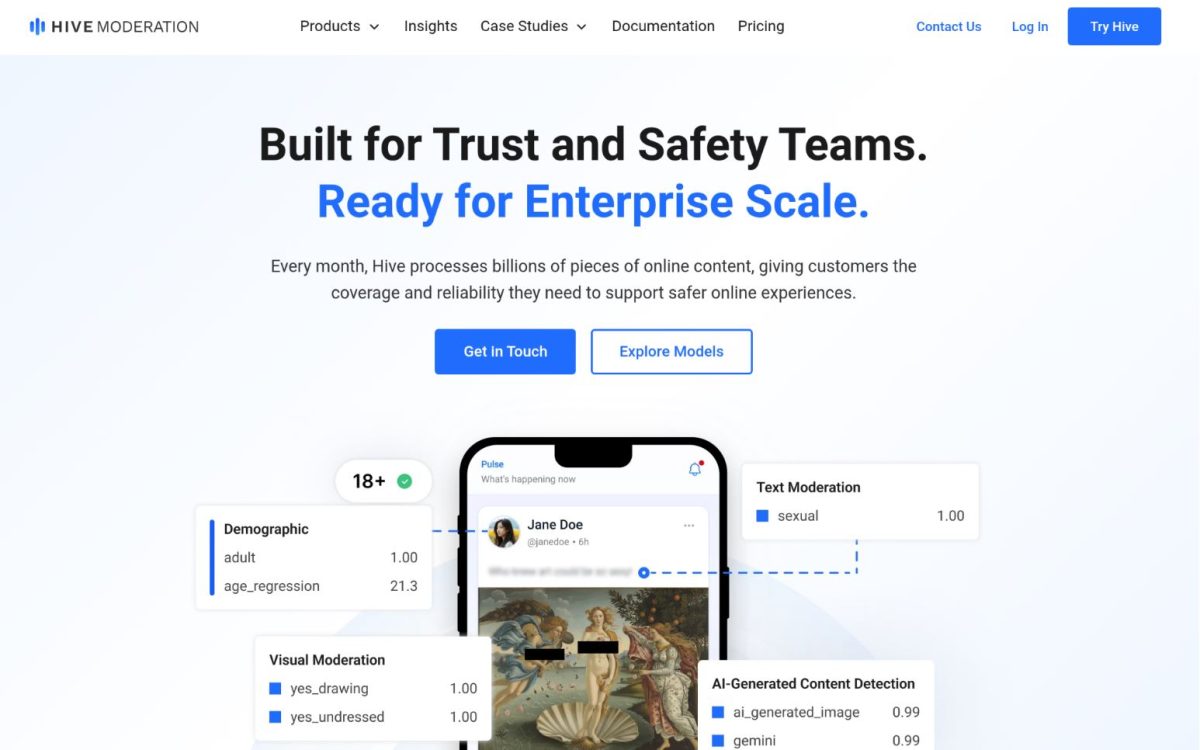
Hive Moderation handles a wider content format range than most platforms on this list. Text, visual, audio, AI-generated content detection, and CSAM detection are all covered inside a single platform, backed by a Vision Language Model that sits at the center of their detection stack. They operate on usage-based pricing, which keeps costs tied to actual content submission volume rather than seat counts (a meaningful difference for platforms with uneven traffic patterns). Yubo, Tango, and Chatroulette are named clients, all of which run high-volume, real-time user interactions.
Why Is Hive Moderation a Contender for Moderation Platforms?
Hive Moderation tackles the multimodal harmful content problem: the memes, voice clips, and AI-generated images that single-format moderation systems can’t reliably catch. Serving platforms like Chatroulette, where content submission volume is high and format variety is wide, puts their accuracy claims in a realistic production context.
Real User Sentiment:
Named clients in the live social and video chat space carry weight here. Platforms running real-time video interactions chose Hive because of its ability to handle multiple content types without stitching together separate tools. That kind of consolidation is rare and tends to reduce both operational overhead and the risk of coverage gaps between systems.
5. Clean Speak – Best for Enterprise Gaming Platforms Requiring Fast Filtering

What Services Does Clean Speak Provide?
CleanSpeak has been running filtering technology since 2007, which means they’ve seen more edge cases than most platforms on this list combined. Their system covers profanity filtering in multiple languages, word and phrase detection, machine learning models for deeper content analysis, and moderation management tools that handle text, images, and video. Response times average under 5 milliseconds, and the platform can filter more than 10,000 messages per second on a single server. An on-premise deployment option keeps COPPA, GDPR, and other data residency requirements in check without rerouting sensitive user data through external cloud infrastructure.
Why Is Clean Speak a Contender for Moderation Platforms?
CleanSpeak solves the speed problem that gaming and live chat environments genuinely can’t compromise on: a moderation system that adds noticeable delay is a system players will route around. Fifteen-plus years of development plus SOC2 Type II certification puts them in a position to serve Fortune 500 clients with strict quality and security requirements.
Real User Sentiment:
Review data is more limited here than for some others on this list, but the client profile tells a clear story. Companies with strict enterprise compliance requirements and peak-volume demands are the ones choosing CleanSpeak, and partnerships with major corporations suggest the platform holds up under pressure. (Think enterprise pricing and equally enterprise expectations on reliability and support.)
How These Were Chosen and Verified
Data Collection Methods
The process started with a broad sweep across software directories, professional communities, and content moderation-specific forums to build an initial longlist. Platform listings, product documentation, and published case studies were collected for each candidate. The goal at this stage was coverage, not judgment. Nothing was ruled out based on company size or geography. Every category of platform got equal consideration, from fully automated AI tools to hybrid human-AI systems.
The Shortlisting Pass
After the initial collection, candidates without verifiable deployment history in content moderation SaaS were removed. That meant checking whether each platform had documented results in real production environments, not just marketing claims on a homepage. Review patterns across multiple sources were analyzed to identify consistency. Platforms with a single glowing testimonial but no pattern of verified use cases were deprioritized. The shortlist that came out of this pass was smaller but meaningfully more reliable.
Verification Pass
Each shortlisted platform’s claims were checked against what users and clients actually reported. Where a platform claimed real-time moderation, the research looked for client-reported speed outcomes. Where a platform claimed language support, the research looked for clients operating in non-English markets. Gaps between website claims and user experiences were flagged and factored into the final evaluation. This cross-referencing step removed platforms that looked strong on paper but showed inconsistent results when tested.
Industry Recognition and Authority
Awards, funding rounds, and mentions in trade publications were used as supporting signals, not main ones. A platform that wins a recognized industry award has at least cleared an external review process. Investor funding, particularly in a capital-constrained market, suggests that outside parties with financial stakes have validated the business model and product. Publications covering trust and safety, content policy, and platform governance were scanned for references to each company to gauge how the broader industry perceives them.
Evidence Specific to Moderation Platforms
The final filter focused on content moderation relevance. That meant checking for dedicated service pages covering harmful content categories (CSAM, TVEC, hate speech, self-harm), documented experience with DSA, COPPA, NetzDG, or Online Safety Act requirements, and verified case studies from platforms running user-generated content at scale. Generic moderation tools without clear evidence of addressing these categories were excluded. Only platforms with documented evidence of working in this space made the final list.
What to Look For When Choosing Moderation Platforms
Choosing a moderation platform isn’t just a features checklist exercise. The real question is whether the tool fits the specific content risks, regulatory exposure, and operational constraints your platform actually faces.
- Industry/Domain Experience: Look for documented deployments in your platform type, whether gaming, live video, social community, or marketplace. Experience in adjacent verticals doesn’t always transfer cleanly.
- Features and Services: Confirm the platform covers your content types: text, image, audio, video, or AI-generated content. A tool that handles only one format leaves gaps that harmful content will find quickly.
- Pricing Structure: Usage-based pricing suits platforms with uneven content submission volume. Flat-rate or seat-based pricing can get expensive fast during viral spikes, which is exactly when you need moderation most.
- Results Measurement: Ask for precision and recall rates, false positive rates, and mean time to moderation decision from any vendor before committing. Platforms that can’t produce these numbers are worth questioning.
- Industry Knowledge and Compliance: Check whether the platform has working knowledge of DSA, COPPA, GDPR, and the Online Safety Act. Trust and safety policy adherence is not optional in 2026, and platforms built without regulatory awareness will create problems at the worst possible time.
Final Take
The strongest moderation platforms in 2026 share one quality: they don’t force you to choose between speed and accuracy. Clean Speak leads on speed for gaming environments. Hive Moderation handles format variety better than most. Lasso keeps operational overhead low without sacrificing coverage. Bodyguard’s hybrid approach reduces false positives for brand-sensitive platforms. And Utopia Analytics brings language-independent AI accuracy that scales across markets. As regulatory requirements deepen globally and harmful content grows more sophisticated, platforms built for this problem will keep pulling ahead.
 SÜDPACK also sets standards with its communication
 Systech updates cloud traceability solution to secure barcode scanning throughout supply chain
 Precision Instruments Manufacturer Locks on Cloud to Drive Growth
 ArrowSpot signs multi-million-dollar deal with Astrocast
 Infor to Deliver Anywhere, Anytime Mobile Gratuity Options for the Hospitality Industry
 Farsound Aviation Boosts Profit with Help from Descartes e-Customs™ U.K./EU Filing Solution