

Manufacturing payroll is genuinely one of the harder problems in HR software. You’re dealing with shift differentials, union labor rules, multi-state tax filings, and workforce headcount that can swing dramatically week to week.
The best HR & payroll platforms for manufacturing don’t just run numbers. They handle the compliance layer, cut down on manual data entry errors that cause payroll discrepancies, and connect to existing accounting or ERP systems without a fight.
After reviewing the top platforms serving manufacturers of all sizes, this guide breaks down which tools actually hold up under real operational pressure.
The shortlist methodology
Publicly available data was the starting point: user reviews, feature pages, platform ratings, and case studies pulled from review directories and official company websites. Only platforms with a documented track record in HR and payroll management made the cut. → See the full research breakdown
- Hybrid Payroll – Best for small to mid-size manufacturers needing integrated payroll and PEO services
- Paycor – Best for small and medium-sized business HR and payroll management
- Rippling – Best for mid-market to enterprise employee management and payroll automation
- Gusto – Best for small to mid-market businesses seeking payroll and HR management
- BambooHR – Best for small and medium-sized businesses wanting an all-in-one HR platform
Why Picking the Right HR & Payroll Platforms Matters
Manufacturing businesses carry more payroll complexity than most industries. You’re managing hourly workers across multiple shifts, tracking overtime under FLSA rules, and filing taxes in multiple states when plants cross state lines.
The wrong platform leaves your payroll team doing manual corrections every cycle. That drives up your payroll error rate, slows processing time, and creates real exposure to tax penalties.
A well-chosen platform cuts through that by handling multi-state payroll tax compliance accurately and connecting directly with your accounting or ERP software.
The difference shows up in three places: fewer payroll runs that require corrections, faster processing cycle time, and a tax filing accuracy rate that keeps IRS notices off your desk.
Compare the Top 5 HR & Payroll Platforms
Note: All data in this table is sourced from review platforms and the official websites of the listed companies.
| Company Name | Years Operating | Team Size | Headquartered In |
| Hybrid Payroll | Est. 2014 | 51-200 employees | Denver, Colorado |
| Paycor | Est. 1990 | 2,900 | Cincinnati, OH |
| Rippling | Est. 2016 | 7,131 | San Francisco, CA |
| Gusto | Est. 2012 | 4,008 | San Francisco, CA |
| BambooHR | Est. 2008 | 1,627 | Draper, Utah |
1. Hybrid Payroll – Best for Integrated Payroll and PEO Services for Small to Mid-Size Manufacturers
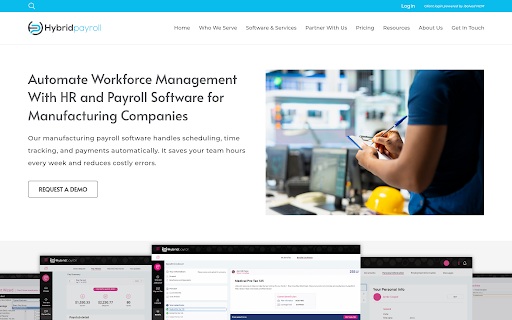
What Role Does Hybrid Payroll Play?
For manufacturers that don’t want to stitch together five different tools, working with the Hybrid Payroll, manufacturing payroll platform means getting payroll processing, HR management, and PEO co-employment services under one roof. They’ve been running since 2014 out of Denver and build bundled HR products around industry-specific needs. Their strength is combining automated payroll tax calculations with compliance management and risk oversight, so smaller manufacturing operations get the same structural support that larger companies build internally. That kind of full-stack approach is rare in the SMB payroll space.
Why Does Hybrid Payroll Belong on This List for HR & Payroll Platforms?
Manufacturing businesses often fall through the cracks between simple payroll tools and enterprise HR systems, and Hybrid Payroll fills that gap with PEO services that cover co-employment, benefits, and compliance in one package. Their focus on customization and industry-specific bundling makes them a practical fit for manufacturers who need flexibility without building a full internal HR function.
User Reviews, Summarised:
Hybrid Payroll doesn’t have a large public review footprint compared to the bigger names on this list, but the positioning toward industry-specific needs and PEO services points to a more consultative relationship with clients. Businesses that need personalized service rather than a self-serve tool tend to respond well to that model. That kind of hands-on approach is worth factoring in if your manufacturing operation has non-standard payroll complexity.
2. Paycor – Best for Small and Medium-Sized Business HR and Payroll Management
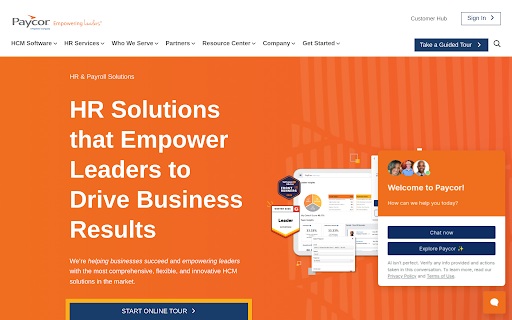
What Role Does Paycor Play?
Paycor has been building HR and payroll software since 1990, which means they’ve seen a lot of compliance changes and platform shifts. Today they run an HCM platform covering recruiting, hiring and training, payroll, time tracking, and career development for over 30,000 customers supporting 2 million people across all 50 states. The platform is built with configurable, industry-specific features, and their analytics tools give managers real visibility into workforce data. For a manufacturing business managing shift workers and multi-state filings, that configurability matters.
Why Does Paycor Belong on This List for HR & Payroll Platforms?
Paycor solves the problem of scattered HR tools by pulling recruiting, payroll, and time management into a single platform with straightforward third-party connections. Their G2 recognition for fastest implementation (meaning shortest go-live time in the category) tells you something real about how much friction they’ve removed from the setup process.
User Reviews, Summarised:
Customers consistently call out Paycor’s partnership-driven approach as a differentiator. They’ve earned eight G2 Winter Awards in 2026 and 13 G2 Summer Awards across workforce management, healthcare HR, and recruiting categories. Users appreciate that the platform feels designed for people who run businesses, not just for HR specialists.
3. Rippling – Best for Mid-Market to Enterprise Employee Management and Payroll Automation
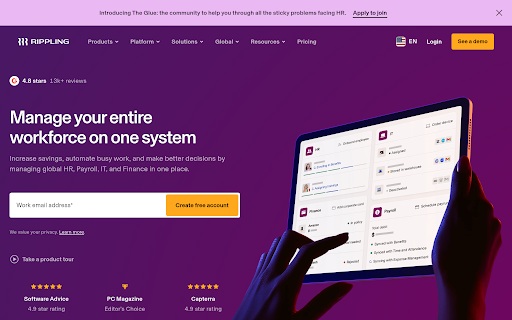
What Role Does Rippling Play?
Rippling does something most platforms don’t: it connects payroll, benefits, devices, and third-party apps into one system built on a single employee data record. Over 500 app connections and the ability to spin up payroll, a corporate card, a laptop, and tools like Slack for a new hire in about 90 seconds. They’ve reached a $16.8 billion valuation after a $450 million Series G round, which reflects genuine market confidence. For manufacturers with growing headcount and complex software stacks, that depth of integration is hard to match.
Why Does Rippling Belong on This List for HR & Payroll Platforms?
The specific problem Rippling addresses is data fragmentation. When employee records live in five different systems, payroll errors and compliance gaps follow. Their single-source-of-truth model removes that risk at scale.
User Reviews, Summarised:
Rippling pulled in 40 Voice of the Customer awards based on feedback from over 10,000 HR professionals, which is a meaningful signal given the sample size. Users consistently rank them at the top for payroll vendor satisfaction and benefits user satisfaction. The mid-market segment tends to give them high marks for time management features.
4. Gusto – Best for Small to Mid-Market Businesses Seeking Payroll and HR Management
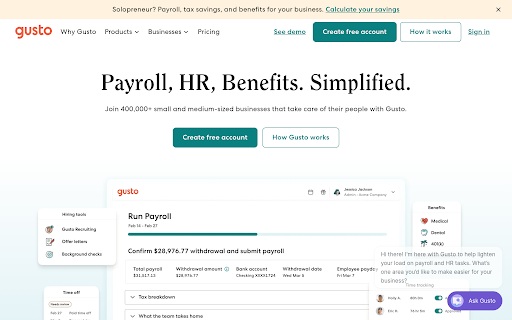
What Role Does Gusto Play?
Gusto built their platform around making payroll genuinely accessible, especially for small business owners who aren’t HR professionals. They serve 400,000 customers across industries including manufacturing, and they handle payroll tax filing with government agencies automatically on every plan (not as a premium add-on, which is actually unusual). With integrations across nearly 150 third-party tools and $735.5 million in 2024 revenue, they’re clearly doing something right at scale. Their interface is clean enough that non-technical users can run payroll confidently.
Why Does Gusto Belong on This List for HR & Payroll Platforms?
Small manufacturers often struggle with payroll tax filing accuracy because it requires tracking federal, state, and local requirements simultaneously. Gusto builds that compliance layer directly into the base product rather than charging extra for it, which keeps payroll error rates low without adding cost.
User Reviews, Summarised:
TechRepublic named Gusto the best overall payroll processing software, and G2 Reviews gave them the #1 Highest Satisfaction award in 2026. The pattern in reviews is consistent: users praise the clean interface and how approachable the platform feels even for first-time payroll administrators. That kind of usability score is hard to fake at 400,000 customers.
5. BambooHR – Best for Small and Medium-Sized Businesses Wanting an All-in-One HR Platform
What Role Does BambooHR Play?
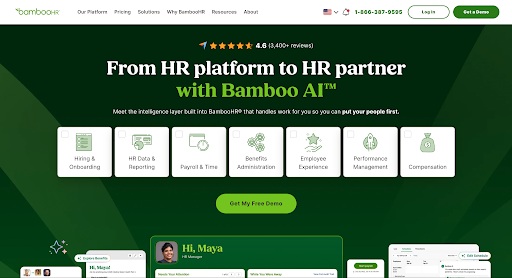
BambooHR has been in the HR software space since 2008 and now serves over 34,000 customers and 3 million employees across 190 countries. Their platform covers HRIS, applicant tracking, time tracking, payroll, benefits, performance management, and compensation planning, all built on native apps rather than acquired modules patched together. That architecture matters because it means the data flows cleanly between functions. They’ve also embedded AI capabilities into the platform, and their 2025/26 Cloud Awards recognition for Best Cloud HR/HRMS Solution reflects continued relevance in a crowded market.
Why Does BambooHR Belong on This List for HR & Payroll Platforms?
BambooHR addresses the problem of disconnected HR tools by offering a genuinely unified system where HR, payroll, and performance data share the same foundation. For manufacturers scaling headcount without proportionally adding HR staff, that kind of connected system cuts the administrative cost per employee meaningfully.
User Reviews, Summarised:
BambooHR’s public review presence is quieter than Rippling or Gusto, but their global reach across 190 countries and 3 million employees signals strong retention. Users in the SMB segment tend to value the platform’s clean organization and the fact that it covers the full employee lifecycle without requiring multiple subscriptions.
Vetting Process and Selection Criteria
The research behind this list started broad before getting specific. Here’s how the shortlisting actually worked.
Data Collection Fundamentals
Building the initial longlist meant pulling from multiple sources: HR software directories, professional review platforms, industry publications, and official company websites. The goal was to capture any platform with meaningful presence in the HR and payroll software space, not just the loudest names. Data points collected at this stage included feature coverage, founding year, team size, and the industries each platform actively served.
Filtering Candidates by Main Criteria
Once the longlist was assembled, platforms without verifiable public information were removed first. That meant checking whether review data existed in meaningful volume, whether the company could be confirmed as actively operating, and whether the feature claims on their site aligned with what third-party reviewers were actually reporting. Platforms with thin or inconsistent review patterns didn’t advance regardless of how polished their marketing looked.
How Claims Stack Up Against Evidence
This step involved cross-referencing what each platform claimed against what real users described in reviews. Award claims were checked against the awarding organizations. Customer counts and market size figures were compared across multiple sources to flag anything that seemed inflated. The goal wasn’t to catch companies in outright falsehoods but to build a realistic picture of where each platform actually performs well versus where it’s still developing.
Industry Reputation and Recognition
Platforms were evaluated for third-party recognition beyond their own marketing. That included G2 awards and rankings, analyst mentions, appearances in industry roundups, and any original research the company had published or participated in. Recognition from organizations with large verified user bases (like G2’s Voice of the Customer awards) carried more weight than self-reported accolades. Consistent recognition across multiple years or award cycles was treated as a stronger signal than a single recent win.
HR & Payroll Platforms Track Record Check
The final filter focused on HR and payroll capability. Each platform was checked for dedicated service pages or resources addressing payroll tax compliance, multi-state filing, benefits administration, and workforce management. Verified reviews from HR managers, payroll administrators, and business owners describing real-world payroll outcomes were weighted heavily. Case studies showing measurable results, such as reduced processing time or improved tax filing accuracy, were treated as strong supporting evidence. Platforms that covered HR and payroll in meaningful depth, rather than offering payroll as a minor feature, made the final list.
What Matters When Selecting HR & Payroll Platforms
Choosing an HR and payroll platform isn’t just about feature checklists. The right fit depends on your business size, your payroll complexity, and how much internal HR capacity you actually have.
Here are the five areas worth examining before you decide.
- Industry/Domain Experience: Look for platforms that have documented experience with manufacturing-specific payroll needs, including shift differentials, overtime calculations, and union labor rules. Generic platforms can work, but purpose-built experience reduces setup friction.
- Features and Capabilities: Map the platform’s feature set against your actual workflow. Payroll processing, tax filing, time tracking, benefits administration, and employee self-service adoption are all separate capabilities. Confirm which ones you actually need before paying for a full suite.
- Pricing Structure: Platforms in this space range from per-employee-per-month SaaS pricing to bundled PEO arrangements (not cheap, but worth it for small businesses that need full HR support). Understand the total cost across your full headcount, including seasonal workers.
- Results Measurement: Ask vendors how they measure payroll error rate and correction frequency, processing cycle time, and tax filing accuracy. Platforms that track these metrics and share them openly tend to be more accountable.
- Industry Knowledge and Compliance: FLSA, ACA, IRS payroll tax regulations, and state labor laws change regularly. The platform you choose should have a clear process for updating calculations and notifying users when rules shift, not leave that research to you.
What It Means for You
Manufacturing payroll isn’t the place to cut corners on software. The platforms on this list each handle the main work well, but the right one depends on your size and complexity. Hybrid Payroll and Gusto suit smaller operations that need integrated support without enterprise pricing. Rippling and Paycor scale better as headcount grows. BambooHR anchors the HR side cleanly. As workforce management becomes more focused on data insights, the gap between well-matched and poorly-matched platforms will only widen.
 Creating a sustainability strategy with recyclable plastic packaging
 In a freight downturn, you need to rely on people & relationships, technology & assets
 Pentest People opens Cheltenham office
 How COVID-19 changed customer expectations of a brands’ digital offering
 Automotive Sector: Elimination of Waste in Product Development
 Modern Telephone Solutions for Fast-Paced Service Industries