

Most AI agent startups build something genuinely interesting, then completely fumble the marketing. Influencer marketing agencies that specialize in tech can change that, but picking the wrong one means paying for reach that doesn’t convert, working with creators whose audiences have never heard of an AI tool, and getting campaign reports full of vanity metrics. After reviewing dozens of agencies across creator rosters, pricing models, and real client outcomes, this guide narrows it down to five that actually know how to market AI products.
The vetting process for this list
Public information drove every decision here. Each agency was reviewed across user testimonials, case studies, ratings from established review platforms, and what their own websites actually claim versus what clients report. Only agencies with a documented track record in digital marketing made the cut.
→ See the full research breakdown
- Clickstrike – Best for AI and software product marketing
- NoGood – Best for growth marketing for enterprise SaaS and fintech companies
- Brighter Click – Best for paid media management and multi-channel acquisition strategy
- Media Glitch – Best for full-funnel performance marketing across multiple channels
- inbeat – Best for creator marketing and paid social campaigns
The Difference the Right Influencer Marketing Agencies Make
Choosing the right agency isn’t just about finding someone who knows what an influencer is. For AI agent startups, the stakes are higher because the product itself is harder to explain. A generalist agency might book you a popular creator with millions of followers and zero overlap with your target audience.
The real challenge is vetting creator authenticity. Fake followers and inflated engagement rates are everywhere, and one bad partnership burns budget fast. Getting attribution right is equally tough. Without proper tracking, there’s no way to know which campaign actually drove signups.
Agencies that specialize in tech know how to match creators to product categories, track Earned Media Value properly, and structure campaigns around cost per engagement rather than raw impressions. That kind of precision is rare, and it’s what separates a campaign that builds pipeline from one that just looks good in a deck.
The 5 Best Influencer Marketing Agencies: Quick Comparison
Note: All data in this table is sourced from review platforms and the official websites of the listed companies.
| Company Name | Years Operating | Headquartered In | Rating |
| Clickstrike | Est. 2018 | New York | Clutch Champion Fall 2023 |
| NoGood | – | New York City, Miami, and San Francisco | – |
| Brighter Click | – | Raleigh | – |
| Media Glitch | – | – | – |
| inbeat | Est. 2018 | Montreal, Canada | – |
1. Clickstrike – Best for AI and Software Product Marketing
Which Products and Services Does Clickstrike Provide?
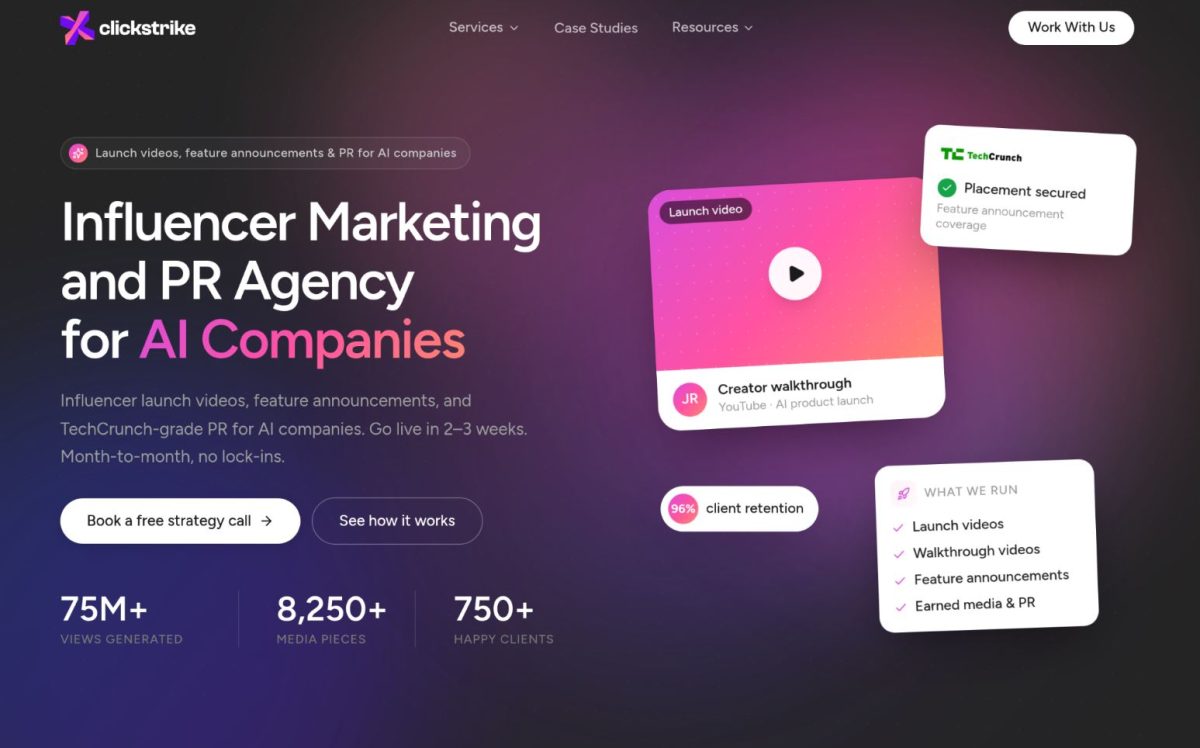
For AI founders who want real traction, the team behind Clickstrike, influencer marketing agency for AI companies, connects tech brands with relevant creators on YouTube, TikTok, X, and LinkedIn, while also securing earned media placements in top-tier publications. Their focus sits squarely on the AI and software category, which means the creator relationships they’ve built are actually relevant to the audiences AI startups are trying to reach. With 75M+ views and 8,250+ media placements in their track record, the results back up the positioning (and a 96% client retention rate says clients agree).
What’s Clickstrike’s Edge in Influencer Marketing Agencies?
The problem most AI startups face is that generic agencies don’t understand the product well enough to brief creators effectively, which leads to awkward content that doesn’t land. Clickstrike’s vertical-specific focus on AI and software means their creator briefs actually reflect how the product works, which translates directly into stronger engagement rates and better influencer-attributed conversions.
From the User Reviews:
Clients consistently point to the quality of creator matches and the speed at which results show up. The case study showing $192,000 in revenue generated within three weeks gets cited more than once. A 96% retention rate in an industry where clients switch agencies constantly says a lot about what the day-to-day experience is like.
2. NoGood – Best for Growth Marketing for Enterprise SaaS and Fintech Companies
Which Products and Services Does NoGood Provide?
NoGood runs full-stack growth marketing across paid and organic channels, with services covering AEO, SEO, organic social, paid search, social ads, performance branding, content marketing, conversion rate work, analytics, and fractional CMO consulting. Their model puts together custom squads for each client rather than assigning a one-size-fits-all team. That approach works particularly well for SaaS and fintech brands where growth challenges tend to be complex and multi-channel. They maintain an 84% client retention rate, which holds up well for a premium-tier agency.
What’s NoGood’s Edge in Influencer Marketing Agencies?
Where NoGood separates itself is in how it blends AI-native systems with human knowledge, running high-velocity experiments across channels rather than locking clients into a single playbook. For enterprise brands that need more than a creator campaign and want growth tied to measurable business outcomes, that kind of multi-channel discipline is genuinely hard to match.
From the User Reviews:
Client feedback points heavily to the team’s proactive communication and willingness to shift strategies when the data calls for it. Numbers like 879% lead generation improvements show up in their case studies, which is the kind of figure that gets a CMO’s attention (think enterprise pricing, though). Clients value the strategic thinking as much as the execution.
3. Brighter Click – Best for Paid Media Management and Multi-Channel Acquisition Strategy
Which Products and Services Does Brighter Click Provide?
Brighter Click manages paid media across Meta, Google, TikTok, Pinterest, and LinkedIn, covering everything from creative strategy to UGC sourcing. Their access to 525+ vetted creators gives them a ready roster for brands that need content at scale. What makes them different from a straight media-buying shop is the addition of fractional CMO leadership, meaning clients get strategic input alongside execution. Their approach tracks contribution margin and revenue rather than platform-level metrics, which is a sensible way to measure what’s actually working.
What’s Brighter Click’s Edge in Influencer Marketing Agencies?
The specific gap they fill is for brands that have paid media running but lack the creative infrastructure to feed it properly. Combining UGC sourcing, influencer strategy, and cross-channel acquisition under one roof means fewer handoff problems and tighter creative-to-performance feedback loops, and that usually shows up in stronger cost per engagement numbers.
From the User Reviews:
Published case studies point to solid improvements in return on investment across multiple verticals, though detailed public reviews are limited compared to more established names on this list. Their vertical-specific approach clearly works well with clients who need more than a generalist media buyer.
4. Media Glitch – Best for Full-Funnel Performance Marketing Across Multiple Channels
Which Products and Services Does Media Glitch Provide?
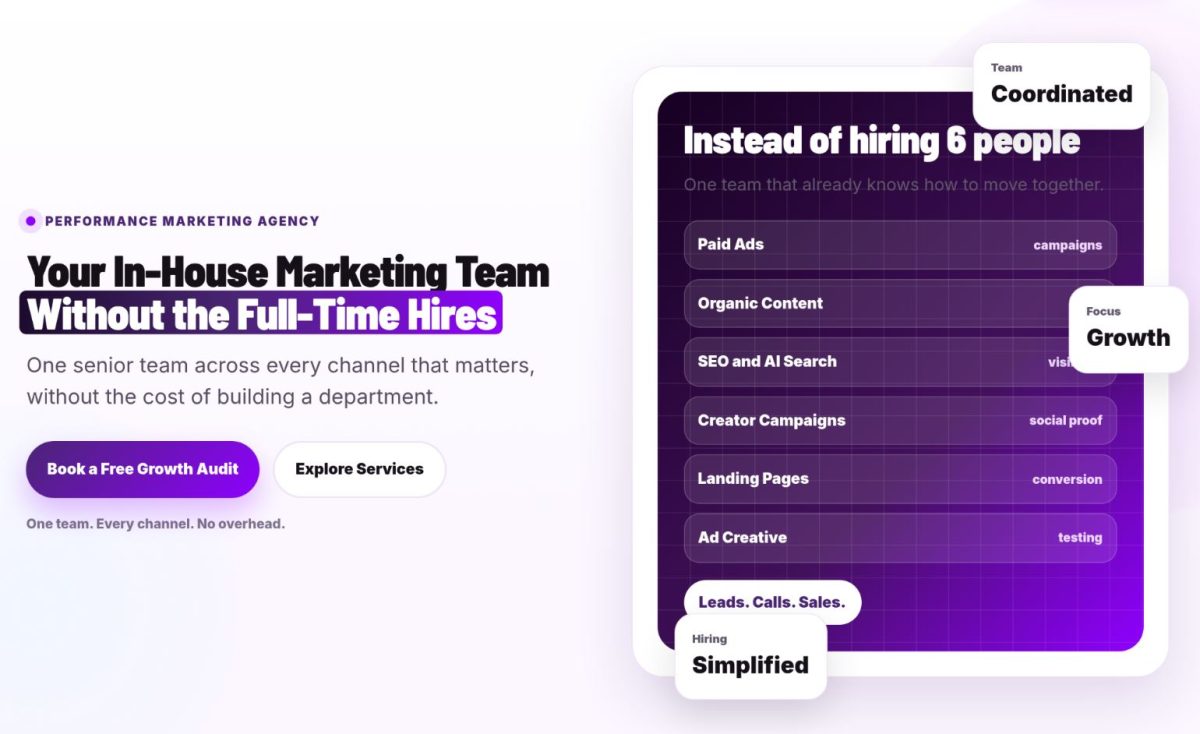
Media Glitch covers the full funnel: paid ads, organic content growth, SEO and AI search, creator campaigns, landing pages, and ad creative production. The angle they push hardest is that a brand gets a coordinated senior team across all those channels without the cost of building that capability in-house (not cheap, but cheaper than hiring six specialists). Their focus stays on metrics that matter to the business, things like cost per lead, conversion rate, and return on ad spend, rather than reach and impressions alone.
What’s Media Glitch’s Edge in Influencer Marketing Agencies?
Coordination across paid, organic, and creator channels is where a lot of performance marketing breaks down. Media Glitch is built around solving that with a single integrated team rather than separate vendors. Their free Growth Audit offer is a low-risk way for brands to test the thinking before committing, which reflects confidence in the strategy they bring to the table.
From the User Reviews:
Detailed public reviews are sparse, so it’s harder to get a clear picture of the typical client experience compared to agencies with larger Clutch or G2 profiles. The integrated service model and senior-team positioning suggest a fit for brands that have already tried single-channel agencies and found them lacking.
5. inbeat – Best for Creator Marketing and Paid Social Campaigns
Which Products and Services Does inbeat Provide?
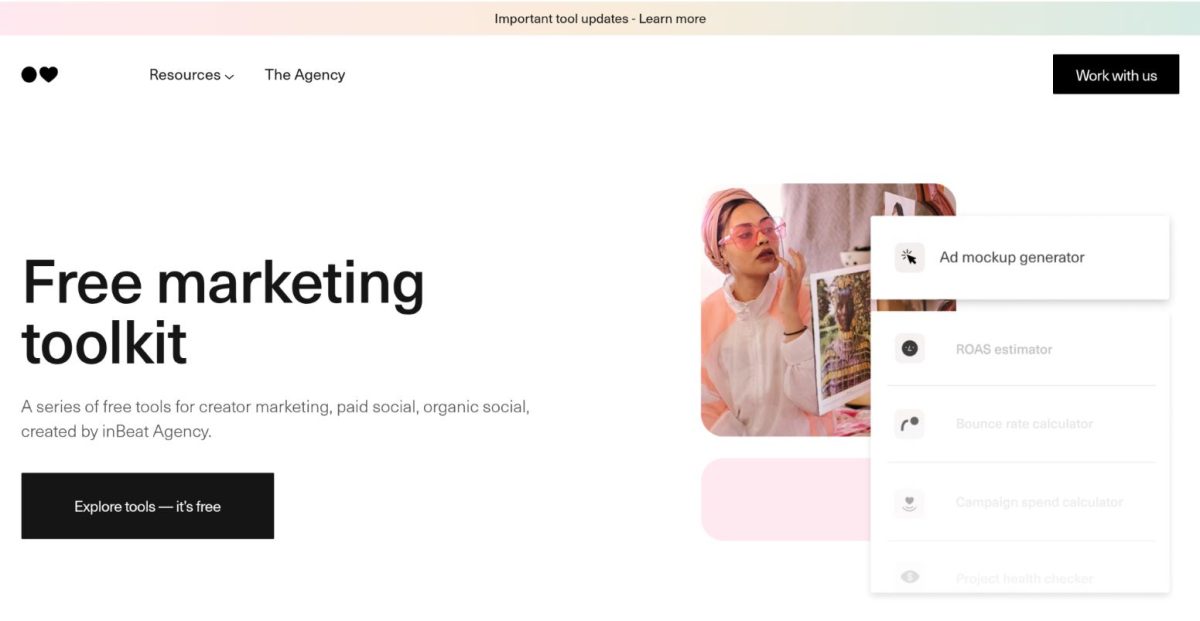
inBeat serves 250+ brands through creator marketing, UGC campaigns, TikTok marketing, and paid social, with a particular strength in micro-influencer execution at scale. Their ability to coordinate campaigns with 1,000+ micro-influencers is the kind of operational muscle that most agencies can’t match. On top of agency services, they offer a free marketing toolkit with calculators and design tools for paid social, which is genuinely useful for brand teams doing some work in-house. The hourly rate sits at $150 to $199, which puts them in the mid-to-upper tier (not cheap, but not enterprise-only pricing either).
What’s inbeat’s Edge in Influencer Marketing Agencies?
Running micro-influencer campaigns at scale requires creator relationship infrastructure that takes years to build. inBeat’s roster and operational process let brands tap into that without starting from scratch. For DTC brands and mobile app companies that need authentic creator content at volume, the audience authenticity scores and follower quality that come with a vetted micro-influencer approach tend to outperform mega-influencer campaigns on a cost per engagement basis.
From the User Reviews:
Clients in mobile apps, consumer packaged goods, and healthcare consistently highlight the team’s ability to execute at scale without losing control over quality. The free toolkit also earns genuine appreciation, not just as a lead magnet but as something brands actually use. That kind of trust-building without a paywall is rare in this space.
The Process Behind This Ranking
Building a list like this takes more than a quick Google search. Here’s how the research was structured.
Setting Up Information Capture
The starting point was building a longlist from multiple sources: agency directories, review platforms like Clutch, published roundups, and direct searches within the AI and tech marketing category. Each agency that appeared consistently across sources was added to the pool for deeper review. The goal at this stage was breadth, pulling in enough candidates to make the shortlisting process meaningful rather than starting with a narrow set.
Pre-Verification Phase
Before any agency was evaluated in depth, an initial filter was applied. Agencies with no verifiable client history, no publicly available case studies, or review profiles that showed suspicious patterns (sudden spikes, uniformly worded five-star reviews, no negative feedback at all) were removed early. What remained was a set of agencies with a real, checkable track record in digital marketing. Review recency also mattered here. Older case studies without recent activity flagged agencies that may have changed significantly since their strongest period.
The Verification Phase
Each shortlisted agency was then checked against its own public claims. If an agency’s website said it had delivered specific results, those results were cross-referenced against client testimonials and independent reviews. Discrepancies between what an agency claims and what clients actually report are more common than most brands realize, so this step filtered out agencies that presented misleadingly. Agencies that showed consistent alignment between their stated capabilities and client-reported outcomes moved forward.
Tracking Authority Markers
Beyond reviews, external signals were considered. Industry awards, mentions in recognized marketing publications, and evidence of original research or proprietary methods all contributed to an agency’s authority score in the evaluation. An agency that appears in credible third-party contexts, not just its own marketing, carries more weight. Awards like Clutch Champion status were noted where present, and agencies with no external recognition were evaluated more conservatively.
Influencer Marketing Agencies Proof Points
Finally, each agency was evaluated for evidence of influencer marketing capability. This meant looking for dedicated service pages with specific methodology detail, verified reviews that referenced creator campaigns (not just general marketing work), and case studies with measurable outcomes tied to influencer or creator activity. Engagement rates, earned media value documentation, and campaign reach figures were the clearest proof points. Agencies that could show real numbers from real campaigns in the tech or AI space were weighted more heavily in the final selection.
How to Pick Your Best Match
Picking the right influencer marketing agency comes down to fit, not just reputation. Here are the five factors worth working through before signing anything.
- Industry and Domain Experience: An agency that has marketed SaaS tools or AI products before will brief creators more accurately and waste less of your budget on trial-and-error. Ask for case studies from your category.
- Features and Service Scope: Some agencies handle the full creator lifecycle from sourcing to contract to content approval. Others focus narrowly on one channel. Match their service scope to what your team actually needs rather than paying for capabilities you’ll never use.
- Pricing Structure: Watch for hidden markups on creator fees. Month-to-month engagements with no setup fees are generally friendlier for startups than long-term retainers with locked-in scopes.
- Results Measurement: Ask exactly how they track influencer-attributed conversions and report on cost per engagement. Agencies that rely on reach and impression counts alone are not giving you the full picture.
- Industry Knowledge and Compliance: Creators promoting AI products need to follow FTC disclosure requirements and platform-specific sponsored content policies. An agency that treats disclosure as optional is a liability, not a partner.
Closing Thoughts
Picking the right influencer marketing agency for an AI agent startup means finding a team that actually understands the product, knows where the real audience lives, and can prove what’s working with numbers that matter. The agencies on this list cover different strengths, from deep AI vertical focus to full-funnel performance and micro-influencer scale. As creator marketing continues to grow as a major channel for tech brands, having the right partner in place early makes a real difference in how fast awareness turns into pipeline.
 1 in 10 manufacturing orders from China & India held up at EU customs checks since COVID-19
 Scorecard Software for Small and Large Enterprises
 ABird Power Solutions Uses Lockdown to Make BigChanges in Workforce Management
 TenderEasy, part of Alpega Group, Named 2019 Top 50 Provider by Spend Matters
 Former MAA board member joins procurement specialist to kickstart manufacturing bounce back
 How Cloud-Managed Switches Save Time and Money