
Upside Parts, a Massachusetts-based custom manufacturing company, released an analysis of more than 30,000 3D-printed parts produced across hundreds of customer orders, looking at how robotics companies use on-demand 3D printing. Robotics customers accounted for 82.3% of total part volume.
The analysis comes as robotics production is expanding across the US, increasing the need for physical parts at different stages of development and deployment. According to the Association for Advancing Automation, robot orders in North America reached $622 million in Q2 2026, up 21.3% year over year in value.
Nearly a third of production is speed-driven
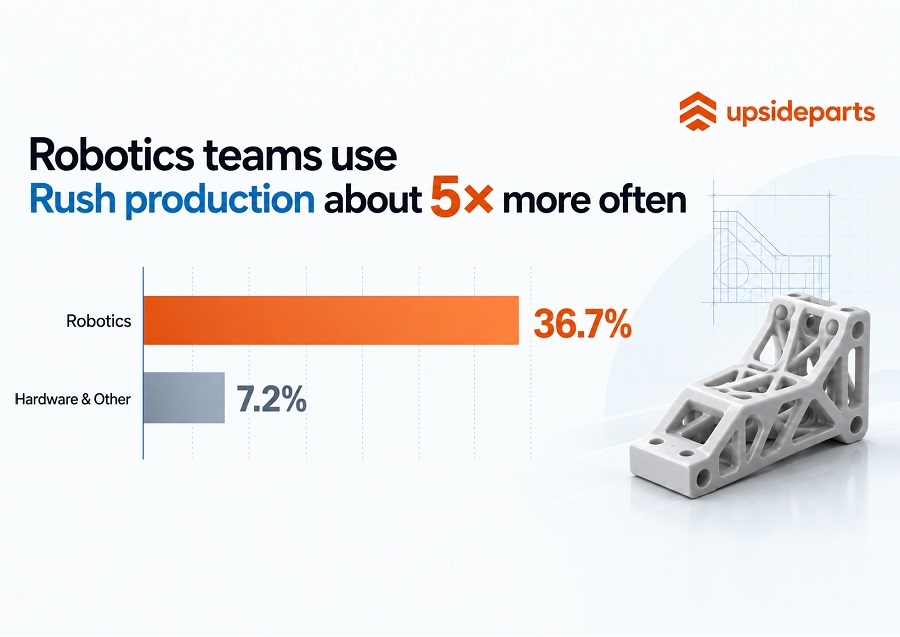
Upside Parts’ data show that 31.5% of parts were produced on a rush schedule. Among robotics customers, 36.7% of parts were rush, compared with 7.2% for hardware&other customers.
“Robotics teams are about five times more likely to use rush production than other customers, as for them manufacturing speed can affect the engineering schedule. In a sense, lead time becomes more than a purchasing metric. It decides how quickly a team moves to the next physical iteration,” said Roman Arkhangelskiy, Founder and Managing Partner of Upside Parts.
The trend aligns with a systematic review of additive manufacturing in spare parts management, which found that additive manufacturing can shorten lead times by enabling on-demand production. NIST identifies faster design iteration and the elimination of tooling lead times among its key manufacturing benefits.
Rush demand continues into larger batches
The company data show that orders above 100 parts accounted for 89.0% of the analysed volume. Around a third of this volume (32.5%) was produced on a rush schedule, compared with 23.8% for orders of 100 parts or fewer. This suggests that the demand for urgency does not fall as order sizes increase.
3D printing moves beyond its traditional role in rapid prototyping. AMPOWER expects that end-use parts will account for 44% of polymer additive manufacturing applications by 2028. Yet Upside Parts’ data shows that fast turnaround remains important for customers even as they move to larger production runs.
Larger batches still require material flexibility
In the production mix, 49% of orders included at least one material outside standard PETG, PLA or ABS. In orders of 101 to 500 parts, no single material accounted for more than 27.1% of volume.
“What stands out is how often engineers need to go beyond the most common plastics. This is not a niche requirement limited to unusual projects. It is part of routine material selection, and the same need shows up in production runs of hundreds of parts,” commented Roman Arkhangelskiy, Founder and Managing Partner of Upside Parts.
Custom parts do not make every element of production unique. Nineteen recurring production combinations accounted for 97.4% of all parts in the dataset. The geometry may change from order to order, but many of the underlying production decisions are familiar.
That creates an opportunity for automation. Repeatable production paths can be standardized and accelerated, while engineers focus on unusual materials, complex geometry and other exceptions.
With the global 3D printing market projected to reach $31.77 billion by 2032, the findings suggest robotics teams use 3D printing for more than fast prototyping. They need short lead times across larger batches and a range of material requirements. For manufacturers, the next challenge will be about reducing the time between an approved order and the start of physical production.
 Building Trust with Blockchain
 Meltio expands its worldwide partner network to meet the growing demand for its wire-laser metal 3D printing solutions
 MHP develops virtual training courses on Apple Vision Pro
 Distributed Denial-of-Service attacks became bigger & more complex in 2021
 5 Costly Mistakes Logistics Executives Make When Choosing Transportation Management Software (TMS)
 Kroger to build automated warehouse ‘shed’ near Cincinnati