

Most B2B buyers judge stainless steel suppliers on three things: price per tonne, lead time and payment terms. Those matter, but they are the easy part.
What separates a reliable supplier from a risky one is the document trail behind each coil, sheet or bar, because that trail is what your quality team, your customer and, increasingly, your customs declaration depend on.
What a good supplier sends before you ask
A supplier worth shortlisting will offer a sample mill test certificate (MTC, sometimes called a mill test report) before you raise the subject, and will say which EN 10204 type it issues as standard. Hesitation here usually means the certificate is produced by a trading office rather than by the mill’s own inspection staff.
Samples are the second signal. Exporting mills often supply material for evaluation so a buyer can test before committing to a full container. Jianglin, a Tianjin-based stainless steel supplier in China, offers free samples with the buyer covering freight, quotes typical international delivery of 15 to 25 days and accepts OA, LC and TT payment, which gives a procurement team time to put a sample through its own checks before the first purchase order.
Ask every shortlisted supplier for the same three things, in writing:
- a sample MTC for the grade and form you intend to buy
- the certificate number of their ISO 9001 registration, so you can check it with the issuing body
- the heat number marking method on the material itself, so certificates can be matched to physical stock

The four certificate types, and what each one proves
EN 10204 defines four types of inspection document. The difference between them is who signs and whether the results relate to your material or to production in general.
| Type | What it contains | Who validates it | What it proves about your lot |
| 2.1 | Declaration of compliance with the order | Manufacturer | Nothing tested |
| 2.2 | Test results from routine production | Manufacturer | Typical values, not your lot |
| 3.1 | Test results from the delivered lot | Mill inspector independent of production | Chemistry and mechanicals for your heat |
| 3.2 | As 3.1, witnessed | Mill inspector plus buyer’s representative or third-party inspector | Same, independently witnessed |
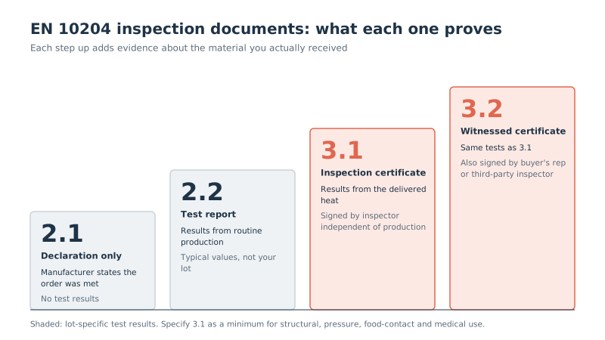
For structural, pressure, food-contact or medical applications, specify 3.1 at minimum in the purchase order. Specify 3.2 when the end customer requires witnessed testing, and budget for the inspector’s day rate.
Verify the metal, not just the paper
A 3.1 certificate tells you what the mill measured. It does not guarantee that the bundle in your warehouse came from that heat. Mix-ups happen at service centres, in consolidation warehouses and during re-packing.
Positive material identification (PMI) closes that gap. A handheld X-ray fluorescence analyser reads chromium, nickel and molybdenum in a few seconds, which is enough to tell 316 from 304. It cannot measure carbon reliably, so low-carbon grades such as 304L and 316L need optical emission spectroscopy if the distinction matters to the application.
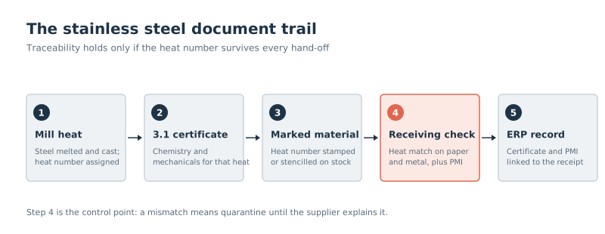
A workable receiving routine for a mid-sized buyer:
-
- Match the heat number stamped or stencilled on the material to the heat number on the MTC.
- Run PMI on a sample from each heat, or every piece for critical service.
- Record the certificate, heat number and PMI result against the goods-received note in the ERP, so traceability survives when the material is cut and issued.
- Quarantine anything that fails to match until the supplier explains it.
CBAM turned emissions data into a supplier requirement
The newest item on the vetting checklist has nothing to do with chemistry. The EU’s Carbon Border Adjustment Mechanism moved into its definitive regime on 1 January 2026 and covers iron and steel, which includes stainless sheet, coil, bar and pipe. Importers of more than 50 tonnes of covered goods a year must hold authorised CBAM declarant status, and certificates for 2026 imports become available to buy from February 2027.
The practical consequence for sourcing is that an importer needs embedded-emissions data from each producing installation. Where verified data is missing, default values apply, and those tend to cost more. A supplier who can provide installation-level emissions figures can work out cheaper than one quoting the same price with no data.
UK buyers have a few months’ grace. HMRC has confirmed that a UK carbon border adjustment mechanism will apply to iron and steel imports from 1 January 2027. Ask the question now, while supplier relationships are still being set up for next year.
Build the checks into onboarding, not the first shipment
None of this works if it lives in one buyer’s inbox. Certificate type, ISO 9001 verification, sample PMI results and emissions data availability belong in the supplier record before the first order, alongside payment terms and lead times. As a recent piece on restructuring supply chains under tariff volatility points out, supplier vetting routinely takes months longer than planned, and ERP integration is one of the biggest risks to the timeline. Front-loading the document checks is how that time gets recovered.
The supplier that wins the business on price can still be the right choice. Just make sure it also wins on paper, because in 2026 the paper is what your customer, your auditor and the customs authority will ask to see.
TL;DR
- Only EN 10204 type 3.1 and 3.2 certificates report test results for the actual lot you bought. A 2.1 or 2.2 document is a declaration, not proof.
- The grade on paper still needs checking on arrival. 316 differs from 304 by roughly 2 to 3% molybdenum, and a handheld analyser confirms that in seconds.
- ISO 9001 certifies a quality management system, not the steel in your container.
- Since 1 January 2026, EU importers bringing in more than 50 tonnes of steel a year need authorised CBAM declarant status. The UK scheme starts 1 January 2027.
Short version: the cheapest quote is rarely the expensive mistake. The expensive mistake is a supplier who cannot hand over the paperwork your auditors, customers and customs authority will now ask for.
 ABBYY launches Vantage, platform delivering human-like skills to digital workforce
 Sage and Microsoft Forge New Pathways for SMB Innovation
 ExtraHop Introduces New Layer of Cloud Threat Defense to Identify & Isolate Advanced Cyberattacks
 RiConnect announced as Headline Sponsor of LiftEx 2024 in London
 Telefónica Tech UK&I partners with IBM to integrate its new ‘QRadar’ Suite
 Discuss Private Label Food Quality and Safety with Trace One at the Food Safety Congress