

For food manufacturers, packaging decisions often start with practical requirements. A tray or tub needs to protect the product, work with the filling line and meet retail specifications. Its shape and format may already be established long before the branding is considered.
That makes it worth looking at how the available space on the pack is used. Is there enough room for the brand to stand out while presenting essential product information clearly?
Banding offers a practical way to explore those opportunities.
360 degrees to tell your story
A band wraps around the pack and seals to itself, creating a continuous surface for branding and product information. The design can extend across the top, sides and underside, giving manufacturers more flexibility in how they present their brand. Much of the food remains visible through the original packaging.
Banding material is available in both paper and film, allowing manufacturers to choose a material that suits the product, its presentation and the conditions it needs to withstand. Paper bands for packaging include brown or white FSC-certified kraft paper and coated options for applications where moisture resistance matters.
Bands can be pre-printed on one or both sides with branding and product information, with food-safe ink options available. An integrated printer can then add variable details, such as batch codes and expiry dates, during the banding process. This brings branding and product-specific information together on the same band.
One band. More than one job.
Dutch stroopwafel producer Markus & Markus provides a useful example. The company sells the crispy pieces left over from production in clear plastic tubs. Originally, the tubs carried a self-adhesive label for branding and product information. This presentation did little to distinguish the product on the shelf. There was also a practical problem: if a tub tipped over, the lid could come loose and the contents could spill.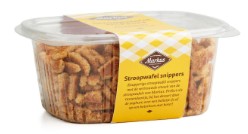
Replacing the self-adhesive label with a printed band addressed both issues. The band gave the tub a more distinctive, recognisable appearance while keeping the product visible. Wrapped around the container and lid, it also helped keep the pack securely closed during handling.
Less waste during application
Banding also removes the need for a release liner. The material seals to itself without adhesive, so there is no backing paper to collect and discard during application.
When a band replaces a conventional self-adhesive label, the liner waste associated with that label is eliminated. For manufacturers processing large volumes, this removes a recurring waste stream from the packaging operation.
Making it work on the line
The production setup can be matched to the application. Banding machines range from Stand Alone units to automated systems designed for integration into existing packaging lines. For suitable applications, manufacturers can retain their current tray or tub and introduce banding as a finishing step.
Positioning technology helps align the printed design consistently from pack to pack, supporting a uniform presentation across a production run.
For food manufacturers reviewing their packaging, this offers a useful starting point: look at the packs already leaving the line. A printed band could give them more room to express the brand, carry product information and secure the lid, while making better use of the packaging format already in place.
 Kroger to build automated warehouse ‘shed’ near Cincinnati
 Ephesoft recognised in 2021 Gartner® Competitive Landscape: Intelligent Document Processing Platform Providers Report
 RKVST showcases supply chain integrity, transparency & trust implementation at IETF 116 Hackathon
 Research reveals that reliance on legacy technology is undermining how UK organisations respond to ransomware
 The 19th century called, it wants its phone system back
 Manhattan Associates Reports Record First Quarter 2019 Performance