

A distributor ranks carrier bids by linehaul rate, the base charge for moving freight from origin to destination. After the award, one carrier’s fuel charges run over budget, another bills detention sooner than expected, and a third rejects loads that then move at spot prices. The lowest bid ends up costing more than the proposals it beat.
That is why many shippers bring in outside help for their transportation request for proposal, or RFP. A well-run RFP gives every carrier the same data, compares bids on total cost and service, and turns the results into a routing guide that holds up after the award.
Market conditions raise the stakes. Cass reported that its Truckload Linehaul Index rose 9.9% year over year in October 2026, and DAT reported that the national average dry van spot rate reached USD 3.05 a mile that month, its highest monthly average since February 2022. In a rising market, a bid built on incomplete data can unravel quickly.
This guide compares six companies that help shippers plan, run and analyze transportation RFPs.
Key Takeaways
- A transportation RFP should compare carriers on linehaul, fuel and accessorials together, not linehaul alone.
- Clean, complete shipment data is the foundation of comparable bids.
- RFP support ranges from fully managed bid events to software and AI tools your team runs.
- Agree on who prepares data, contacts carriers and approves awards before the bid opens.
Quick Comparison
| Company | Type of support | Modes | Best for |
| TLI | Assessment and RFP process with bid benchmarking | LTL, volume LTL, full truckload | Shippers wanting a no-obligation starting point |
| RXO | Managed RFP from kickoff to final awards | Managed transportation bids | Shippers who want a provider to run the event |
| C.H. Robinson | Procure IQ, bid management and Managed Solutions | Truckload focus for Procure IQ; multimodal managed services | Large shippers segmenting lanes by buying strategy |
| Echo Global Logistics | Benchmarking and procurement analysis in managed transportation | Multimodal | Shippers wanting procurement within broader management |
| Emerge | Digital RFP platform with mini bids and benchmarking | Truckload | Shippers bidding often or seasonally |
| project44 | AI Freight Procurement Agent within its TMS | Multimodal | Shippers moving toward continuous, rules-based sourcing |
What Good RFP Support Should Cover
Before comparing providers, decide what you need help with:
- Data preparation: Shipment-level history with ZIP codes, volumes by period, weights, freight class for LTL, accessorial history and invoiced charges.
- Bid design: A consistent package with response format, fuel methodology, accessorial definitions, service expectations and bid rounds.
- Carrier communication: Questions, clarifications and revisions shared equally with every participant.
- Analysis: Bids normalized onto the same cost components and tested for service fit.
- Award and implementation: Written award confirmations, routing guide setup and invoice checks after go-live.
How We Chose These Companies
We reviewed each company’s published service pages, documentation and announcements, focusing on how it supports data preparation, bid events, analysis and award decisions. We did not run bids through these services, so treat this as a comparison of documented capabilities rather than a performance ranking.
6 Transportation RFP Consulting and Management Companies
1. TLI
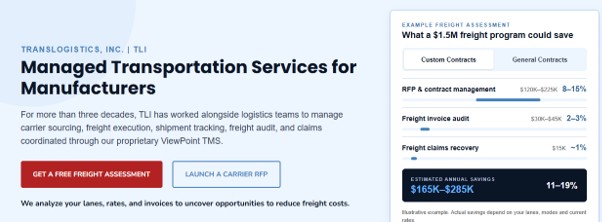
TLI’s transportation RFP services focus on LTL, volume LTL and full truckload freight. TLI analyzes a shipper’s shipping history, solicits competitive bids from vetted carriers and benchmarks proposed rates against current costs.
What it offers
- A no-cost, no-obligation freight assessment and RFP process for qualifying shippers.
- Review of carrier capabilities and service commitments alongside price.
- A review of incomplete records to judge whether the data supports a useful RFP.
Best for: Shippers who want competitive pricing that fits their operation, not simply the lowest quoted rate.
What to confirm: Your eligibility, and the fact that your carriers are never contacted without your written approval.
2. RXO
RXO offers a transportation RFP management service that runs a shipper’s bid from the carrier kickoff through the final round of awards, for annual bids and mini bids. C.H. Robinson has agreed to acquire RXO, and the two companies operate independently until the transaction closes.
What it offers
- Outreach and communication with carriers throughout the bid.
- In-depth scenario analysis with actionable recommendations.
- An online bid management system with templatized documents.
Best for: Shippers who want a provider to manage the whole event.
What to confirm: The contracting entity, which tasks stay with your team, and how awards are communicated.

3. C.H. Robinson
C.H. Robinson’s Procure IQ gives shippers a personalized view of their truckload lanes alongside its marketplace data, to help decide which freight should go to an RFP and which suits the spot market. Its pricing tools also include bid management and market rate benchmarking.
What it offers
- Lane-by-lane procurement strategy recommendations.
- Market rate benchmarking against the market average.
- Managed Solutions combining TMS technology, 3PL managed transportation and 4PL services.
Best for: Large shippers weighing an annual bid against segmented or spot buying.
What to confirm: Which tools apply to your volume and region, and how the pending RXO acquisition affects your service team.
4. Echo Global Logistics
Echo includes procurement support within its managed transportation service, with a dedicated account management team and a network of more than 50,000 transportation providers. It covers truckload, partial truckload, LTL, intermodal and expedited freight, and also offers freight brokerage.
What it offers
- Market benchmarking and procurement analysis.
- Process mapping and optimization.
- Transportation network strategy development.
Best for: Shippers who want RFP work handled as part of an ongoing managed program.
What to confirm: Whether procurement support is available on its own, and how bid results and recommendations are reported.
5. Emerge
Emerge offers a digital freight procurement platform built around its Dynamic RFP product. Shippers upload their lanes, manage carrier quotes and evaluate their carrier network with benchmarking tools in one place.
What it offers
- Mini bids for seasonal, promotional or surge volume during the year.
- Benchmarking that shows whether rates are above or below market.
- Carrier scorecards that shippers can shape with their own carrier data.
Best for: Truckload shippers who want to bid more often than once a year.
What to confirm: How the platform connects with your TMS and whether your lanes fit its truckload focus.
6. project44
project44’s AI Freight Procurement Agent, announced on February 26, 2026, works within its Intelligent Transportation Management System. It automates carrier selection, rate benchmarking and negotiations within limits the shipper defines.
What it offers
- Continuous benchmarking of contracted rates against market conditions.
- Automated mini-bids and renewal negotiations within defined guardrails.
- A recommendation-only mode, with automation expanded as confidence grows.
Best for: Shippers moving from periodic bids toward continuous, rules-based sourcing.
What to confirm: Which approval thresholds, carrier eligibility rules and contract parameters you will set, and who reviews exceptions.

How to Compare the Proposals You Receive
Normalize every bid onto the same components: linehaul, fuel and expected accessorials. The illustration below uses invented figures for one shipment on one lane with identical service assumptions.
| Component (illustrative) | Carrier A | Carrier B |
| Linehaul | USD 900 | USD 950 |
| Fuel (same index and basis) | USD 150 | USD 150 |
| Expected accessorials from lane history | USD 80 | USD 20 |
| Modeled total | USD 1,130 | USD 1,120 |
Carrier B’s total is USD 10 lower despite a higher linehaul rate, because of lower expected accessorials. Check that estimate against the carrier’s terms and lane history, then test service fit: lane coverage, capacity limits, equipment and tender acceptance history.
Use market data as context only. DAT’s October dry van spot linehaul averaged USD 2.22 a mile, excluding an amount equal to an average fuel surcharge. These are national spot averages, not contract quotes for your lanes. For more on how connected systems support procurement decisions, see this look at interoperability between shippers and carriers.
Turn Awards Into a Routing Guide That Holds Up
An award only saves money if it is carried into daily operations:
| Step | What to do |
| Confirm awards | Send each carrier its lanes, rates, fuel and accessorial terms, effective dates and backup position, and get written acknowledgment |
| Load and test | Enter rates and carrier sequences in the tendering system and rate sample shipments against the award |
| Check invoices | Compare early invoices with contracted linehaul, fuel and accessorial terms |
| Monitor | Track tender acceptance, on-time delivery, invoice accuracy and spot use on awarded lanes |
If you use automation for monitoring or re-sourcing, name the approver, define exceptions and document when a recommendation needs human review.
Conclusion
The right RFP partner depends on how much of the work you want to hand over. Some providers run the full bid event, some fold procurement into managed transportation, and others give your team software or AI tools to run bids more often.
Whichever you choose, start from clean shipment data, compare bids on total cost and service, and assign clear owners for the award and the invoices that follow.
FAQ
What is a transportation RFP? It is a formal request that gives carriers the same shipment data and response format, so their bids can be compared on equal terms.
How often should shippers run a freight RFP? Many run an annual bid, but mini bids for seasonal or problem lanes can keep rates current between full events.
Why not award lanes to the lowest linehaul rate? Fuel, accessorials and rejected tenders can make the lowest linehaul bid the most expensive in practice.
Should I include my current carriers in the RFP? Usually, yes, but agree in writing who will contact them and when.
Can AI replace a procurement team? AI tools can automate benchmarking and routine negotiations, but shippers still need to set approval limits and review exceptions.
 WEROCK updates industrial tablet Rocktab L110
 What to Look for in a Cloud-Based Backup Provider for Your Business
 Umbraco launches inaugural Impact Report
 Getting started with voltage optimisation
 Channel leaders confident in industry’s ability to build collaborative partnerships
 Command Alkon to Host Digital Collaboration Session at CONEXPO-CON/AGG 2020