
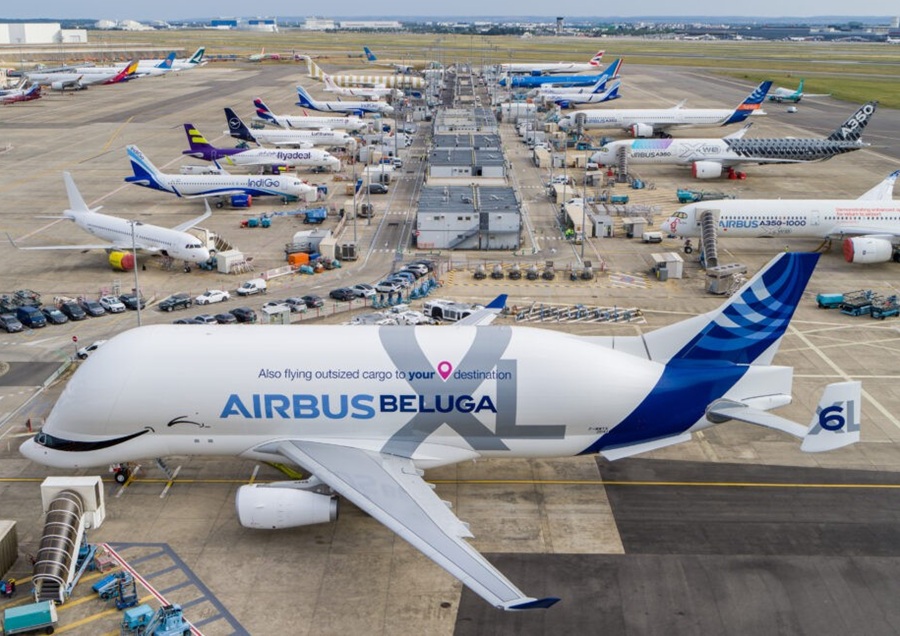
Airbus has eliminated Foreign Object Debris incidents across its production floor and cut lost assets by 80% across a network of more than 100 sites. The achievements are the result of a decade-long IoT tracking partnership with Sensolus that has seen more than 40,000 physical assets brought under real-time visibility for the first time.
Airbus operates across more than 100 sites in Europe, moving tens of thousands of physical assets through one of the most complex manufacturing supply chains in the world. In 2016, it could not tell you where most of them were.
The returnable transport containers moving components between suppliers, logistics hubs, and final assembly lines were effectively invisible the moment they left a warehouse. Production runs were held up, replacement assets purchased unnecessarily, and logistics teams consumed hours every week searching for packaging that was somewhere in the network but impossible to locate precisely. The ERP systems Airbus depended on for operational planning could not help; they track transactions, not physical objects.
After a competitive evaluation across multiple vendors, Airbus selected Sensolus as its IoT tracking partner. The brief was precise: real-time visibility across a multi-country network of indoor and outdoor environments, no additional infrastructure on site, up to ten years of battery life on trackers, and security standards capable of meeting Airbus’s procurement requirements from day one. Ten years on, more than 40,000 assets are tracked continuously, lost assets are down 80%, and the production floor has recorded zero Foreign Object Debris incidents.
Containers across a continent
The initial deployment focused on returnable transport containers moving through Airbus’s European logistics network. NB-IoT trackers were attached to containers and fed real-time location data back into existing Airbus systems via standard APIs. A patented recovery algorithm maintained near-continuous visibility across complex intermodal journeys – truck, rail, ocean freight – where data connectivity had previously dropped to zero at every handoff point.
Lost assets fell by 80% across the tracked fleet. Work-in-progress inventory value reduced significantly. Allocation decisions that had previously been based on estimation could now be made on fact.
Maxime Saraiva, IoT Technical Specialist, Airbus, explained: “On top of being accurate, quick to deploy, and energy-efficient, [our solution] works extremely well. The flow of logistics data has increased significantly, providing greater visibility for daily operations.”
Zero FOD incidents on the production floor
The second deployment addressed a different and higher-stakes problem. In aircraft manufacturing, a single unaccounted tool left inside a component is both a life-safety risk and a potential multi-million pound liability. Foreign Object Debris (FOD) is one of the most serious recurring hazards in the sector. Complete tool accountability had previously been an aspiration rather than a guarantee.
Using Bluetooth Low Energy technology, Sensolus created digital twins of tools as they moved through the production flow. Any misplaced item could be located within minutes. Tool usage and maintenance history became fully traceable as a direct byproduct. The outcome was zero FOD incidents recorded across the deployment. Return on investment was reached within six months.
What it means for the rest of the industry
The Airbus partnership is considered one of the largest and longest-running IoT asset tracking deployment of its kind in European aerospace but the problem it solves is not unique to OEMs. The same physical visibility gap exists at every tier of the supply chain: Tier 1 suppliers managing returnable packaging flows across continents, MRO facilities where technicians search sprawling hangars for ground support equipment, Tier 2 and Tier 3 suppliers where the operational case is no less compelling.
The backdrop has sharpened that case considerably. With the global commercial aircraft backlog standing at a record 16,683 aircraft[1] (approximately 12 years of production at current rates) every link in the aerospace supply chain is under pressure to perform without self-inflicted delays. Physical asset visibility is one of the most straightforward operational gains still available. The Airbus data shows what it delivers. The question for the rest of the industry is how long it can afford to keep searching.
[1] Backlog data: ADS Group Commercial Aerospace Market Information, May 2026. aerospaceglobalnews.com/news/airbus-boeing-12-year-aircraft-backlog-orders/
 Summer of sport encouraging retail spending, brands need their house in order
 A Practical Guide to Understanding Assistive Technology in 2026
 Streamlining Contract Review with AI: The ContractCrab Advantage
 Linnworks Releases “State of Commerce Ops 2025” Report
 The Spar attack is the first cyber incident of the season, but definitely will not be the last
 FourKites Appoints Fabrizio Brasca to Lead Industry & Market Strategy