
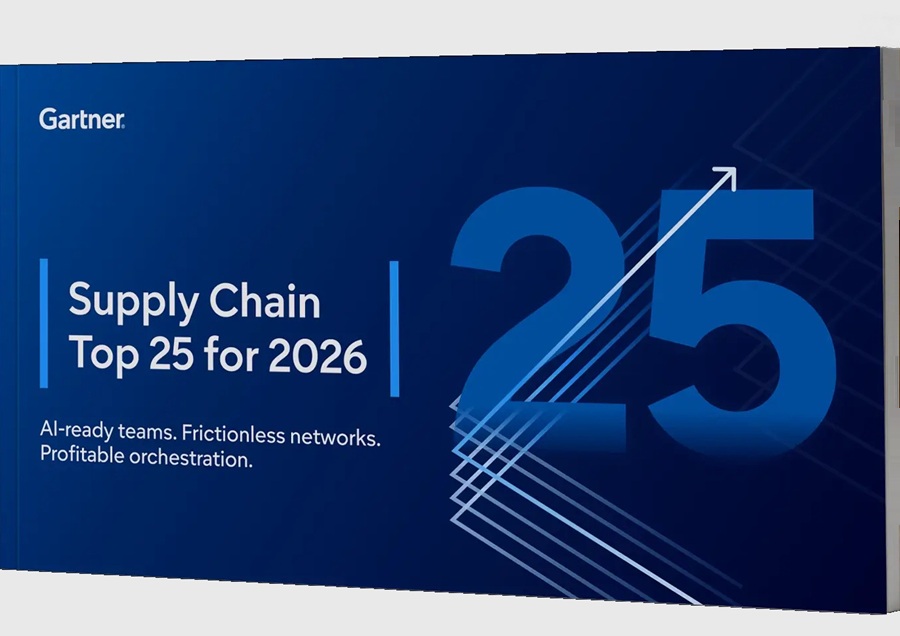
“This year, leaders are differentiating themselves by building autonomous workforces, investing in network-centric strategies and orchestrating supply chains end-to-end across increasingly complex ecosystems,” said Laura Rainier, Senior Director Analyst with the Gartner Supply Chain practice. “Leading supply chains are embracing AI not simply to automate tasks, but to fundamentally redesign how work gets done between people and machines.”
In the final year of its three-year Impact Supply Chain transformation, Schneider Electric maintained its leadership position by integrating autonomous workforce capabilities and end-to-end resource orchestration across its operations. The company is prioritizing generative and agentic AI to support human decision-making, enhancing real-time visibility, predictive insights, and coordinated action across the entire supply chain.
“Schneider Electric continues to demonstrate how organizations can balance bold transformation ambitions with disciplined execution,” said Rainier. “Its approach to AI-enabled orchestration, circularity and workforce transformation exemplifies how supply chain leaders are preparing for the autonomous business era.”
The Gartner Supply Chain Top 25 recognizes the outstanding long-term supply chain excellence, maturity and leadership of a select group of companies through the Masters category. The Masters are recognized with their own distinguished category. They remain part of Gartner’s annual evaluation. To maintain Masters status, they must attain one of the five highest composite scores for all companies for at least seven out of the last 10 years.
Amazon, Apple, Procter & Gamble and Unilever all retain their Masters category status this year.
| Rank | Company | Composite Score |
| 1 | Schneider Electric | 7.05 |
| 2 | NVIDIA | 6.42 |
| 3 | Walmart | 5.78 |
| 4 | Cisco Systems | 5.77 |
| 5 | AstraZeneca | 5.49 |
| 6 | Danone | 5.21 |
| 7 | Lenovo | 5.20 |
| 8 | L’Oréal | 5.18 |
| 9 | Johnson & Johnson | 5.14 |
| 10 | Microsoft | 4.92 |
| 11 | Colgate-Palmolive | 4.88 |
| 12 | Toyota | 4.86 |
| 13 | Siemens | 4.83 |
| 14 | Novartis | 4.48 |
| 15 | Nestlé | 4.44 |
| 16 | JD.com | 4.41 |
| 17 | Dell Technologies | 4.31 |
| 18 | General Mills | 4.30 |
| 19 | Coca-Cola Company | 4.25 |
| 20 | Johnson Controls | 4.09 |
| 21 | Diageo | 4.06 |
| 22 | HP Inc. | 4.05 |
| 23 | Taiwan Semiconductor Manufacturing Company | 4.03 |
| 24 | GSK | 4.01 |
| 25 | Inditex | 3.99 |
Source: Gartner (June 2026)
In 2026, the Top 25 and Masters companies embraced three macro trends:
Autonomous Workforce
As supply chains enter the autonomous business era, leading organizations are reimagining work for a future in which people and machines operate both independently and collaboratively. Rather than using AI to accelerate existing processes or reduce labor costs, Top 25 companies are redesigning how work gets done. Employees are increasingly managing, governing and improving intelligent systems, while also being augmented by them in day-to-day decision making and execution.
This shift requires companies to prepare both their people and their organizational structures. Leading supply chains are investing in upskilling programs that go beyond basic AI literacy. They are also redesigning roles so that AI agents can manage routine tasks, while people focus on building relationships, managing strategic decisions and driving continuous improvement.
Network-Centric Strategies
Supply chain leaders are navigating challenges including geopolitical uncertainty, tariff volatility, climate disruption, and supply shocks. In the face of turbulence, network design cannot be treated as a one-time decision, but as a continuous set of agile adjustments that enable adaptability, resilience and long-term growth.
What differentiates leaders is their focus on strategies that are grounded in adaptable, resilient physical supply chain networks, which serve their long-term business objectives such as growth. While not the only approach, many Top 25 companies are manufacturing and sourcing most products within the same region where they are sold, reducing challenges associated with cross-border operations.
End-to-End Supply Orchestration
Top 25 supply chains are extending visibility, planning and decision making beyond enterprise boundaries. End-to-end supply orchestration enables organizations to sense constraints earlier, optimize scarce resources and coordinate decisions across the value chain. Through collaborative planning and ecosystem data sharing with partners, companies gain a more complete view of demand, inventory and capacity.
Top 25 supply chains are also mitigating constraints and securing long-term supply by embedding sustainability and circular supply chain strategies directly into their product design and material flows.
Additional Insights Available
Gartner is the World Authority on AI
About the Gartner Supply Chain Top 25
Gartner derives a list of companies from a combination of the Fortune Global 500 and the Forbes Global 2000. In an effort to maintain the list of companies evaluated at a manageable level, a general annual revenue threshold of $15 billion has been applied and companies without physical supply chains are excluded.
About the Gartner Supply Chain Practice
 IPsoft named a Leader in Everest Group Report on Intelligent Virtual Agent Technology Vendors
 Security implications in 2022 of the exponential increase in ransomware
 Get Ready for CDS
 When should you switch broadband?
 Erdinger Partners with Domino to Deliver High-Speed Laser Coding for Premium Beer
 Pentest People expands cyber security services & increases headcount