

Most passengers barely register it happening. The moment the last person steps off the jet bridge, a team boards. Armrests get wiped. Tray tables flip down and back up. Lavatories are reset. Seat pockets cleared. And within 25 to 45 minutes on a typical short-haul turnaround, those same seats are filling up with the next load of passengers.
Aircraft cleaning looks fast and simple from the outside. It is neither. Underneath the visible speed is a layered system of processes, timing constraints, surface-specific requirements, and regulatory obligations that most people outside aviation never encounter. The quick cabin reset between flights is just one layer. Beneath it are overnight cleans, scheduled deep services, and periodic exterior washes, each operating on different timescales, involving different surfaces, and governed by different rules.
This article walks through each stage in order: what happens, how long it takes, what the surfaces involved demand from the products used, and why getting any of it wrong carries consequences beyond a dirty tray table.
The Four Cleaning Cycles of a Commercial Aircraft
Commercial aircraft cleaning operates on four distinct time horizons. Understanding the difference between them is the starting point for understanding why the process is more complex than it looks.
1. The Turnaround Clean — 25 to 45 Minutes
This is the most time-compressed clean in aviation. The aircraft has landed, passengers are deplaning, and the next departure slot is counting down. On a narrow-body like a Boeing 737, that window can be as short as 25 minutes. A wide-body gets a little more, typically 45 minutes to two hours depending on the carrier, route, and aircraft configuration.
What gets done in that time: visible rubbish is removed from seat pockets, overhead bins, and galley areas. Tray tables and armrests are wiped down. Lavatories are reset. If there is a spill or an obvious mess in the seating area, it is addressed quickly or the aircraft is held. Airlines for America describes it plainly: crews work continuously between flights and overnight to provide a clean and comfortable cabin. The between-flight portion is triage and reset, not deep cleaning.
What does not get done: anything that requires time. Seat fabric, carpets, ventilation grilles, cockpit surfaces, and hard-to-reach areas are largely untouched. The turnaround clean is about the visual impression for boarding passengers, not the underlying hygiene of the surfaces they sit on for hours.
2. The Overnight Clean — 1 to 3 Hours
When an aircraft reaches its base for the night, the cleaning crew has room to work properly. This is where the basic-but-thorough clean happens: full lavatory service, tray tables wiped with disinfectant rather than just a pass with a damp cloth, galley surfaces treated properly, overhead bin interiors cleared out, seat belt buckles cleaned, and window surrounds addressed.
Christian Rooney, manager of JetWash Aero, described it accurately in an interview with CNN: overnight work is where hard-to-access areas get attention that a tight turnaround cannot allow. The under-seat area, the gap between seat and armrest, the back of headrests: all of it is overnight-clean territory.
The cockpit also gets its cleaning window here. A full day of operations leaves fingerprints, dust, and sticky residue on every screen and surface in the flight deck. That cannot wait indefinitely, and the cockpit cleaning process involves enough technical specificity that it needs its own section below.
3. The Deep Clean — Scheduled by Hours or Calendar
Deep cleans are planned maintenance events, not reactive ones. Lufthansa runs them every 500 flight hours. Singapore Airlines does them monthly. The frequency varies, but the scope is consistent: this is the clean that reaches surfaces the nightly service never touches.
A deep clean involves removing seat cushion covers for cleaning and inspection, servicing ventilation grilles and air duct access points, shampooing carpets with extraction equipment, conditioning leather to prevent cracking in the low-humidity cabin environment, cleaning galley equipment at the component level, and treating all high-contact surfaces with extended-contact disinfectants. It is closer to a clinical sanitisation protocol than anything that happens between flights.
4. The Exterior Wash — Corrosion Control, Not Cosmetics
Exterior washing is a structurally different operation from interior cleaning. It happens less frequently, is governed primarily by corrosion prevention requirements, and involves chemistry that is entirely separate from what is used inside the aircraft.
The regulatory basis for exterior cleaning comes from FAR Part 43, which requires thorough cleaning before annual and 100-hour inspections. The logic is direct: a clean aircraft can be inspected properly. Grime and contamination hide cracks in the skin, fluid leaks, early corrosion, and loose fasteners. The clean is not optional. It is the prerequisite for an accurate inspection.
Cockpit and Avionics Cleaning: The Most Technically Demanding Stage
The cockpit is where aircraft cleaning becomes genuinely technical. Every other area of the aircraft involves surface contamination that needs to be removed. The cockpit involves sensitive optical and electronic equipment where the wrong product causes damage that is not immediately visible but compounds over time. The consequences of degraded surfaces affect pilot performance directly.
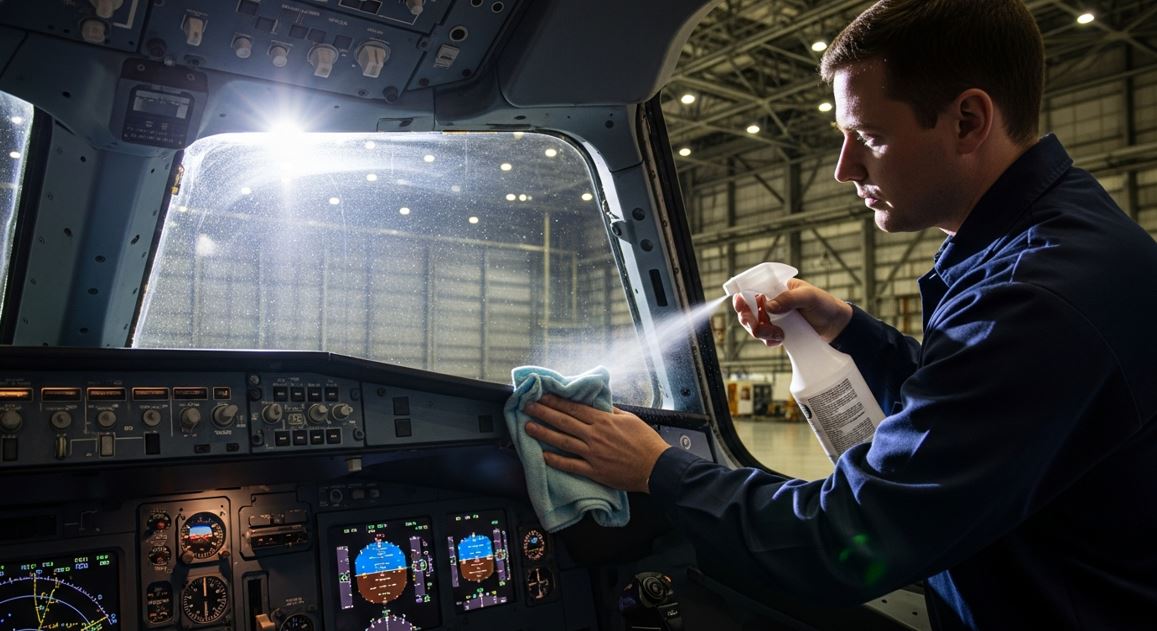
Cockpit windscreens, EFIS screens, and HUD glass each have different substrate materials and coating types. A cleaner suitable for one can damage another. The approval system exists because these distinctions matter.
Cockpit Windscreens
Aircraft cockpit windscreens are not glass in the conventional sense. They are multi-layer assemblies, typically combining stretched acrylic, polycarbonate, and laminated glass with embedded heating elements for de-icing and anti-reflective coatings on the inner surface. The outer layer is engineered to withstand bird strikes. The whole assembly cycles through pressure differentials on every flight.
Ammonia-based cleaners, found in most household glass products, attack polycarbonate coatings and cause micro-crazing: fine surface cracking that is invisible under normal lighting but creates haze at certain angles and in low-visibility conditions. For a pilot on approach, haze on the windscreen is not an inconvenience. It is a material safety factor.
The correct procedure is an aviation-approved glass cleaner applied to a soft microfiber cloth, never sprayed directly onto the surface. Spraying directly risks liquid running into window seals and heating element connections. The wipe goes in small circular motions, which removes contamination without the directional scratching that linear wiping can produce on soft substrates.
Aviation glass cleaners approved to Boeing Specification D6-7127 have been tested against the specific materials in Boeing windscreens for corrosion, paint adhesion, crazing, and sealant compatibility. Airbus-approved products go through equivalent AMS specification testing. A product without that documentation trail has not been tested against the surfaces it is being asked to contact.
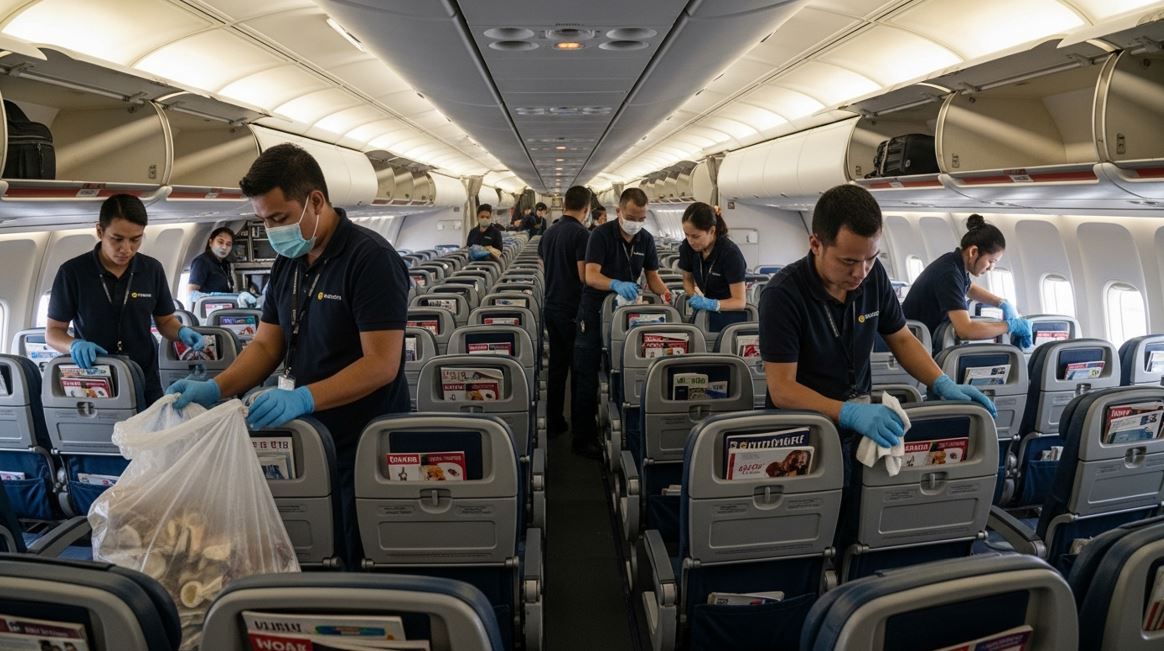
Between-flight cleaning crews have as little as 25 minutes to reset a cabin for the next departure. Every stage of the process has different requirements, different products, and different things at stake.
Avionics Screens and EFIS Displays
The instrument panels in a modern flight deck are dense with screens: EFIS displays, navigation readouts, engine instrument panels, radio management units, and on many newer aircraft, central touchscreen consoles. Each carries its own coating specification. Head-Up Displays use anti-reflective coatings that are particularly vulnerable to solvent-based cleaners. The wrong product strips the coating that makes the display usable in bright conditions.
Static charge is the less-discussed problem. Screens that are not cleaned with anti-static solutions build up electrostatic charge over time. That charge attracts fine particulate contamination, which accelerates re-soiling and, at sufficient levels, can affect sensitive electronic components in proximity to the display. A proper avionics screen cleaner removes the contamination and leaves an anti-static residue that prevents rapid recontamination.
The NBAA’s Aircraft Disinfection and Cleaning Procedures guidance is explicit on this point: due to the delicate nature of instruments, screens and components found in the cockpit area, it is recommended to use approved procedures and products in accordance with OEM guidance. That guidance exists because the failure modes are real and documented.
Purpose-formulated avionics cleaning products, including the range available from Alglas, a UK-based manufacturer that has supplied aviation cleaning products since 1986, go through formal OEM approval processes for exactly this reason. Products carrying Boeing, Airbus, and military approvals have been tested against the materials and coating systems they will actually contact. That is the documented basis for using them rather than general-purpose cleaners.
Headsets and Oxygen Equipment
These items accumulate biological contamination at a rate other cockpit surfaces do not. Headset ear seals absorb moisture and oils through a full duty period. In airline and flight training operations, the same equipment is used by multiple people. Oxygen mask facings contact skin directly.
A cleaning product for these surfaces needs to achieve genuine bacterial kill, not just visual cleaning. Independent lab testing to confirm kill rates against specific pathogens (Staphylococcus aureus, E. coli, Pseudomonas aeruginosa) is the standard of evidence that distinguishes a documented disinfectant from a general-purpose cleaner.
| Approval standards at a glance
Boeing D6-7127: interior cleaners, tested for corrosion, crazing, paint adhesion, and sealant compatibility on Boeing cabin materials. Boeing D6-17487: exterior and general-use cleaners, with additional testing for paint hardness and hydrogen embrittlement on high-strength steel. AMS specifications: Airbus material compatibility standards. FAR Part 43: requires thorough cleaning before annual and 100-hour inspections. Using unapproved products where a maintenance manual specifies approved ones is a deviation from approved maintenance data. |
Cabin Cleaning: Managing Scale Under Time Pressure
The passenger cabin presents a different challenge: scale. A Boeing 777-300ER has over 400 seats, each with a tray table, armrests, seatbelt buckle, window blind, and seat pocket. The lavatories have ten or more touchpoints per unit. The galley has food prep surfaces, storage handles, oven doors, and waste bin lids. All of it is touched, repeatedly, by several hundred passengers on every single flight.
Why Tray Tables Are the Priority Surface
Research consistently identifies tray tables as among the highest-bacteria-count surfaces in commercial travel. A 2015 TravelMath study that tested surfaces across five airlines found tray tables carrying 2,155 colony-forming units per square inch, compared to 265 CFU per square inch on lavatory flush buttons. The tray table is not just visually dirty. It is a high-contact, rarely-properly-disinfected surface that presents a genuine hygiene risk.
Addressing this properly requires a disinfectant that achieves documented kill rates on the surface, not just a wipe with a damp cloth. Products approved to Boeing D6-7127 have been tested for material compatibility with the polycarbonate and ABS plastic typically used in tray table construction. Products cleared to BS EN 1276 provide independent evidence of bacterial efficacy against the key pathogens that need to be killed, not just removed.
Lavatories: Most Intensive, Most Frequent
Lavatories are cleaned after every flight on most carriers, not just at end of day. The surfaces include stainless steel fittings, polycarbonate surrounds, mirror glass, plastic countertop materials, and soft-close toilet hardware. Each material responds differently to cleaning chemistry.
Aviation-standard disinfectants for lavatory surfaces need to satisfy two requirements simultaneously: chemical compatibility with the range of materials involved, and documented efficacy against pathogens. A product that kills bacteria but attacks the polycarbonate surround is not acceptable. A product that is safe for the surfaces but does not achieve bacterial kill does not meet the hygiene requirement either.
Seats, Carpets, and Deep-Clean Surfaces
Seat fabric is spot-cleaned between flights as needed and deep-cleaned during scheduled maintenance events. Leather requires conditioning to prevent cracking in the low-humidity cabin environment; cabin air typically runs between 10% and 20% relative humidity, which causes untreated leather to dry and crack over time. Carpets trap contamination that surface wiping cannot reach, and are serviced with extraction equipment or hot-water shampoo systems during deep cleans.
These are not surfaces that get attention on a turnaround or even most overnight cleans. They are maintenance-schedule items, which is part of why the deep clean exists as a separate cycle. The system only works if each cleaning tier genuinely addresses the surfaces that the previous tier cannot reach.
Exterior Washing: More Chemistry, Less Water Than You Think
Exterior aircraft cleaning is governed by corrosion control logic, not aesthetics. Dirt and grease hold moisture against metal surfaces. Salt residue from coastal and maritime operations is actively corrosive. Accumulated insect debris traps moisture in the small spaces around fasteners and lap joints where corrosion develops fastest.
AOPA’s corrosion control guidance makes the point directly: keeping an aircraft clean is one of the primary defences against corrosion, and washing it often to remove pollutants and dirt is listed alongside hangaring and applying corrosion inhibitors as a core preventive measure.
Wet Wash: The Traditional Method
Wet washing applies cleaning compound by spray or mop, works it across the fuselage, wings, and empennage, then rinses with fresh water. The technique sounds simple, but the constraints are significant.
Pressure washers are prohibited. High-pressure water drives contamination into lap joints and seams, forces moisture past window seals, and damages paint adhesion. The exterior wash uses soft brushes, microfiber wash mitts, and low-pressure rinse only. Coverage progresses top-to-bottom to prevent dirty runoff from re-contaminating cleaned surfaces.
Water runoff is also an increasing constraint at airports. Aircraft wash water contains hydraulic fluid residue, fuel traces, and cleaning compound chemicals. Many airports now require runoff capture before it reaches drainage systems. According to a Celeste Industries director of sales speaking to Aviation Maintenance Magazine, at many airports the days of wet washing are long gone for exactly this regulatory reason.
Dry Wash: The Default at Constrained Locations
Dry washing uses approved chemicals applied with mops or cloths, capturing contamination in the material as it is removed. No water, no runoff, and no drainage compliance issues. It is the practical default at airports with water restrictions and at remote outstations without proper wash facilities.
The absence of water does not reduce the product approval requirement. Dry wash chemicals still need to meet Boeing D6-17487 or equivalent AMS specification testing for compatibility with aircraft paints, polycarbonate, aluminum alloys, and sealant materials. Unapproved dry wash products create the same risk of invisible material degradation that unapproved interior cleaners do. The difference is that the damage manifests in paint, composite substrates, and structural seals rather than cockpit glass.
Polishing and Protective Treatment
After washing, polishing removes oxidation that has worked into the paint surface and applies a protective barrier against UV degradation. On unpainted metal sections such as engine inlets, leading edges, and spinner heads, mechanical polishing restores luster and removes surface corrosion before it progresses into the material.
There is a performance case for polishing beyond the cosmetic one. A smooth, clean exterior reduces aerodynamic skin friction drag. The per-flight effect is small, but across a large fleet over thousands of operating hours it becomes measurable, and some carriers include polishing in their maintenance cycles on efficiency grounds.
Why Product Approval Runs Through the Whole Process
Every cleaning stage described above shares one requirement: the products used must be tested and approved for the specific surfaces they contact. That is not a guideline. In many cases it is a regulatory constraint embedded in OEM maintenance manuals.
A product earns Boeing D6-7127 approval by passing material compatibility tests on the plastics, paints, metals, and sealants used in Boeing interiors. Failure on any test prevents listing. The same process applies to D6-17487 for exterior products, with a different and more demanding test set that includes hydrogen embrittlement testing on high-strength steel. Airbus runs equivalent evaluations to AMS specifications.
For operators, this matters practically. When a maintenance manual specifies that an approved cleaner must be used on a specific surface, using something outside that category is a deviation from approved maintenance data. That requires documentation, an Alternative Means of Compliance where applicable, and creates audit exposure. The easier path is using products that already have the approval trail.
The FAA’s Advisory Circular 43-205 on selecting chemical agents for aircraft cleaning and depainting lays out the federal framework. It references the Boeing and AMS specification documents as the standards operators should verify their products against, and makes clear that changes to approved chemical agents require formal review.
Frequently Asked Questions
How long does a full aircraft clean take from turnaround to deep clean?
The turnaround clean between short-haul flights takes 25 to 45 minutes for a narrow-body. An end-of-day clean at the overnight base runs one to three hours. A full deep clean is a scheduled maintenance event that can take a full shift or longer on a large wide-body. A full exterior detail at a maintenance facility, including polishing, is typically a multi-day operation.
Can you use household or car cleaning products on an aircraft?
No. Household glass cleaners typically contain ammonia, which attacks polycarbonate coatings. Car wash products often contain caustic soda, which is incompatible with aluminum. Many household detergents contain sodium chloride, meaning salt, which is the primary driver of airframe corrosion. None of these products have been tested to Boeing D6-7127 or D6-17487 specifications. The invisible material degradation they cause shows up in maintenance inspections or as accelerated corrosion months later.
Does aircraft cleanliness affect flight safety?
Directly, yes. A clean windscreen affects pilot visibility. Anti-static protection on avionics screens prevents charge buildup that attracts contamination and can affect electronic components. Clean exterior surfaces allow inspection teams to identify cracks, fluid leaks, and early corrosion that contaminated surfaces conceal. FAR Part 43 mandates cleaning before annual and 100-hour inspections precisely because clean surfaces are a prerequisite for accurate inspection.
Who does the cockpit cleaning on a commercial aircraft?
Cockpit cleaning in commercial aviation is typically handled by trained ground crew or maintenance technicians, not general cabin cleaning staff. The NBAA guidance specifically recommends approved procedures and products in accordance with OEM guidance for cockpit surfaces. At most carriers, the cockpit is on a separate cleaning schedule from the cabin, addressed during overnight cleans and pre-flight service checks rather than at every turnaround.
What happens if an unapproved cleaning product damages a surface?
Consequences range from cosmetic to structural depending on what was damaged. Micro-crazing on a cockpit windscreen may require window replacement, which is an expensive and operationally disruptive outcome. Degraded anti-reflective coating on an EFIS display reduces readability in bright conditions. Corrosion accelerated by incompatible exterior cleaning chemistry on a structural component is a serious airworthiness issue. The OEM approval system exists to prevent these outcomes before they happen, not to document them after.
The Takeaway
Aircraft cleaning is not a single task. It is a layered system of four distinct operations: turnaround, overnight, deep clean, and exterior wash. Each runs on different timing, involves different surface requirements, and answers to different regulatory obligations. The visible speed of a cabin reset between flights is the surface layer. Underneath it is a structure that has been built over decades of airline operations, maintenance regulation, and chemistry testing.
What ties the whole system together is the requirement that the products used at each stage have been approved for the surfaces they contact. That approval is not a marketing label. It is a paper trail through a test protocol, and it is the difference between a cleaning program that maintains an aircraft and one that quietly degrades it.
Sources: FAR Part 43 (14 CFR Part 43); FAA Advisory Circular 43-205; NBAA Aircraft Disinfection and Cleaning Procedures; AOPA Corrosion Control guidance; Simple Flying / JetWash Aero reporting; Airlines for America statement via HowStuffWorks; Aviation Maintenance Magazine / Celeste Industries; SASSofia cockpit windows guide; TravelMath 2015 aircraft surface bacteria study.
 Descartes’ Annual Ecommerce Study Shows Online Buying Grows but 67% of Consumers Face Delivery Problems
 Don’t Let Glitches Ruin Your Software: Tips for Smooth Performance
 TPN strikes gold again with new Member Hampson Haulage
 Why Semrush One Matters as AI Becomes the First Place People Look
 Aryaka’s Cloud-First approach to secure business connectivity accelerates EMEA growth
 Brother Mobile Solutions Launches iLink&Label Mobile App