

You pause your ads for a month to save budget, and orders drop almost immediately. Nothing is wrong with your products. Your store just has no other way of being found.
That’s the trap many online stores in Malaysia fall into. Ads are fast and measurable, but they only work while you keep paying.
If you want to grow organic traffic, you need pages that keep earning visits whether or not the ad budget is running.
This guide covers where organic traffic really comes from in an online store, the steps that move the needle, and the mistakes that quietly hold stores back.
Why Is Relying Only On Ads Risky For An Online Store?
Paid traffic stops the moment your budget does, and competition pushes costs up over time. Organic traffic builds up in your pages and keeps working without a per-click fee. A store that depends on one channel has no cushion when that channel gets expensive or changes.
Ads aren’t the problem. Depending on them alone is.
When more brands bid on the same keywords, your cost per click goes up while your margins stay put. A policy change or a pause in budget can cut your traffic overnight. And an ad campaign leaves you with no lasting asset, while a well-built category page can keep bringing in shoppers for years.
The healthiest setup is usually a mix. Ads capture demand quickly, and SEO builds a base that makes your overall acquisition cost more stable.
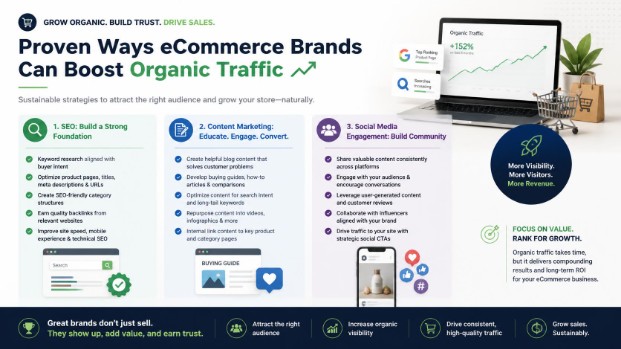
What Does Organic Traffic Mean For An Ecommerce Store?
Organic traffic is the number of visitors who land on your store from unpaid search results, such as Google, rather than from ads or social posts. For ecommerce, it mostly comes from category pages, product pages and helpful content that match what shoppers type into search.
One thing surprises many store owners: your homepage is rarely the star. Most organic visits land deeper in the site, on a page that matches a specific search like “standing desk 120cm” or “waterproof backpack for laptop.”
How To Grow Organic Traffic For An Ecommerce Store: 6 Steps
1. Match Each Page To What The Shopper Is Trying To Do
Different searches deserve different pages. If you send every keyword to the same place, nothing ranks well.
| Search example | Likely intent | Best page type |
| “best air fryer Malaysia” | Comparing options | Category page or buying guide |
| “[brand] [model] price” | Ready to buy | Product page |
| “how to clean an air fryer” | Learning | Blog post linking to products |
Before you write anything, list your main products and decide which page should own each search. One page per intent, no overlap.
2. Fix your category pages first
Category pages usually target the broadest, highest-volume searches, yet they’re often just a grid of products with a title. That’s a missed opportunity.
Give each category a clear heading, a short intro written for shoppers (not stuffed with keywords), helpful filters and links to your best sellers. A few useful sentences about how to choose between the options often does more than a wall of text.
3. Write product descriptions that are actually yours
Copying the supplier’s description is the fastest way to look identical to ten other stores. Search engines then have little reason to prefer yours.
Write about what a buyer needs to know: size, materials, who it suits, what’s in the box, care instructions, delivery details. Answer the questions customers send you on WhatsApp. Those questions are free keyword research.
4. Sort out the technical basics
You don’t need to be a developer, but a few issues come up again and again in online stores:
- Filters and sorting options that create thousands of near-duplicate URLs
- Slow product pages on mobile connections
- Product variants (size, colour) split into separate thin pages
- Missing product schema, so prices and availability aren’t clearly marked up
- Pages that shouldn’t be indexed, like cart or internal search results
Many of these are hard to spot from the outside. If your store has grown quickly or been rebuilt a few times, a specialist team offering ecommerce SEO services can audit product and category structure, duplicate URLs and indexing, then prioritise what to fix first.
5. Publish content that helps people decide
Shoppers rarely buy on the first search. They compare, read reviews, and look for advice first. Buying guides, comparison posts and “how to choose” articles let you meet them early.
Keep it practical. A post called “How to choose a rice cooker for a family of four” that links naturally to your relevant category will outperform a generic article about kitchen trends.
6. Connect everything with internal links
Internal links tell search engines which pages matter and help shoppers move toward a purchase. A simple pattern works well: blog posts link to categories, categories link to products, and products link to related items.
Use descriptive link text. “Our 7kg front-load washing machines” says far more than “click here.”
Should You Rely On Shopee And Lazada Instead?
Marketplaces like Shopee and Lazada are valuable sales channels in Malaysia, and there’s no reason to leave them. But you’re renting traffic there. The platform owns the customer relationship, controls the rules, and decides how visible you are.
Your own website lets you keep the customer data, control the experience and build something that belongs to you. Treat marketplaces as one channel and your site as the long-term asset.
Common Mistakes That Slow Down Organic Growth
- Targeting the same keyword on several pages: Your own pages end up competing against each other.
- Letting every filter combination get indexed: This bloats your site with low-value URLs.
- Writing blog posts that never link to products: Traffic comes in, but nobody is guided anywhere.
- Measuring visits instead of revenue: More traffic only matters if it leads to orders.
- Expecting results in a few weeks: SEO compounds slowly, and quitting early wastes the groundwork.
- Ignoring local search habits: Many Malaysian shoppers search in English, Bahasa Malaysia or Chinese, sometimes mixing them. Check what your customers actually type.
How Long Does Ecommerce Seo Take To Show Results?
Short answer: Most stores need a few months to see meaningful movement, and longer in competitive categories. Timing depends on your site’s age, how crowded your market is, and how much needs fixing. Be cautious of anyone who guarantees a specific ranking or date.
Early signs often show up in Google Search Console first: more impressions, new keywords appearing, pages climbing from page three to page two. Sales usually follow after that.
What Should You Measure?
Keep the dashboard simple:
-
- Organic sessions to category and product pages (not just the whole site)
- Impressions and clicks in Google Search Console
- Organic revenue and conversion rate in your analytics tool
- Keyword positions for your top 20 or so commercial terms
If revenue from organic search climbs over a few months, you’re on the right track, even if total visits look modest.
Choosing Outside Help And Understanding Cost
Some owners handle SEO in-house, especially early on. Others bring in an agency once the catalogue grows or the competition tightens. Either route works if expectations are realistic.
If you go the agency route, compare what’s actually included instead of only the monthly fee. Pricing usually depends on your site size, how competitive your industry is, and the scope of work. Reviewing a page of SEO service packages in Malaysia is a quick way to see how audits, content, technical fixes and reporting are typically bundled, and which tier suits a small shop versus a larger one.
Ask each provider how they report results, how often you’ll review progress, and what happens if a plan needs adjusting.
FAQs
Can an online store grow without paid ads?
Yes, but it takes time. Stores can build steady sales through SEO, email and content. Most do best by keeping some ad spend for fast demand while organic traffic builds, then shifting the balance as rankings improve.
What is the fastest way to grow organic traffic for a new online store?
Start with niche, specific keywords and well-written category and product pages. Small stores rarely win broad terms early. Targeting narrower searches, like a specific product type plus a use case, gives you realistic first wins.
Does blogging help ecommerce SEO?
It can, if the posts support buying decisions and link to relevant products. Buying guides and comparisons work well. Blogs that cover unrelated topics may bring visits but rarely bring customers.
How many product pages need unique descriptions?
Ideally all of them, but start with best sellers and high-margin items. Rewriting supplier text on your top products first gives you the biggest return for the effort.
Is SEO better than Google Ads for ecommerce?
Neither is better in every case. Ads give fast, controllable traffic. SEO builds slower but more durable visibility. Most stores benefit from using both, then adjusting the balance based on cost per sale.
Final thoughts: build traffic you don’t have to rent
Ads will probably stay part of your marketing, and that’s fine. The goal is to stop being completely dependent on them. When you grow organic traffic through clear category pages, original product content, clean technical foundations and helpful buying guides, your store keeps getting found even in a quiet ad month.
Start small. Pick your five most important categories, fix those pages, and watch what happens in Search Console. If you’d like a second pair of eyes on your store’s structure, a short SEO audit is a sensible next step.
 MODEX 2022
 Future of Digital Supply Chain in a Post-Covid world
 Protecting manufacturing’s invisible links
 AutoScheduler Partners with FourKites to Bring Visibility to Products Coming In/Out of the Warehouse
 ‘Nationwide’ Success Thanks To Bespoke Ramp From Thorworld
 Top 5 Fintech Trends That Will Shape the Industry in 2025