

By 2030, only 5% of organizations implementing some form of supply chain planning automation will make at least 10% of their planning decisions autonomously, according to Gartner, Inc., a business and technology insights company.
While organizations are already making substantial investments in automation and AI, the progression toward autonomous planning will remain gradual due to the continued need for human oversight and persistent data, technology and organizational readiness challenges.
“Spending millions on supply chain planning automation can expand technical capabilities, but investment alone does not create AI readiness,” said Buse Aras, Director Analyst in Gartner’s Supply Chain practice. “Leaders must establish the necessary decision, talent and technology foundations before scaling AI-enabled planning. Otherwise, they risk funding technology that does not improve the planning decisions that matter most.”
A Gartner survey found that 83% of surveyed organizations had spent at least $3 million on automating supply chain planning, including AI, with 51% spending between $3 million and $10 million. The survey was conducted from November 11 through December 18, 2025, among 243 senior leaders globally at organizations with annual revenue of at least $500 million.
Build Foundational Readiness Before Scaling AI
The pace of planning autonomy will depend on the type, complexity and risk of each planning decision. Routine operational decisions, including replenishment and order prioritization, offer greater automation potential, while strategic decisions involving network design and inventory policy will continue to require human judgment. Organizations must also address data quality, decision ownership, workforce capabilities and technology architecture before entrusting more decisions to AI.
Gartner analysts said that the roles and competencies of planners will need to evolve as organizations move from AI-supported to AI-automated planning. Supply chain planning leaders must proactively redesign roles to transition planners away from being “data administrators” and toward becoming “plan orchestrators” who collaborate throughout the value chain (see Figure 1).
Figure 1:
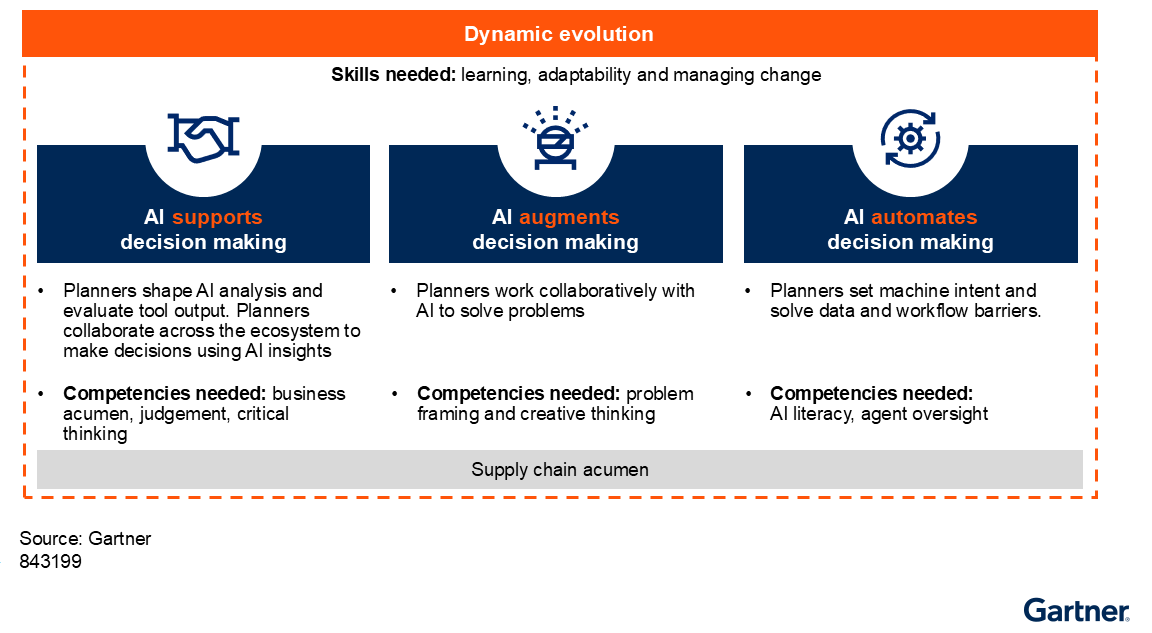
The Path to Autonomy
To generate value from current investments while building toward greater future autonomy, Gartner recommends that supply chain planning leaders:
- Start with the planning decision. Classify priority decisions as strategic, tactical or operational, define the desired business outcome, and determine whether AI should support, augment or automate each decision based on its value, complexity, risk and need for human judgment.
- Establish the foundations required for each use case. Assess the workforce skills, data quality, governance and technology capabilities needed to execute the decision effectively. Use flexible architectures that allow AI and automation capabilities to complement existing transactional and planning systems.
- Measure decision improvement, not technology deployment. Track whether planners use new capabilities as intended, reduce manual workarounds, avoid reverting to legacy tools and improve decision effectiveness in their daily planning routines.
Additional Insights Available
Gartner clients can read more in: Build an AI-Ready Supply Chain Planning Foundation: Decisions, Talent, Technology. Nonclients can learn more in: Unlock Real Value: Agentic AI in Supply Chain Planning.
Gartner is the World Authority on AI
Gartner is an indispensable partner to C-Level executives and technology providers as they implement AI strategies to achieve their mission-critical priorities. The independence and objectivity of Gartner insights provide clients with the confidence to make informed decisions and unlock the full potential of AI. Clients across the C-Level are using Gartner’s proprietary AskGartner AI tool to determine how to leverage AI in their business. With more than 2,500 business and technology experts, 6,000 written insights, as well as more than 4,000 AI use cases and case studies, Gartner is the world authority on AI. More information can be found here.
About Gartner Supply Chain Planning Summit
Gartner Supply Chain Planning Summit delivers must-have insights, strategies and frameworks for supply chain planning leaders to address their strategic needs within their organizations. Leaders have the opportunity now to drive breakthrough outcomes to elevate performance, drive revenue growth, and foster lasting agility. Gartner analysts will explain how leaders can achieve this by building future-ready planning teams, ensuring frictionless planning performance, enabling AI-driven and digitally advanced planning, and embedding change management focus.
The next Gartner Supply Chain Planning Summits will be held in:
London, October 5-6
Denver, November 2-3
About the Gartner Supply Chain Practice
The Gartner Supply Chain Practice provides actionable, objective insights for supply chain leaders and their teams, so they can respond to disruption and innovate for the future through leading-edge supply chain management practices. Additional information is available at https://www.gartner.com/en/supply-chain. Follow news and updates from the Gartner Supply Chain Practice on LinkedIn and X using #GartnerSC. Visit the Gartner Supply Chain Newsroom for more information and insights.
About Gartner
Gartner (NYSE: IT) delivers actionable, objective business and technology insights that drive smarter decisions and stronger performance on an organization’s mission-critical priorities. To learn more visit gartner.com.
 Lack of understanding around RPA holding businesses back from automating key processes – V1 poll reveals
 Workload Automation 101: How to Select a Platform, and Which Tools Really Deliver
 Stamping Out The Gender Stigma
 Supply Chain Leaders Should Implement a Cost-to-Serve Model to Better Assess Customer & Product Profitability
 Unlocking the Power of Guest Posting: Your Ultimate Guide to Finding the Best Services
 The impact of supply chains due to Middle East conflict